
Antibiotic resistance- can reducing outpatient prescription help?

Antibiotic resistance is increasing at a rapid rate making pathogens and other bacterial species resistant to currently available antibiotics. Its impact is already visible globally and clock is ticking faster than ever pushing scientists all over the world to develop better antibiotics with higher specificity (only!) for pathogens. Antibiotic consumption is directly related to antibiotic resistance and policies across the continents are underway to control the consumption and prescription of antibiotics.

A recent article in elife introduces the problem of unnecessary antibiotic use and provides data to avert it.

Inappropriate antibiotic use leads to increased risk of adverse events, disruption of colonization resistance and other benefits of the microbial flora, and bystander selection for antibiotic resistance, with little to no health gains for the patient.”

To address the problem, Christine et al. used publically available data (NAMCS/NHAMCS) and mathematical models to find what would happen if antibiotic consumption is averted in hypothetical scenarios.

What they did?
The analysis included sixteen antibiotics that are frequently prescribed in the outpatient setting and nine potentially pathogenic bacterial species that are commonly carried in the normal human microbiome. For each antibiotic-species pair, they estimated the proportion of antibiotic exposures experienced by that species that could be averted under four hypothetical scenarios.

1) Eliminate unnecessary antibiotic use across all outpatient conditions.
2) Eliminate all antibiotic use for outpatient respiratory conditions for which antibiotics are not indicated.
3) Eliminate all antibiotic use for acute sinusitis.
4) Prescribe nitrofurantoin* for all cases of cystitis in women.”

“*Nitrofurantoin- a recommended first-line therapy with good potency against common uropathogens, low levels of resistance, and decreased risk of collateral damage to the intestinal microbiome”

Results
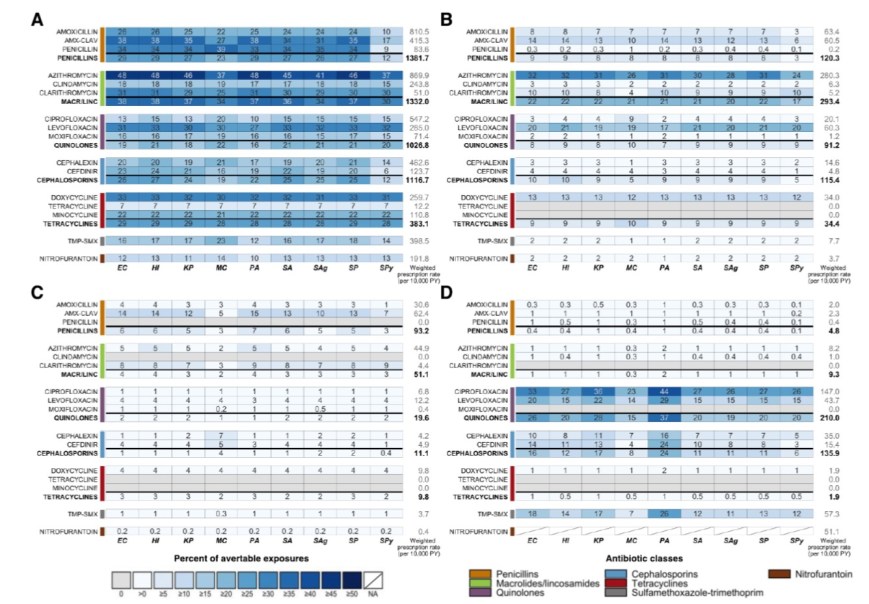
Picture1

Heatmaps showing the estimated percentage of species exposures to each antibiotic or antibiotic class that could be averted if A: unnecessary antibiotic prescriptions across all outpatient conditions, B: all antibiotic use for outpatient respiratory conditions for which antibiotics are not indicated, C: all antibiotic use for acute sinusitis, or D: non-nitrofurantoin treatment of cystitis in women was eliminated. Drug class results include prescriptions of all antibiotics in that class, as identified by the Lexicon Plus classification system.
Abbreviations: Antibiotics (y-axis): AMX-CLAV=amoxicillin-clavulanate,, MACR/LINC=macrolides/lincosamides, TMP-SMX=sulfamethoxazole-trimethoprim;

Organisms (x-axis): EC=E. coli, HI=H. influenzae, KP=K. pneumoniae, MC=M. catarrhalis, PA=P. aeruginosa, SA=S. aureus, SAg=S. agalactiae, SP=S. pneumoniae, SPy=S. pyogenes; PY=person-years


The darker shades in panel A (scenario 1) clearly indicated that “elimination of unnecessary antibiotic prescriptions across all outpatient conditions would prevent 6 to 48% (IQR: 17 to 31%) of antibiotic-species exposures. If all unnecessary antibiotic use could be prevented, over 30% of exposures to amoxicillin-clavulanate, penicillin, azithromycin, clarithromycin, levofloxacin, and doxycycline across most potential pathogens of interest could be averted.

In panel D (scenario 4), they found that prescribing nitrofurantoin not only averted antibiotic exposure in non-causative bacterial species (bystanders) but also in causative species for cystitis in women.
Overall, 27% of ciprofloxacin use is associated with acute cystitis in women. Organisms that are not causative pathogens of cystitis have proportions of avertable exposures close to or less than 27%, but a substantially higher proportion of exposures could be averted among causative pathogens – 33%, 36%, and 44% of ciprofloxacin exposures to E. coli, K. pneumoniae, and P. aeruginosa, respectively.

The study addresses the limitations with regard to data availability and reporting in public database. Authors are cautious and point out,

It is important to note that the reduction in antibiotic exposures estimated here does not translate to the same reduction in the prevalence of resistance or in the morbidity and mortality attributable to resistance. Additionally, in this analysis, we give each exposure equal weight. However, the selective pressure imposed by a single exposure depends on a number of variables, including pharmacokinetics, pharmacodynamics, distribution of bacteria across body sites, and bacterial population size. For example, we might expect that the probability of resistance scales with population size, and thus that an exposure received by an individual with higher bacterial load will have a larger impact on resistance.

Overall, this study indeed provides evidence that “improved prescription of antibiotics has the potential to prevent antibiotic exposure experienced by bacterial species throughout microbiome.

February 2, 2020

Have a nice Sunday! Today, in this Digest we have several papers about the relationship between the microbiome and different neurological/psychological conditions, such as ASD, depression or anxiety, or about the microbiome and the inflammatory bowel disease. Enjoy!


Human and General Microbiome

Review: Host-microbiota interactions in inflammatory bowel disease – Roberta Caruso – Nature Reviews Immunology 

Review: Considering gut microbiota in treatment of type 2 diabetes mellitus – Aneseh Adeshirlarijaney – Gut Microbes

Review: Gut Dysbiosis Dysregulates Central and Systemic Homeostasis via Suboptimal Mitochondrial Function: Assessment, Treatment and Classification Implications – George Anderson – Current Topics in Medicinal Chemistry

Book Chapter: Immune-Kynurenine Pathways and the Gut Microbiota-Brain Axis in Anxiety Disorders – Alper Evrensel – Anxiety Disorders 

Book Chapter: Autism and Gut-Brain Axis: Role of Probiotics – Saravana Babu Chidambaram – Personalized Food Intervention and Therapy for Autism Spectrum Disorder Management

Review: Microbial-Based and Microbial-Targeted Therapies for Inflammatory Bowel Diseases – Akihiko Oka – Digestive Diseases and Sciences

Precision Microbiome Modulation with Discrete Dietary Fiber Structures Directs Short-Chain Fatty Acid Production – Edward C. Deehan – Cell Host and Microbe

Urinary microbiome in uncomplicated and interstitial cystitis: is there any similarity? – Süleyman Yıldırım – World Journal of Urology

The gut microbiota response to helminth infection depends on host sex and genotype – Fei Ling – The ISME Journal 

Metabolism of multiple glycosaminoglycans by Bacteroides thetaiotaomicron is orchestrated by a versatile core genetic locus – Didier Ndeh – Nature Communications

Gestational diabetes and the human salivary microbiota: a longitudinal study during pregnancy and postpartum – Mie K. W. Crusell – BMC Pregnancy and Childbirth 

Vaginal dysbiosis associated-bacteria Megasphaera elsdenii and Prevotella timonensis induce immune activation via dendritic cells – Nienke H.van Teijlingen – Journal of Reproductive Immunology

Variability in Skin Microbiota between Smokers, Former Smokers, and Non-Smokers – Katherine G. Thompson – Journal of the American Academy of Dermatology

Microbiota changes and Intestinal Microbiota Transplantation in Liver Diseases and Cirrhosis – Jasmohan S. Bajaj – Journal of Hepatology

Host-Specific Evolutionary and Transmission Dynamics Shape the Functional Diversification of Staphylococcus epidermidis in Human Skin – Wei Zhou – Cell


Animal Microbiome and Animal Experiments

Effect of probiotic administration on gut microbiota and depressive behaviors in mice – Quan Feng Liu – DARU Journal of Pharmaceutical Sciences

Deciphering the bifidobacterial population within the canine and feline gut microbiota – Giulia Alessandri – Applied and Environmental Microbiology

Dissecting the factors shaping fish skin microbiomes in a heterogeneous inland water system – Yaron Krotman – Microbiome

Prenatal exposure to glufosinate ammonium disturbs gut microbiome and induces behavioral abnormalities in mice – Tianyu Dong – Journal of Hazardous Materials

High prevalence of Phasi Charoen-like virus from wild-caught Aedes aegypti in Grenada, W.I. as revealed by metagenomic analysis – Maria E. Ramos-Nino – PLoS ONE

Common structuring principles of the Drosophila melanogaster microbiome on a continental scale and between host and substrate – Yun Wang – Environmental Microbiology Reports

Community assembly of the native C. elegans microbiome is influenced by time, substrate, and individual bacterial taxa – Julia Johnke – Environmental Microbiology 


Environmental Microbiome

Patterns of local, intercontinental and inter-seasonal variation of soil bacterial and eukaryotic microbial communities – Johan De Gruyter – FEMS Microbiology Ecology

Dynamics and ecological distributions of the Archaea microbiome from inland saline lakes (Monegros Desert, Spain) – Mateu Menéndez-Serra – FEMS Microbiology Ecology


January 17, 2020

I 100% concur with Barak about our great Microbiome Digest, and we invite YOU to join us to create useful content for our community. Today’s Digest hopefully brings you much food for thought. I would draw your attention towards two papers about insecticide and antibiotic resistance. The first is about the mechanism for malaria transmitting mosquitoes to tolerate the common pesticide, pyrethroid. The second is on a potential genetic engineering approach to replacing antibiotic resistant plasmids with artificial ones. Of course, there are many more articles and news pieces to read from. Enjoy!

Jobs and Events

MICROBIOME CONNECT SKIN USA 2020 – Global Cosmetics News

Postdoc Computational and Statistical Analysis of Microbiome Data (0.8 – 1.0 FTE) – Universiteit Utrecht

Digest this! New exhibition explores the hidden world of microbes inside — and on — you! – Ottawa Citizen

Call for papers: Cancer Evolution and Metastasis – Genome Biology

General microbiology

Setting the agenda for social science research on the human microbiome – Beth Greenhough et al. – University of Nottingham

Exploring microbial worlds – Lei Tang – Nature Methods

Community-driven Metadata Standards for Agricultural Microbiome Research – JP. Dundore-Arias et al – Phytobiomes Journal

Antimicrobial/Insecticide resistance

Mobile resistome of human gut and pathogen drives anthropogenic bloom of antibiotic resistance – Kihyun Lee et al. – Microbiome

Structures of lipoprotein signal peptidase II from Staphylococcus aureus complexed with antibiotics globomycin and myxovirescin – Samir Olatunji et al. – Nature Communications

** A sensory appendage protein protects malaria vectors from pyrethroids – Victoria A. Ingham et al. – Nature

Press: Malaria-carrying mosquitoes get a leg up on insecticides – Flaminia Catteruccia – Nature

** Potentiation of curing by a broad-host-range self-transmissible vector for displacing resistance plasmids to tackle AMR – Alessandro Lazdins et al. – PLoS One

Promising antifungal activity of new oxadiazole against Candida krusei – Daniella Renata Faria et al. – PLoS One

Impact of multi-drug resistant bacteria on economic and clinical outcomes of healthcare-associated infections in adults: Systematic review and meta-analysis – Miquel Serra-Burriel et al. – PLoS One

Pregnancy and early life

The association between dietary patterns before and in early pregnancy and the risk of gestational diabetes mellitus (GDM): Data from the Malaysian SECOST cohort – Heng Yaw Yong et al. – PLoS One

Nucleic Acid-Based Screening of Maternal Serum to Detect Viruses in Women with Labor or PROM – Ankit A. Shah et al. – Reproductive Sciences

Provision of Lipid-Based Nutrient Supplements to Mothers During Pregnancy and 6 Months Postpartum and to Their Infants from 6 to 18 Months Promotes Infant Gut Microbiota Diversity at 18 Months of Age but Not Microbiota Maturation in a Rural Malawian Setting: Secondary Outcomes of a Randomized Trial – Arox W Kamng’ona et al. – The Journal of Nutrition

Human skin microbiome

Distribution of microbial communities and core microbiome in successive wound grades of diabetic foot ulcer individuals – Apoorva Jnana et al. – Applied and Environmental Microbiology

Review: The skin microbiome as a clinical biomarker in atopic eczema: Promises, navigation, and pitfalls – Matthias Reiger et al. – The Journal of Allergy and Clinical Immunology

Characterization and Analysis of the Skin Microbiota in Acne: Impact of Systemic Antibiotics – Seo-Yeon Park et al. – Journal of Clinical Medicine

Human gut microbiome

Review: Microbial Production of Bioactive Chemicals for Human Health – Xia Wu et al. – Current Opinion in Food Science

Gut microbiota compositional profile and serum metabolic phenotype in patients with primary open-angle glaucoma – Haijun Gong et al. – Experimental Eye Research

Inulin-type fructan intervention restricts the increase in gut microbiome–generated indole in patients with peritoneal dialysis: a randomized crossover study – Li Li et al. – The American Journal of Clinical Nutrition

Human reproductive microbiome

Review: The Reproductive Microbiome: An Emerging Driver of Sexual Selection, Sexual Conflict, Mating Systems, and Reproductive Isolation – Melissah Rowe et al. – Trends in Ecology & Evolution

Press: What we’re learning about the reproductive microbiome – Cell Press – Phys.org

Cancer microbiome

Assessment of peritoneal microbial features and tumor marker levels as potential diagnostic tools for ovarian cancer – Ruizhong Miao – PLoS One

Animal experiments

Acute oral methylmercury exposure perturbs the gut microbiome and alters gut-brain axis related metabolites in rats – Xiaoying Lin et al. – Ecotoxicology & Environmental Safety

Perfluorooctane sulfonate alters gut microbiota-host metabolic homeostasis in mice – Limin Zhang et al. – Toxicology

Fecal transplant prevents gut dysbiosis and anxiety-like behaviour after spinal cord injury in rats – Emma K. A. Schmidt et al. – PLoS One

Impact of antibiotic-resistant bacteria in the mouse intestine on immune activation and Clostridioides difficile infection – James Keith et al. – Infection and Immunity

Animal microbiome

Evolutionary signal in the gut microbiomes of 74 bird species from Equatorial Guinea – Darien C. Capunitan et al. – Molecular Ecology

Whole blood transcriptomic analysis of beef cattle at arrival identifies potential predictive molecules and mechanisms that indicate animals that naturally resist bovine respiratory disease – Matthew A. Scott et al. – PLoS One

Body-site specific microbiota reflect sex and age-class among wild spotted hyenas – Connie A Rojas et al. – FEMS Microbiology Ecology

Plant, root and soil microbiome

Biochar mediates microbial communities and their metabolic characteristics under continuous monoculture – Hongmiao Wu et al. – Chemosphere

Functional Metagenomic Exploration Identifies Novel Prokaryotic Copper Resistance Genes from Soil Microbiome – Chao Xing et al. – Metallomics

** A Pathogen-Responsive Gene Cluster for Highly Modified Fatty Acids in Tomato – Ju Eun Jeon et al. – Cell

Effects of soil physicochemical properties on microbial communities in different ecological niches in coastal area – Tianyun Shao et al. – Applied Soil Ecology

Soil microbial community structure and function mainly respond to indirect effects in a multifactorial climate manipulation experiment – Evi Deltedesco et al. – Soil Biology and Biochemistry

Long term effects of management practice intensification on soil microbial community structure and co-occurrence network in a non-timber plantation – Liang Xue et al. – Forest Ecology and Management

Soil microbial and macrofauna dynamics under different green manure termination methods – Carolyn B. Marshall & Derek H. Lynch – Applied Soil Ecology

Microbial abundance, composition, and function in nectar are shaped by flower visitor identity – Megan M Morris et al. – FEMS Microbiology Ecology

Ecological clusters based on responses of soil microbial phylotypes to precipitation explain ecosystem functions – Ying Wu et al. – Soil Biology and Biochemistry

Phylogenetic Analysis of Symbiotic Bacteria Associated with Two Vigna Species under Different Agro-Ecological Conditions in Venezuela – María Daniela Artigas Ramírez et al. – Microbes and Environments

Diversity and structure of bacterial community in rhizosphere of lima bean – Regina Maria Silva Sousa et al. – Applied Soil Ecology

Distinct factors drive the assembly of quinoa-associated microbiomes along elevation – Zhiquan Cai et al. – Plant and Soil

Influence of plant fraction, soil and plant species on the microbiota: a multi-kingdom comparison – Tkacz, A et al. – mBio

Spatial Variation in Soil Fungal Communities across Paddy Fields in Subtropical China – Pengfa Li et al. – mSystems

Water and extremophile microbiome

Impacts of antimony and arsenic co-contamination on the river sedimentary microbial community in an antimony-contaminated river – Rui Xu et al. – Science of the Total Environment

Interactions of PAH-degradation and nitrate-/sulfate-reducing assemblages in anaerobic sediment microbial community – Xunan Yang et al. – Journal Hazardous Materials

Influence of wastewater microbial community on the performance of miniaturized microbial fuel cell biosensor – Nan Xiao et al. – Bioresource Technology

Intra-host symbiont diversity in eastern Pacific cold seep tubeworms identified by the 16S-V6 region, but undetected by the 16S-V4 region – Corinna Breusing et al. – PLoS One

Phages and viruses

Biogeographic study of human gut-associated crAssphage suggests impacts from industrialization and recent expansion – Tanvi P. Honap et al. – PLoS One

Bioinformatics

Gclust: A Parallel Clustering Tool for Microbial Genomic Data – Ruilin Li et al. – Genomics, Proteomics & Bioinformatics

Microbes in the news

Insomnia: When I took part in a sleep study – Yella Hewings-Martin – Medical News Today

How to Keep Your Baby’s Skin Healthy When It’s Cold Outside – Joane Amay – Ebony

Prebiotics, cosmeceuticals may improve skin condition – Ingrid Torjesen – Dermatology Times

Next frontier is to identify and use good bacteria to treat specific diseases – Namita Kohli – The Week

Five next-gen depression treatments that could revolutionize the field – Alexandra Pattillo – Inverse

Coeliac disease linked to bacteria exposure – Liam Mannix – The Sydney Morning Herald

GETTING TO KNOW YOUR MICROBIOME BETTER – Kim-Anh Lê Cao – Pursuit

Common foods can help ‘landscape’ the jungle of our gut microbiome – San Diego State University – Medical Xpress

Pioneering scientists create designer prebiotics to disrupt the microbiome health space – Nikki Hancocks – NutraIngredients

Applying knowledge of the human microbiome to pig health – The Pig Site

Your microbiome reveals more about your health than your genes do – Michael Le Page – New Scientist

UH joins new national consortium to advance microbiome research – University of Hawaiʻi at Mānoa

Check out these awesomely creepy puppets of microbial creatures – Thom Dunn – BoingBoing

Microbes on the market

Bloom Science Granted Exclusive Option to License Microbiome-Based Technology for the Development of Novel Treatments for Multiple Neurological and Oncology Conditions – Bloom Science – PR Newswire

Mawi and CosmosID Collaborate to Enable More Precise Microbiome Analysis – Business Wire – Yahoo! Finance

January 16, 2020

Good morning/night everyone!

What I love about writing for MD is the huge diversity of topics we’re meeting along the process of making the daily digest. Even though I’m mostly working on plant and root microbiome, it’s amazing to see how diverse is the world of microbiome and how much more there is to accomplish. Check out today’s digest- and don’t forget the News section as well! it is highly interesting!

General Microbiology

Detection of phylogenetic core groups in diverse microbial ecosystems, Marcos Parras Molto, bioRxiv

Isolation of an archaeon at the prokaryote–eukaryote interface, Hiroyuki Imachi, Nature

Ferrosomes are iron storage organelles formed by broadly conserved gene clusters in bacteria and archaea, Carly R. Grant , bioRxiv

Human microbiome

Distribution of microbial communities and core microbiome in successive wound grades of diabetic foot ulcer individuals, Apoorva Jnana, AEM

Animal microbiome

Parasites modulate the gut-microbiome in insects: A proof-of-concept study, Brian Fredensborg, PlosONE

The effect of diet on the gastrointestinal microbiome of juvenile rehabilitating green turtles (Chelonia mydas), Jennifer Bloodgood ,PlosONE

Rotten-skin disease significantly changed giant spiny frog(Paa spinosa) gut microbiota, Tuoyu He, bioRxiv

Bacterial Biogeography of the Colon in Dogs With Chronic Inflammatory Enteropathy, Paula Giaretta, Veterniary Pathology

Plant and environmental microbiome

Biostimulants applied to maize seeds modulate the enzymatic activity and metaproteome of the rhizosphere, Monica Mattarozzi, Applied Soil Ecology

Biological inhibition of soil nitrification by forest tree species affects Nitrobacter populations, Amandine Laffite, Environmental Microbiology

Extremophile microalgae: An overview, Veronica Malavasi , Journal of Phycology

Methods in microbiome

**Taxonomic classification method for metagenomics based on
core protein families with Core-Kaiju
, Anna Tovo, bioRxiv

**Metagenomic sequencing with spiked primer enrichment for viral diagnostics and genomic surveillance, Xianding Deng , Nature Microbiology

Quantitative PCR provides a simple and accessible method for quantitative microbiota profiling, Ching Jian, PlosONE

The effect of storage conditions on microbial communities in stool, Kristien Nel Van Zyl, PlosONE

Beyond mass spectrometry, the next step in proteomics, Winston and Gregory Timp, Science Advances

Microbiome in the news

Illumina Announces New Sequencing System, Partnership with Roche and Software Suite to Accelerate Adoption of Genomics

Integrating microbiomes into clinical trials – the importance of time

Bayer and Azitra partnership looks to develop skin microbiome products for eczema

**Please read! our mental health is the MOST important thing in our life! Researchers facing ‘shocking’ levels of stress, survey reveals

December 23, 2019

In today’s digest read about the subway microbiome (from surface and air samples collected at 16 subway stations in Oslo, Norway), role of Staphylococcus epidermidis in healthy maturation of the nasal microbiome, effect of storage and time on urinary microbiome, and more. Happy Holidays!

General microbiome

The emergence of microbiome centres – Jennifer B. H. Martiny – Nature Microbiology

Subway microbiome

*The subway microbiome: seasonal dynamics and direct comparison of air and surface bacterial communities– Jostein Gohli – Microbiome

Gut microbiome

Engineered E. coli Nissle 1917 for the delivery of matrix-tethered therapeutic domains to the gut– Pichet Praveschotinunt – Nature Communications

Urinary microbiome

*The urinary microbiota composition remains stable over time and under various storage conditions – Caspar Bundgaard-Nielsen – bioRxiv

Vaginal microbiome

Review: Genetic Heterogeneity and Taxonomic Diversity among Gardnerella Species – Joana Castro – Trends in Microbiology

Nasal microbiome

*Staphylococcus epidermidis Contributes to Healthy Maturation of the Nasal Microbiome by Stimulating Antimicrobial Peptide Production – Qian Liu – Cell Host & Microbes

Animal microbiome

Characterization of the Pig Gut Microbiome and Antibiotic Resistome in Industrialized Feedlots in China – Chunlai Wang – mSystems

Animal experiments

Altered microbiota composition reflects enhanced communication in 15q11-13 CNV mice– Dian Eurike Septyaningtrias – Neuroscience Research

Plant/root/soil microbiome

Time after Time: Temporal Variation in the Effects of Grass and Forb Species on Soil Bacterial and Fungal Communities – S. Emilia Hannula – mBio

Habitat filtering shapes the differential structure of microbial communities in the Xilingol grassland– Jie Yang – Scientific Reports

Water microbiome

Metagenomic Insights into the Effects of Seasonal Temperature Variation on the Activities of Activated Sludge– Chenbing Ai – Microorganisms

Viruses

Plant virome reconstruction and antiviral RNAi characterization by deep sequencing of small RNAs from dried leaves – Victor Golyaev – Scientific Reports

Bioinformatics

Identifying the causes and consequences of assembly gaps using a multiplatform genome assembly of a bird-of-paradise – Valentina Peona – bioRxiv

Transcriptome assembly from long-read RNA-seq alignments with StringTie2– Sam Kovaka – Genome Biology

Deconvoluting the diversity of within-host pathogen strains in a multi-locus sequence typing framework – Guo Liang Gan – BMC Bioinformatics

The Generalized Matrix Decomposition Biplot and Its Application to Microbiome Data – Yue Wang – mSystems

December 20, 2019

This may be our last edition of the Microbiome Digest before the holidays kick in. A rich and dynamic Digest brings you all things microbiome (apologies for the tight formatting). An encouraging report on how we can reduce antimicrobial resistance organically, an amazing recovery of a human genome and an oral microbiome from chewed birch pitch thousands of years ago, and a network analysis reveals four levels of hierarchical trophic interactions in the human gut microbiome. Enjoy Reading and Happy Holidays!
Events
BMC Medicine’s upcoming collection, New Frontiers in Diagnosis, Treatment and Management of Neuromuscular Disorders, is soliciting submissions.
Current Issue of The ISME Journal
The 9th Gut Microbiota for Health World Summit – March 7 and 8 2020 in Madrid, Spain
General microbiology
High-order interactions distort the functional landscape of microbial consortia – Sanchez-Gorostiaga & Bajić et al. – PLoS Biology
Antimicrobial resistance
Human skin microbiome
Human oral microbiome
** A 5700 year-old human genome and oral microbiome from chewed birch pitch – Theis Z. T. Jensen et al. – Nature Communications
Press: Ancient “Chewing Gum” Reveals a 5,700-Year-Old Microbiome – Jim Daley – Scientific American
Human respiratory microbiome
Press: Child asthma flare-ups coincide with microbiome changes – JULIA EVANGELOU STRAIT-WUSTL – Futurity
Human gut microbiome
Human vaginal microbiome
Human gut-microbiota-brain axis
Review: Tryptophan Metabolism: A Link Between the Gut Microbiota and Brain – Kan Gao et al. – Advances in Nutrition
Cancer microbiome
Metabolomics
The total microbiome functions in bacteria and fungi – Robert Starke et al. – Journal of Proteomics
Animal experiments
Animal microbiome
Plant, root and soil microbiome
Root microbiomes as indicators of seagrass health – Belinda C Martin et al. – FEMS Microbiology Ecology
Water and extremophile microbiome
Phages and viruses
Technology
Manipulating rod-shaped bacteria with optical tweezers – Zheng Zhang et al. – Scientific Reports
Bioinformatics
** Evidence for a multi-level trophic organization of the human gut microbiome – Tong Wang et al. – PLoS Computational Biology
Microbes in the news
The microbiome is fundamental to both health and disease – Fabian Brockotter – Poultry World
Low FODMAP Diet Helps IDB Patients – Kenny Walter – MDMAG
Oral Health: Caring for the Other Microbiome – Julia Peterman – Whole Foods Magazine
Non-microbiology pick


October 16, 2019

Happy Wednesday! Today’s digest includes the human gut virome, microbiome recovery after antibiotics, and the fungi growing on museum skeletons. Enjoy!

Pregnancy and early life

The vaginal microbial communities of healthy expectant Brazilian mothers and its correlation with the newborn’s gut colonization – Dobbler – World Journal of Microbiology and Biotechnology

Human skin microbiome

In vitro Antimicrobial Activity of Acne Drugs Against Skin-Associated Bacteria – Blaskovich – Scientific Reports

Human gut microbiome

Review: The Human Gut Virome Is Highly Diverse, Stable, and Individual Specific – Shkoporov – Cell Host & Microbe

Review: Inflammatory Bowel Disease: A Potential Result from the Collusion between Gut Microbiota and Mucosal Immune System – Yue – Microorganisms

Individualized recovery of gut microbial strains post antibiotics – Koo – npj Biofilms and Microbiomes

Animal experiments

Depletion of dietary aryl hydrocarbon receptor ligands alters microbiota composition and function – Brawner – Scientific Reports

Rat H1 parvovirus infection leads to alterations in gut microbiota – Xiang – Pathogens and Disease

Positive effect of an electrolyzed reduced water on gut permeability, fecal microbiota and liver in an animal model of Parkinson’s disease – Bordoni – PLoS One

The Sulfate-Reducing Microbial Communities and Meta-Analysis of Their Occurrence during Diseases of Small–Large Intestine Axis – Kushkevych – Journal of Clinical Medicine

Plant, root, and soil microbiome

Spatial gradients in the characteristics of soil-carbon fractions are associated with abiotic features but not microbial communities – Sengupta – Biogeosciences

Water and extremophile microbiome

Diversity, Distribution, and Ecology of Fungi in the Seasonal Snow of Antarctica – Menezes – Microorganisms

Interaction and assembly processes of abundant and rare microbial communities during a diatom bloom process – Zhang – Environmental Microbiology

Built environment

Changes in the Bacterioplankton Community Structure from Southern Gulf of Mexico During a Simulated Crude Oil Spill at Mesocosm Scale – Valencia-Agami – Microorganisms

Increased loading leads to convergence of microbial communities and high methane yield in adapted anaerobic co-digesters – Wang – Water Research

Skeleton bones in museum indoor environments offer niches for fungi and are affected by weathering and deposition of secondary minerals – Pinzari – Environmental Microbiology

Bioinformatics

Species abundance information improves sequence taxonomy classification accuracy – Kaehler – Nature Communications

October 5, 2019

This weekend, read about how cooking food modifies the microbiome, how bacteria ‘strip off’ to evade antibiotics, and more. Check out an interesting pilot study looking at potential inclusion and exclusion criteria of donors for safe vaginal microbiota transplant. Enjoy!

Events

Bioinformatics for the Microbiome Symposium 2019, Stanford University, Monday October 28.
Some tickets are still available!

General microbiome

Mobile phones as fomites for potential pathogens in hospitals: microbiome analysis reveals hidden contaminants – Rebecca Simmonds – Journal of Hospital Infection

Review: Microbiomes as sources of emergent host phenotypes – J. B. Lynch and E. Y. Hsiao – Science

Vaginal microbiome

*Conceptual Design of a Universal Donor Screening Approach for Vaginal Microbiota Transplant – Kevin DeLong – Frontiers in Cellular and Infection Microbiology

Highly diverse anaerobe-predominant vaginal microbiota among HIV-infected pregnant women in Zambia – Joan T. Price – PlosOne

Urinary microbiome

*Possible role of L-form switching in recurrent urinary tract infection – Katarzyna M. Mickiewicz – Nature Communications

Aerococcus urinae and Globicatella sanguinis Persist in Polymicrobial Urethral Catheter Biofilms Examined in Longitudinal Profiles at the Proteomic Level – Yanbao Yu – Biochemistry Insights

Gut microbiome

*Cooking shapes the structure and function of the gut microbiome – Rachel N. Carmody – Nature Microbiology

Integrated paired-end enhancer profiling and whole-genome sequencing reveals recurrent CCNE1 and IGF2 enhancer hijacking in primary gastric adenocarcinoma – Wen Fong Ooi – Gut

Effects of Low-FODMAP Diet on Symptoms, Fecal Microbiome, and Markers of Inflammation in Patients With Quiescent Inflammatory Bowel Disease in a Randomized Trial – Selina R.Cox – Gastroenterology

Water microbiome

Trophic networks improve the performance of microbial anodes treating wastewater – Christin Koch – npj Biofilms and Microbiomes

Application of a novel molecular technique to characterise the effect of settling on microbial community composition of activated sludge – Luong N.Nguyen – Journal of Environmental Management

Bacterial diversity in Icelandic cold spring sources and in relation to the groundwater amphipod Crangonyx islandicus – Ragnhildur Guðmundsdóttir – PlosOne

Animal microbiome

Looking like the locals – gut microbiome changes post-release in an endangered species – Rowena Chong – Animal microbiome

Animal experiment

Letrozole treatment of pubertal female mice results in activational effects on reproduction, metabolism and the gut microbiome – Pablo Arroyo – PlosOne

Microbiota of MR1 deficient mice confer resistance against Clostridium difficile infection – Ashley D. Smith – PlosOne

Exploring the microbiota of upper respiratory tract during the development of pneumonia in a mouse model – Yoshitomo Morinaga – PlosOne

Plant microbiome

Microbiome profiling of the onion thrips, Thrips tabaci Lindeman (Thysanoptera: Thripidae) – Suresh J. Gawande – PlosOne

Food

Comparison of the microbial composition of African fermented foods using amplicon sequencing – Maria Diaz – Scientific Reports

The impact of grape processing and carbonic maceration on the microbiota of early stages of winemaking – Raffaele Guzzon – Journal of Applied Microbiology

Fungi

Phyllosphere Fungal Communities of Plum and Antifungal Activity of Indigenous Phenazine-Producing Pseudomonas synxantha Against Monilinia laxa – Tamara Janakiev – Frontiers in Microbiology

Microbial communities associated with the black morel Morchella sextelata cultivated in greenhouses – Gian Maria Niccolò Benucci – PeerJ

Viruses

The gut virome in inflammatory bowel disease pathogenesis: From metagenomics to novel therapeutic approaches – Federica Ungaro – United European Gastroenterology Journal

Association of the Eukaryotic Vaginal Virome with Prophylactic Antibiotic Exposure and Reproductive Outcomes in a Subfertile Population Undergoing In Vitro Fertilization: A Prospective Exploratory Study – Ashley M. Eskew – Obstetrics and Gynaecology

Bioinformatics

ProphET, prophage estimation tool: A stand-alone prophage sequence prediction tool with self-updating reference database – João L. Reis-Cunha – PlosOne

September 26, 2019

Have a nice day! Today, in this digest we have a good number of papers, including those associated with beneficial microbes, compounds, and interventions. Some highlights: host-microbiome evolution, microbiome and urinary tract infections, the first reported bloodstream infection caused by gut-habiting Prevotella species, microbiome activity in halitosis, and more! Enjoy.   


General or Human Microbiome

The role of multilevel selection in host microbiome evolution – Simon van Vliet – PNAS

Review: Diagnosis of Urinary Tract Infection in the Neuropathic Bladder: Changing the Paradigm to Include the Microbiome – Catherine S. Forster – Topics in Spinal Cord Injury Rehabilitation 

Review: A critical review on diet-induced microbiota changes and cardiovascular diseases – Muthukumaran Jayachandran – Critical Reviews in Food Science and Nutrition 

Review: Microbiota: a novel regulator of pain – Manon Defaye – Journal of Neural Transmission

Relationship of tongue coating microbiome on volatile sulfur compounds in healthy and halitosis adults – Wei Ye – Journal of Breath Research

An Infectious Diseases Perspective on Fecal Microbiota Transplantation for Clostridioides difficile Infection in Children – Jillian M Cotter – Journal of the Pediatric Infectious Diseases Society

First bloodstream infection caused by Prevotella copri in a heart failure elderly patient with Prevotella-dominated gut microbiota: a case report – Patrizia Posteraro – Gut Pathogens

Pain regulation by gut microbiota: molecular mechanisms and therapeutic potential – Ran Guo – British Journal of Anaesthesia

The Dysbiosis and Inter-Kingdom Synergy Model in Oropharyngeal Candidiasis, a New Perspective in Pathogenesis – Martinna Bertolini – Journal of Fungi

Microbiome Influence in the Pathogenesis of Prion and Alzheimer’s Diseases – Valeria D’Argenio – International Journal of Molecular Sciences

Protein Intake at Twice the RDA in Older Men Increases Circulatory Concentrations of the Microbiome Metabolite Trimethylamine-N-Oxide (TMAO) – Sarah M. Mitchell – Nutrients

Potential Strategies in the Prevention of Nonsteroidal Anti-inflammatory Drugs-Associated Adverse Effects in the Lower Gastrointestinal Tract – Chuan-Guo Guo – Gut and Liver


Composition of gut microbiota of children and adolescents with perinatal HIV infection taking antiretroviral therapy in Zimbabwe – Trym T Flygel – The Journal of Infectious Diseases

Gut Microbiome in Psoriasis is Perturbed Differently During Secukinumab and Ustekinumab Therapy and Associated with Response to Treatment – Nai-Lun Yeh – Clinical Drug Investigation

The association between gut microbiota development and maturation of intestinal bile acid metabolism in the first 3 y of healthy Japanese infants – Masaru Tanaka – Gut Microbes


Animal Microbiome

Food Preservatives Induce Proteobacteria Dysbiosis in Human-Microbiota Associated Nod2-Deficient Mice – Lucia Hrncirova – Microorganisms

Maternal Dietary Protein Intake Influences Milk and Offspring Gut Microbial Diversity in a Rat (Rattus norvegicus) Model –  Matthew F. Warren – Nutrients

Microbiota, Gut Health and Chicken Productivity: What Is the Connection? – Juan M. Diaz Carrasco – Microorganisms

Microbiota Composition and Functional Profiling Throughout the Gastrointestinal Tract of Commercial Weaning Piglets – Raphaële Gresse – Microorganisms 

Microbiota fingerprints within the oral cavity of cetaceans as indicators for population biomonitoring – Pedro Soares-Castro – Scientific Reports

Core gut microbial communities are maintained by beneficial interactions and strain variability in fish – Fotini Kokou – Nature Microbiology

Beneficial Microbes and Compounds

Role of Dietary Flavonoid Compounds in Driving Patterns of Microbial Community Assembly – Kerry L. Ivey – mBio

Oral Administration of β-Glucan and Lactobacillus plantarum Alleviates Atopic Dermatitis-like Symptoms – In Sung Kim – Journal of Microbiology and Biotechnology

Protective Effect of Probiotic Bacteria and Estrogen in Preventing HIV-1-Mediated Impairment of Epithelial Barrier Integrity in Female Genital Tract – Sara Dizzell – Cells (MPDI)

Fish Oil, but Not Olive Oil, Ameliorates Depressive-Like Behavior and Gut Microbiota Dysbiosis in Rats under Chronic Mild Stress – Te-Hsuan Tung – Biomolecules

The Potential Impact of Probiotics on the Gut Microbiome of Athletes – Laura Wosinska – Nutrients

Royal Jelly and Its Components Promote Healthy Aging and Longevity: From Animal Models to Humans – Hiroshi Kunugi – International Journal of Molecular Sciences

Postbiotics and Their Potential Applications in Early Life Nutrition and Beyond – Carrie A. M. Wegh – International Journal of Molecular Sciences

Antifungal and Antivirulence Activity of Vaginal Lactobacillus Spp. Products against Candida Vaginal Isolates – Camilla Itapary dos Santos – Pathogens

Metabolic and Vascular Effect of the Mediterranean Diet – Antonino Tuttolomondo – International Journal of Molecular Sciences


Environmental Microbiome

Unveiling resistome profiles in the sediments of an Antarctic volcanic island – V.B. Centurion – Environmental Pollution

Functional metagenomic analysis of dust-associated microbiomes above the Red Sea – Nojood A. Aalismail – Scientific Reports


Bioinformatics

The EFI Web Resource for Genomic Enzymology Web Tools: Leveraging Protein, Genome, and Metagenome Databases to Discover Novel Enzymes and Metabolic Pathways – Rémi Zallot – Biochemistry

Pavian: Interactive analysis of metagenomics data for microbiome studies and pathogen identification – Florian P Breitwieser – Biochemistry


Methods

Review: Common principles and best practices for engineering microbiomes – Christopher E. Lawson – Nature Reviews Microbiology

Sample Preservation and Storage Significantly Impact Taxonomic and Functional Profiles in Metaproteomics Studies of the Human Gut Microbiome – Oskar Hickl – Microorganisms

Optimizing bacterial DNA extraction in urine – Matthew M. Munch – PLoS One


August 24, 2019

This weekend, read about the microbial index of skin health for children with eczema, gut microbiome of koalas, and interactions between the gut bacterial microbiome and virome of rhesus monkey. Happy reading!

General microbiome

Why we need a small data paradigm – Eric B. Hekler – BMC Medicine

Correspondence: The importance of genome sequence quality to microbial comparative genomics – Theo H. M. Smits – BMC Genomics

The applications of Big Data in molecular diagnostics – Yin Kwan Evelyn Wong – Expert Review of Molecular Diagnostics

Tiny Hidden Genes within Our Microbiome – Karin Mittelman & David Burstein – Cell

Skin microbiome

*A Microbiome-Based Index for Assessing Skin Health and Treatment Effects for Atopic Dermatitis in Children – Zheng Sun – mSystems

Gut microbiome

Reproducible changes in the gut microbiome suggest a shift in microbial and host metabolism during spaceflight – Peng Jiang – Microbiome

Review: Gut Microbiota, Dietary Phytochemicals, and Benefits to Human Health – Ran Yin – Current Pharmacology Reports

Mild cognitive impairment has similar alterations as Alzheimer’s disease in gut microbiota – Binyin Li – Alzheimer’s & Dementia

Design of synthetic microbial consortia for gut microbiota modulation – Jorge F. Vázquez-Castellanos – Current Opinion in Pharmacology

Intestinal microbiota and colorectal cancer: changes in the intestinal microenvironment and their relation to the disease – Sandra Aparecida dos Reis – Journal of Medical Microbiology

Review: Celiac disease: a comprehensive current review – Giacomo Caio – BMC Medicine

Pregnancy and early life

Maternal IgA protects against the development of necrotizing enterocolitis in preterm infants – Kathyayini P. Gopalakrishna – Nature Medicine

Oral microbiome

Oral Microbiome and Cancer Therapy-Induced Oral Mucositis – Jean-Luc C Mougeot – JNCI Monographs

Respiratory microbiome

Deciphering the Ecology of Cystic Fibrosis Bacterial Communities: Towards Systems-Level Integration – Annamaria Bevivino – Trends in Molecular Medicine

Water and extremophile microbiome

Effects of water recirculation rate on the microbial community and water quality in relation to the growth and survival of white shrimp (Litopenaeus vannamei) – Zhao Chen – BMC Microbiology

Pseudomethylobacillus aquaticus gen. nov., sp. nov., a new member of the family Methylophilaceae isolated from an artificial reservoir – Ceshing Sheu – International Journal of Systematic and Evolutionary Microbiology

Bacterial Communities from Extreme Environments: Vulcano Island – Camilla Fagorzi – Diversity

Diversity and biogeography of SAR11 bacteria from the Arctic Ocean – Susanne Kraemer – bioRxiv

Review: Metal and organic pollutants bioremediation by extremophile microorganisms – Patricia Giovanella – Journal of Hazardous Material

Animal microbiome

*Faecal inoculations alter the gastrointestinal microbiome and allow dietary expansion in a wild specialist herbivore, the koala – Michaela D. J. Blyton – Animal microbiome

Impact of pine leaf biochar amendment on bacterial dynamics and correlation of environmental factors during pig manure composting – Jiao Li – Bioresource Technology

Animal experiment

Potential roles of gut microbiome and metabolites in modulating ALS in mice – Eran Blacher – Nature

Plant microbiome

Shared mycorrhizae but distinct communities of other root-associated microbes on co-occurring native and invasive maples – Tonia DeBellis – PeerJ

Non-target Effects of Trichoderma on Plants and Soil Microbial Communities – Monika Jangi – Plant Microbe Interface

Inhibitory and nutrient use phenotypes among co‐existing Fusarium and Streptomyces populations suggest local coevolutionary interactions in soil – Adil Essarioui – Environmental Microbiology

Phages and viruses

*The altered gut virome community in rhesus monkeys is correlated with the gut bacterial microbiome and associated metabolites – Heng Li – Virology Journal