
October 28, 2019

Monday morning digest is about microbiome and microbial metabolites in depression, neuronal function and fear extinction, and epilepsy in children; functional foods in lung cancer risk and microbiota based novel marker of colorectal cancer.

General microbiome

Gut microbial metabolites in depression: understanding the biochemical mechanisms – Giorgia Caspani – Microbial Cell

Engineering commensal bacteria to rewire host–microbiome interactions – In Young Hwang – Current Opinion in Biotechnology

Human microbiome

The composition and functional protein subsystems of the human nasal microbiome in granulomatosis with polyangiitis: a pilot study – Josef Wagner – Microbiome

Autoinducer-2 of gut microbiota, a potential novel marker for human colorectal cancer, is associated with the activation of TNFSF9 signaling in macrophages – Qing Li – Oncoimmunology

Distinct Gut Microbiota Composition and Functional Category in Children With Cerebral Palsy and Epilepsy – Congfu Huang – Frontiers in Pediatrics

Drug resistant gut bacteria mimic a host mechanism for anticancer drug clearance – Peter Spanogiannopoulos – BioRxiv

A comprehensive human minimal gut metagenome extends the host’s metabolic potential – Marcos Parras-Molto – BioRxiv

Enriched taxa were found among the gut microbiota of centenarians in East China – Na Wang – PlosOne

Animal experiments

The microbiota regulate neuronal function and fear extinction learning – Coco Chu – Nature

Syntrophic growth of alkaliphilic anaerobes controlled by ferric and ferrous minerals transformation coupled to acetogenesis – Daria G. Zavarzina – ISME Journal

Contribution of fungal microbiome to intestinal physiology, early-life immune development and mucosal inflammation in mice – Erik van Tilburg Bernardes – BioRxiv

Plant, root, soil microbiome

Root-associated microbiomes of wheat under the combined effect of plant development and nitrogen fertilization – Shuaimin Chen – Microbiome

Water microbiome

Deterministic and stochastic processes driving the shift in the prokaryotic community composition in wastewater treatment plants of a coastal Chinese city – Liyuan Hou – Applied Microbiology and Biotechnology

Metabolic specializations within a bacterial community to create living rocks – Samantha C Waterworth – BioRxiv

Probiotics/Prebiotics

Association of Dietary Fiber and Yogurt Consumption With Lung Cancer Risk Jae Jeong Yang – JAMA Oncology

Effect of probiotics on the occurrence of nutrition absorption capacities in healthy children: a randomized double-blinded placebo-controlled pilot study – A. Ballini – European Review for Medical and Pharmacological Sciences

Microbes in the news

Can we predict the future? Bill Gates says yes, in this one area – CNBC

Exposure to Sunlight Boosts Good Gut Microbiome Bacteria, and Vitamin D Levels – Genetic Engineering and Biotechnology News
Harnessing the Power of Microbes to Fight Cancer – Medscape

October 26, 2019

Highlights: Bacterial communities in aquaculture, crocodiles, tadpoles, mushrooms, coasts, sports facilities; viruses; standardization issues of human microbiome research; some cool events and news hot off the press!


Events and jobs

2019 Genome Center Halloween Symposium – 31/10/2019 – UCD, USA

MB Seminar: Marine Host-Microbiome Interactions: Challenges and Opportunities (Dr. Jonathan Eisen, UC Davis) – 22/11/2019 – UCSD, USA

General microbiome 

Metabolic specializations within a bacterial community to create living rocks – Samantha C Waterworth – bioRxiv

Analysis of bacterial microbiome associated with nylon and copper nets in an aquaculture context – Paula Canada – Aquaculture

The gut-eye-lacrimal gland-microbiome axis in Sjögren Syndrome – Claudia M. Trujillo-Vargas – The Ocular Surface

Multi-site human microbiome

DNA extraction for human microbiome studies: the issue of standardization  – K. Leigh Greathouse Genome Biology

Storage media and not extraction method has the biggest impact on recovery of bacteria from the oral microbiome – Xiaoyan Zhou – Nature

Factors contributing to interindividual variation in retronasal odor perception from aroma glycosides: the role of odorant sensory detection threshold, oral microbiota and hydrolysis in saliva – Mango Parker – ACS

Animal experiments 

Contribution of fungal microbiome to intestinal physiology, early-life immune development and mucosal inflammation in mice – Erik van Tilburg Bernardes – bioRxiv

Animal microbiome 

Gut microbiota structure differs between honey bees in winter and summer – Lucie Kešnerová – bioRxiv

Characterisation of the intestinal microbiota of commercially farmed saltwater crocodiles, Crocodylus porosus – Nicky-Lee Willson – Applied Microbiology and Biotechnology

Changes in intestinal microbial community of Rana chensinensis tadpoles during metamorphosis – Hongyu Yang – Aquaculture

Plant, root, and soil microbiome

Impact of agro-farming activities on microbial diversity of acidic red soils in a Camellia Oleifera Forest – Jun Li – Revista Brasileira de Ciência do Solo

A horizon scan of priorities for coastal marine microbiome research – Stacey M. Trevathan-Tackett – Nature

Water and extremophile microbiome 

Effects of disinfection efficiency on microbial communities and corrosion processes in drinking water distribution systems simulated with actual running conditions – Ying Zhu – Journal of Environmental Sciences

Built environment 

Microbial diversity of bioaerosol inside sports facilities and antibiotic resistance of isolated Staphylococcus spp. – Marta Małecka-Adamowicz – Aerobiologia

Food microbiology

Comparing approaches for capturing bacterial assemblages 2 associated with symptomatic (bacterial blotch) and asymptomatic 3 mushroom (Agaricus bisporus) caps – Samuel J. Martins – APS

Comprehensive Understanding of the Bacterial Populations and Metabolites Profile of Fermented Feed by 16S rRNA Gene Sequencing and Liquid Chromatography–Mass Spectrometry – Wei Jin – MDPI Metabolites

Phages and viruses

Viruses RIG up intestinal immunity – Sanghyun Lee – Nature Immunology

Gut DNA Virome Diversity and Its Association with Host Bacteria Regulate Inflammatory Phenotype and Neuronal Immunotoxicity in Experimental Gulf War Illness – Ratanesh K Seth – MDPI Viruses

Viral quasispecies – Esteban Domingo – PLoS Genetics

Techniques

Effective application of machine learning to microbiome-based classification problems – Begüm D. Topçuoğlu – bioRxiv

LEMMI: A continuous benchmarking platform for metagenomics classifiers – Mathieu Seppey – bioRxiv

Microbes in the news

Even the Fetus Has Gut Bacteria, Study Shows – News Wise

Tropical Air Microbiome Analysis Reveals Daily Cycle, Environmental Drivers – genomeweb

Global Microbiome Sequencing Market – Yahoo

How our day-to-day food intake shapes our gut microbiota – Gut microbiota for health

Tracking down the functions of the microbiome – phys.org

Unhealthy gut microbiome reduces brain synaptic pruning, impairs learning – News Medical

Harnessing the Power of Microbes to Fight Cancer – Medscape.com

October 23, 2019

A rich Digest today featuring the “Prime Editing” invented by the David R. Liu lab, which promises to correct 89% of point mutations, an ultra-deep metagenomic study of phages in aquatic systems and strain level interaction between bacteria and plants. Enjoy!

General microbiology

** Search-and-replace genome editing without double-strand breaks or donor DNA – Andrew V. Anzalone et al. – Nature

Resolving a piece of the archaeal lipid puzzle – Ann Pearson – PNAS

Antimicrobial resistance

Commentary: Surveillance and monitoring of antimicrobial resistance: limitations and lessons from the GRAM project – Jesse Schnall et al. – BMC Medicine

Preprint: In vitro Efficacy of Novel Glucan Synthase Inhibitor, Ibrexafungerp (SCY-078), Against Multidrug- and Pan-resistant Candida auris Isolates from the Outbreak in New York – Yan Chun Zhu et al. – bioRxiv
https://www.biorxiv.org/content/10.1101/811182v1.abstract

Review: Proteomics approach to understand bacterial antibiotic resistance strategies – Bo Peng et al. – Expert Review of Proteomics

Human oral microbiome

Subgingival Microbiota and Longitudinal Glucose Change: The Oral Infections, Glucose Intolerance and Insulin Resistance Study (ORIGINS) – R.T. Demmer et al. – Journal of Dental Research

Human gut microbiome

Review: Systems biology perspective for studying the gut microbiota in human physiology and liver diseases – Ozlem Altay et al. – EBioMedicine

Review: Intestinal microbiota and colorectal carcinoma: Implications for pathogenesis, diagnosis, and therapy – Ana Montalban-Arques & Michael Scharl – EBioMedicine

Perspective: Carbohydrate-based Prebiotics in Targeted Modulation of Gut Microbiome – Ka-Lung Lam & Peter Chi Keung Cheung – Journal of Agricultural and Food Chemistry

Metabolomics

Early Detection of Cystic Fibrosis Acute Pulmonary Exacerbations by Exhaled Breath Condensate Metabolomics – Xiaoling Zang et al. – Journal of Proteome Research

Food microbiome

Peer pressure: Evolutionary responses to biotic pressures in wine yeasts – C. G. Conacher et al. – FEMS Yeast Research

Animal experiments

Disruption of gut integrity and permeability contributes to enteritis in a fish-parasite model: a story told from serum metabolomics – Ariadna Sitjà-Bobadilla et al. – Parasites & Vectors

Animal microbiome

Estimating the burden of dengue and the impact of release of wMel Wolbachia-infected mosquitoes in Indonesia: a modelling study – Kathleen M. O’Reilly et al. – BMC Medicine

Plant, root and soil microbiome

Preprint: Insights into the desert living skin microbiome: geography, soil depth, and crust type affect biocrust microbial communities and networks in Mojave Desert, USA – Nuttapon Pombubpa et al. – bioRxiv

** Metabolites in the root exudates of groundnut change during interaction with plant growth promoting rhizobacteria in a strain-specific manner – Sravani Ankati & Appa Rao Podile – Journal of Plant Physiology

Environmental and biotic drivers of soil microbial β-diversity across spatial and phylogenetic scales – Loïc Chalmandrier et al. – Ecography

Soil hydrology drives ecological niche differentiation in a native prairie microbiome – James S Griffin et al. – FEMS Microbiology Ecology

Consistent host and organ occupancy of phyllosphere bacteria in a community of wild herbaceous plant species – Julien Massoni et al. – The ISME Journal

Effect of aridity and dune type on rhizosphere soil bacterial communities of Caragana microphylla in desert regions of northern China – Jiangli Gao et al. – PLoS One

Rhizosphere bacterial community in watermelon-wheat intercropping was more stable than in watermelon monoculture system under Fusarium oxysporum f. sp. niveum invasion – Hongjie Yu et al. – Plant and Soil

Phosphorus-acquisition strategies of canola, wheat and barley in soil amended with sewage sludges – C. Nobile et al. – Scientific Reports

Water and extremophile microbiome

Distinctive microbial communities in subzero hypersaline brines from Arctic coastal sea ice and rarely sampled cryopegs – Zachary S. Cooper et al. – FEMS Microbiology Ecology

Performance and microbial communities of different biofilm membrane bioreactors with pre-anoxic tanks treating mariculture wastewater – Huining Zhang et al. – Bioresource Technology

Do organic substrates drive microbial community interactions in Arctic snow? – Benoît Bergk Pinto et al. – Frontiers in Microbiology

Genomic signatures for sedimentary microbial utilization of phytoplankton detritus in a fast-flowing estuary – Mariya W. Smit et al. – Frontiers in Microbiology

pH control and microbial community analysis with HCl or CO2 addition in H2-based autotrophic denitrification – Wei Xing et al. – Water Research

Extremophilic nitrite-oxidizing Chloroflexi from Yellowstone hot springs – Eva Spieck et al. – The ISME Journal

Phages and viruses

** Phage-centric ecological interactions in aquatic ecosystems revealed through ultra-deep metagenomics – Vinicius S. Kavagutti et al. – Microbiome

Review: Phage Therapy with a Focus on the Human Microbiota – Sharita Divya Ganeshan & Zeinab Hosseinidoust – Antibiotics

Technology

Preprint: Gene copy normalization of the 16S rRNA gene cannot outweigh the methodological biases of sequencing – Robert Starke & Daniel Morais – bioRxiv

Review: Third generation sequencing in the clinical laboratory: Exploring the advantages and challenges of nanopore sequencing – Lauren M. Petersen et al. – Journal Clinical Microbiology

Microbes in the news

Which foods are beneficial for a healthy gut microbiome? – Ana Sandoiu – Medical News Today

Microbiome: Untapped source of novel antimicrobials – Delthia Ricks – Medical Xpress

The Problem With Labeling Gut Troubles ‘Dysbiosis’ – Elizabeth Preston – Undark

Bacteria for beauty: why you need to start thinking about your skin microbiome – Hannah Ebelthite – Telegraph

Research Finds These Mediterranean Diet Foods Protect The Gut Microbiome – Jamie Schneider – Mind Body Green

Are undiscovered antibiotics ‘silently waiting’ in our own bodies? Researchers scour microbiome for helpful genes – Shelly Fan – Genetic Literacy Project

Reprogramming the microbiome: Antara Lifesciences targets the human health space with dual targeted formulation – Tingmin Koe – Food Navigator Asia

Transient and long-term disruption of gut microbes after antibiotics – Jeff Hansen – UAB News

Microbes on the market

Microba, Psomagen Partner to Launch Microbiome Test in US – GenomeWeb

October 21, 2019

Good Morning! Highlights of today’s digest include malaria parasite control by a symbiont: investigation of a host immune response and mosquito development in responds to the mosquito symbiont Asaia. On a relating note, please also check out Parasite Microbiome Project, which aims to provide interactive centralized platform and resources for researchers to dissect complex interactions between parasites, hosts and their respective microbiota. Finally, a plant-microbe interactions study aimed to define a core microbiota of wheat crop and a possibility to use certain microbial taxa for management of stripe rust, a widely occuring wheat leaf disease.

General microbiome
*Asaia Activates Immune Genes in Mosquito Eliciting an Anti-Plasmodium Response: Implications in Malaria Control – Cappelli et al. – Frontiers in Genetics

*Opinion: Parasite microbiome project: Grand challenges – Dheilly et al. – PLOS PATHOGENS

Human oral microbiome
Deep metagenomics examines the oral microbiome during dental caries, revealing novel taxa and co-occurrences with host molecules – Baker et al. – bioRxiv

Human gut microbiome
Review: Is there any association between gut microbiota and type 1 diabetes? A systematic review – Jamshidi et al. – Gut Pathogens

Differential Effects of Typical Korean Versus American-Style Diets on Gut Microbial Composition and Metabolic Profile in Healthy Overweight Koreans: A Randomized Crossover Trial – Shin et al. – Nutrients

Animal experiments
Colonic Microbiota and Metabolites Response to Different Dietary Protein Sources in a Piglet Model – Li et al. – Frontiers in Nutrition

Antibiotics and Host-Tailored Probiotics Similarly Modulate Effects on the Developing Avian Microbiome, Mycobiome, and Host Gene Expression – Ward et al. – mBio

Evaluation of the bacterial ocular surface microbiome in clinically normal cats before and after treatment with topical erythromycin – Darden et al. – PLOS ONE

Animal microbiome
Effects of Nutritional Deprivation and Re-Alimentation on the Feed Efficiency, Blood Biochemistry, and Rumen Microflora in Yaks (Bos grunniens) – Zou et al. – MDPI Animals

Plant, root and soil microbiome
* Wheat‐associated microbiota and their correlation with stripe rust reaction – Dai et al. – Journal of Applied Microbiology

Prophage induction mediated by quorum sensing signals alters soil bacterial community structure – Liang et al. – bioRxiv

Water and extremophile microbiome
Chemical and biological dispersants differently affect the bacterial communities of uncontaminated and oil-contaminated marine water – de Almeida Couto et al. – Brazilian Journal of Microbiology

Shift of Sediments Bacterial Community in the Black-Odor Urban River during In Situ Remediation by Comprehensive Measures – Zhang et al. – MDPI Water

Built environment
Pathogen surveillance in the informal settlement, Kibera, Kenya, using a metagenomics approach – Hendriksen et al. – PLOS ONE

October 20, 2019

In today’s microbiome digest, several interesting studies have been covered including a) the relationships between multidrug-resistant bacteria (MDRB) colonization and dysbiosis after liver transplantation, b) microbiome and host transcriptome signature in patients with Atopic dermatitis or psoriasis, c) in the animal microbiome section- effect of host genetics on the gut microbiome composition of Avian, Bovine, and Drosophila models, d) a study which shows Composition of gut microbiota can modulate adaptive immune responses in chickens to vaccination against influenza viruses, e) CSMD, a bioinformatics pipeline specifically developed to generate accurate species-level microbiome profiles for clinical samples with low microbial loads and many more. Enjoy your Sunday with the latest microbiome feed.

General microbiome

Research highlight: Your microbiome is what you eat – Ashley York – Nature Reviews Microbiology

Gastro-intestinal and oral microbiome signatures associated with healthy aging – Harinder Singh – GeroScience

The future of microbiome‐based therapeutics in clinical applications – Anukriti Sharma – Clinical Pharmacology and Therapeutics

Human gut microbiome

Colonizing multidrug-resistant bacteria and the longitudinal evolution of the intestinal microbiome after liver transplantation – Medini K. Annavajhala – Nature Communication

Normal gut microbiome in NMDA receptor encephalitis – Julia Herken – Neurology, Neuroimmunology and Neuroinflammation

Urolithin Metabotypes Can Determine the Modulation of Gut Microbiota in Healthy Individuals by Tracking Walnuts Consumption over Three Days – Izaskun García-Mantrana – Nutrients 

Fecal microbiota transplantation results in bacterial strain displacement in patients with inflammatory bowel diseases – Manli Zou – FEBS openbio

Alterations to the Gastrointestinal Microbiome Associated with Methamphetamine Use among Young Men who have Sex with Men – Ryan R. Cook – Scientific Reports

Human skin microbiome

Microbe-host interplay in atopic dermatitis and psoriasis – Nanna Fyhrquist – Nature Communications

Human reproductive tract microbiome

Review: Maternal microbiome and the hypertensive disorder of pregnancy, preeclampsia – Kalie F Beckers – American Journal of Physiology Heart and Circulatory Physiology

Animal microbiome / Animal experiments

Changes in Microbiota and Development of Nonspecific Inflammation of Genitals in Female C57Bl/6 Mice after Aerosol Infection with Mycobacterium tuberculosis – S. I. Kayukova – Bulletin of Experimental Biology and Medicine

Land-use change has host-specific influences on avian gut microbiomes – Priscilla A. San Juan – The ISME Journal

Host genetic effects upon the early gut microbiota in a bovine model with graduated spectrum of genetic variation – Peixin Fan – The ISME Journal

Host determinants of among-species variation in microbiome composition in drosophilid flies – Karen L. Adair – The ISME Journal

Faecal microbiome sequences in relation to the egg-laying performance of hens using amplicon-based metagenomic association analysis – A. A. Elokil – Animal

Of microbes and mange: consistent changes in the skin microbiome of three canid species infected with Sarcoptes scabiei mites – Alexandra L. DeCandia – Parasites & Vectors

Commensal gut microbiota can modulate adaptive immune responses in chickens vaccinated with whole inactivated avian influenza virus subtype H9N2 – AlexanderYitbarek – Vaccine

Bioinformatics

CSMD: A computational subtraction-based microbiome discovery pipeline for species-level characterization of clinical metagenomic samples – Yu Liu – Bioinformatics

Microbiome news

MICROBE TALK: THE ROLE OF MICROBES IN CANCER

EcoBiome Innovation Center Launches MyEcoBiome™ Personal Soil Health Test

October 16, 2019

Happy Wednesday! Today’s digest includes the human gut virome, microbiome recovery after antibiotics, and the fungi growing on museum skeletons. Enjoy!

Pregnancy and early life

The vaginal microbial communities of healthy expectant Brazilian mothers and its correlation with the newborn’s gut colonization – Dobbler – World Journal of Microbiology and Biotechnology

Human skin microbiome

In vitro Antimicrobial Activity of Acne Drugs Against Skin-Associated Bacteria – Blaskovich – Scientific Reports

Human gut microbiome

Review: The Human Gut Virome Is Highly Diverse, Stable, and Individual Specific – Shkoporov – Cell Host & Microbe

Review: Inflammatory Bowel Disease: A Potential Result from the Collusion between Gut Microbiota and Mucosal Immune System – Yue – Microorganisms

Individualized recovery of gut microbial strains post antibiotics – Koo – npj Biofilms and Microbiomes

Animal experiments

Depletion of dietary aryl hydrocarbon receptor ligands alters microbiota composition and function – Brawner – Scientific Reports

Rat H1 parvovirus infection leads to alterations in gut microbiota – Xiang – Pathogens and Disease

Positive effect of an electrolyzed reduced water on gut permeability, fecal microbiota and liver in an animal model of Parkinson’s disease – Bordoni – PLoS One

The Sulfate-Reducing Microbial Communities and Meta-Analysis of Their Occurrence during Diseases of Small–Large Intestine Axis – Kushkevych – Journal of Clinical Medicine

Plant, root, and soil microbiome

Spatial gradients in the characteristics of soil-carbon fractions are associated with abiotic features but not microbial communities – Sengupta – Biogeosciences

Water and extremophile microbiome

Diversity, Distribution, and Ecology of Fungi in the Seasonal Snow of Antarctica – Menezes – Microorganisms

Interaction and assembly processes of abundant and rare microbial communities during a diatom bloom process – Zhang – Environmental Microbiology

Built environment

Changes in the Bacterioplankton Community Structure from Southern Gulf of Mexico During a Simulated Crude Oil Spill at Mesocosm Scale – Valencia-Agami – Microorganisms

Increased loading leads to convergence of microbial communities and high methane yield in adapted anaerobic co-digesters – Wang – Water Research

Skeleton bones in museum indoor environments offer niches for fungi and are affected by weathering and deposition of secondary minerals – Pinzari – Environmental Microbiology

Bioinformatics

Species abundance information improves sequence taxonomy classification accuracy – Kaehler – Nature Communications

October 11, 2019

Good morning everyone!

Today’s digest is full of great reviews paper, among else- from the gut microbiome to bacterial metabolic modelling. Also featured is a lovely paper regarding vaginal microbiome transplantation (with interesting translational meaning!) and a food-for-thought paper about microbiology past, present and furture (1st in the list down).

Have a great weekend and happy Jewish New year!

Food for Thought

Shift in the paradigm towards next-generation microbiology, Blaz Sterz & Luka Kronegger, FEMS Microbiology Letters

Human microbiome

** Re‐assessing microbiomes in the low‐biomass reproductive niche, Jessica L. O’Callaghan, BJOG

** Incorporating functional trade-offs into studies of the gut microbiota, Aspen T Reese, Curr. Opi. Microbiology

** Gut microbial metabolites in depression: understanding the biochemical mechanisms, Giorigia Caspani, microbial cell

** Vaginal microbiome transplantation in women with intractable bacterial vaginosis, Ahinoam Lev-Sagie, Nature Medicine

Gut microbiome diversity is associated with sleep physiology in humans, Robert P. Smith, PLOS One

Microbial Interactions in Oral Communities Mediate Emergent Biofilm Properties, P.I. Diaz, J. Dental Research

Animal microbiome

A wild microbiome improves mouse modeling of the human immune response, Sara E. Hamiltion, Lab Animal

Gut Microbiota of Migrating Wild Rabbit Fish (Siganus guttatus) Larvae Have Low Spatial and Temporal Variability, Duy Le, Microbial Ecology

Environmental microbiome

** Implications of indoor microbial ecology and evolution on antibiotic resistance, Sarah Ben Maamar, J. Exp. science & Env. Epid.

A microcosm approach highlights the response of soil mineral weathering bacterial communities to an increase of K and Mg availability, O. Nicolitch, Scientific Reports

Preceding crop and tillage system affect winter survival of wheat and the fungal communities on young wheat roots and in soil, Hanna Friberg, FEMS Microbiology Letters

Viral microbiome

A review on viral metagenomics in extreme environments, Sonia Davila-Ramos, Frontiers in Microbiology

Methods in microbiology

Multi-faceted approaches to discovering and predicting microbial nutritional interactions, Sebastian Gude, Curr. Opi. Biotechnology

Artificial neural network-assisted Fourier transform infrared spectroscopy for differentiation of Salmonella serogroups and its application on epidemiological tracing of Salmonella Bovismorbificans outbreak isolates from fresh sprouts, Helene Obereuter, FEMS Microbioogy Letters

October 9, 2019

Today’s Digest includes plenty of human gut microbiome papers, and plant, soil, water microbiome papers. Today features a major expansion of human gut MAGs, evolution of human gut microbiome compared with apes, and how soil microbiome affects climate change and vice versa. A potentially revolutionary technology promises to finally bring microbiome dark matters into daylight, and don’t forget to check out our own Elies Bik’s excellent work on exposing scientific fraud! Enjoy.

General microbiology

Tradeoffs in hyphal traits determine mycelium architecture in saprobic fungi – Anika Lehmann et al. – Scientific Reports

Review: Nature’s recyclers: anaerobic microbial communities drive crude biomass deconstruction – Stephen P Lillington et al. – Current Opinion in Biotechnology

Review: Microbial functional diversity: From concepts to applications – Arthur Escalas e t al. – Ecology and Evolution

Antimicrobial resistance

Preprint: Discordant bioinformatic predictions of antimicrobial resistance from whole-genome sequencing data of bacterial isolates: An inter-laboratory study – Ronan M Doyle et al. – bioRxiv

Human gut microbiome

** Preprint: A unified sequence catalogue of over 280,000 genomes obtained from the human gut microbiome – Alexandre Almeida et al. – bioRxiv

** Convergence of human and Old World monkey gut microbiomes demonstrates the importance of human ecology over phylogeny – Katherine R. Amato et al. – Genome Biology

Press: New research furthers understanding about what shapes human gut microbiome – EurekAlert!

Review: Sodium, Hypertension, and the Gut: Does the Gut Microbiota Go Salty? – Katarina Smiljanec & Shannon L. Lennon – American Journal of Physiology-Heart and Circulatory Physiology

Tea Compounds and the Gut Microbiome: Findings from Trials and Mechanistic Studies – Timothy Bond & Emma Derbyshire – Nutrients

Fecal microbiota and metabolites are distinct in a pilot study of pediatric Crohn’s disease patients with higher levels of perceived stress – Laura M. Mackner et al. – Psychoneuroendocrinology

Review: The Gut Microbiota in Celiac Disease and probiotics – Richa Chibbar & Levinus A. Dieleman – Nutrients

Systemic Lupus Erythematosus and dysbiosis in the microbiome: cause or effect or both? – Gregg J Silverman et al. – Current Opinion in Immunology

Review: The Multiple Sclerosis Gut Microbiota: A Systematic Review – Ali Mirza et al. – Multiple Sclerosis and Related Disorders

Animal experiments

Oolong tea polyphenols ameliorate circadian rhythm of intestinal microbiome and liver clock genes in mouse model – Tongtong Guo et al. – Journal of Agricultural and Food Chemistry

Review: Caenorhabditis elegans: a model to understand host–microbe interactions – Arun Kumar et al. – Cellular and Molecular Life Sciences

Animal microbiome

Wildlife-microbiome interactions and disease: exploring opportunities for disease mitigation across ecological scales – Candace L. Williams et al. – Drug Discovery Today: Disease Models

Plant, root and soil microbiome

Soil Microbial Communities Involved in Reductive Dissolution of Arsenic from Arsenate-laden Minerals with Different Carbon Sources – Shigeki Yamamura et al. – Environmental Science & Technology

Volatile‐mediated antagonism of soil bacterial communities against fungi – Xiaogang Li et al. – Environmental Microbiology

Interactions between soybean, Bradyrhizobium japonicum and Soybean mosaic virus: the effects depend on the interaction sequence – Sofía Andreola et al. – Functional Plant Biology

New insights into the responses of soil microorganisms to polycyclic aromatic hydrocarbon stress by combining enzyme activity and sequencing analysis with metabolomics – Xiaona Li et al. – Environmental Pollution

Understanding the phyllosphere microbiome assemblage in grape species (Vitaceae) with amplicon sequence data structures – Prashant Singh et al. – Scientific Reports

** Review: Soil microbiomes and climate change – Janet K. Jansson & Kirsten S. Hofmockel – Nature Reviews Microbiology

Variation in pickleweed root-associated microbial communities at different locations of a saline solid waste management unit contaminated with petroleum hydrocarbons – Abdur Rahim Khan et al. – PLoS One

Plant-plant competition influences temporal dynamism of soil microbial enzyme activity – E. J. Schofield et al. – Soil Biology and Biochemistry

Comparison of microphototrophic communities living in different soil environments in the High Arctic – Ekaterina Pushkareva et al. – Frontiers in Ecology and Evolution

Water and extremophile microbiome

Novel facultative Methylocella strains are active methane consumers at terrestrial natural gas seeps – Muhammad Farhan Ul Haque et al. – Microbiome

Selective bacterial colonization processes on polyethylene waste samples in an abandoned landfill site – Edoardo Puglisi et al. – Scientific Reports

Variation in pickleweed root-associated microbial communities at different locations of a saline solid waste management unit contaminated with petroleum hydrocarbons – Abdur Rahim Khan et al. – PLoS One

Bacterial and Fungal Diversity Inside the Medieval Building Constructed with Sandstone Plates and Lime Mortar as an Example of the Microbial Colonization of a Nutrient-Limited Extreme Environment (Wawel Royal Castle, Krakow, Poland) – Magdalena Dyda et al. – Microorganisms

Evaluating the effect of biochar on mesophilic anaerobic digestion of waste activated sludge and microbial diversity – Bo Wu et al. – Bioresource Technology

Species-specific differences in the microbiomes and organic exudates of crustose coralline algae influence bacterioplankton communities – Zachary A. Quinlan et al. – Frontiers in Microbiology

A global comparison of the bacterial communities of bilge water, boat surfaces, and external port water – Laura G. Schaerer et al. – Applied and Environmental Microbiology

Microbes in space

Simulated manned Mars exploration: effects of dietary and diurnal cycle variations on the gut microbiome of crew members in a controlled ecological life support system – Hai-Sheng Dong et al. – PeerJ

Technology

** Targeted isolation and cultivation of uncultivated bacteria by reverse genomics – Karissa L. Cross et al. – Nature Biotechnology

Bioinformatics

Tandem repeats lead to sequence assembly errors and impose multi-level challenges for genome and protein databases – Ole K Tørresen et al. – Nucleic Acids Research

Microbes in the news

Bill Gates thinks understanding the body’s microbiome will help solve malnutrition – Katie Palmer – Quartz

Press for yesterday’s article: Unlocking CRISPR’s Potential To Alter the Microbiome – Technology Networks

Press for yesterday’s article: New Study Finds CRISPR May Be The Secret To Improving Gut Health – Gretchen Lidicker – Mind Body Green

Drug Metabolism and Microbiome – Maryam Azizi – News Medical

The Gut-Lupus Link: How Gut Bacteria May Impact Disease Development and Activity – Lupus Foundation of America

Microbes on the market

BASF and Biomillenia Join Forces in Microbiome Research to Promote Healthy Skin – Business Wire

Non-microbiology pick

** Our own Elies Bik is featured in this Dutch report on exposing scientific fraud, and see a Google translated version here.

CRISPR-Cas9 system that kills targeted pathogenic bacteria may be microbiome friendly.

By: Puck deRoos

Please join me in welcoming our new contributor Puck deRoos. She will be writing short articles about the latest microbiome papers. I am so excited to have you on the team! – Elisabeth Bik

New research has highlighted a potential system that can specifically target pathogenic bacteria without disturbing the rest of the microbial community1.  

Currently, the ways to treat pathogenic bacterial infections are non-specific and may have unintentional longer lasting effects because they often alter the composition of the gut microbiome. The rise of multi-drug resistant bacteria has shown the limitations of general broad-spectrum antibiotics2, while phage-based therapy has been associated with  a smaller but similar rise in phage resistant bacteria3,.  Stool transplants have shown promising results in treatment of particular intestinal conditions, but are not suitable for many other diseases. In addition, they completely alter the patients gut microbiome, which may have unknown long-term effects4


The CRISPR (Clustered Regularly Interspaced Short Palindromic Repeats) Cas-9 (CRISPR ASsociated protein-9) system is able to target specific microbial species, and cause cell death due to double stranded breaks in the microbial DNA. In a recent paper published in Nature Communications, researchers have developed a method to specifically target microbial pathogens using a cis-conjugative CRISPR system where all the necessary machinery is encoded within one plasmid, or bacterial DNA sequence.

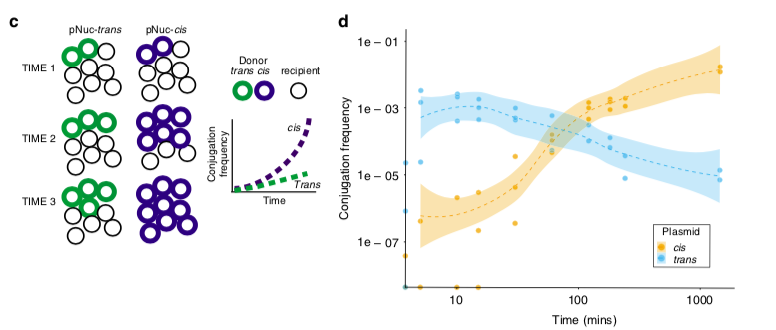
The cis-conjugative plasmid system has much higher rate of conjugation, which is how bacteria transfer genetic material between different cells, than its trans-conjugative counterpart, which has the CRISPR and conjugative sequences on different plasmids. One of the reasons the cis-conjugative system is more effective is that it is able to continue to work throughout multiple conjugations, so its effect increases exponentially throughout time. In contrast,  the trans system only works once. 

The rates of conjugation were measured from host bacteria Escherichia coli to bacterial recipient Salmonella enterica. The rate for the cis system continually increased and reached a maximum of 1 X 10⁻² at 24hour, while the trans system maxed out early at ~1 X 10⁻³ but decreased to ~1 X 10⁻⁵ at 24hours. These results showed a ~1000-fold increase in the rates of the new cis-conjugative system compared to previous trans-conjugative system. 

Macintosh HD:Users:puck:Desktop:Screen Shot 2019-10-04 at 3.51.57 PM.png


This new tool for targeting specific bacteria can be extremely useful within the human microbiome. Most microbial communities in our body exists as a biofilm, a community of different microorganisms that stick together on a surface. The new cis-conjugative system developed by researchers at Schulich School of Medicine and Dentistry has up to a potential 100% effective rate of conjugation with bacteria grown in a biofilm. The same cis system in a regular bacterial assay or filter based assay shows a ~500 to 1000-fold decrease in the rate of conjugation, increasing the systems usefulness in regards to the microbiome. 

In conclusion, this new method of specifically delivering a CRISPR-Cas-9 system to pathogenic bacteria without disrupting the composition of the entire microbial community is an exciting new direction for the targeted  treatment of microbial infections. 


1. Hamilton TA et al. Efficient inter-species conjugative transfer of a CRISPR nuclease for targeted bacterial killing. Nature Communications. 10, 4544 (2019). https://doi.org/10.1038/s41467-019-12448-3

2. Theuretzbacher, U. Antibiotic innovation for future public health needs. Clin. Microbiol. Infect. 23, 713–717 (2017). 

3. Chatain-Ly, M. H. The factors affecting effectiveness of treatment in phages therapy. Front. Microbiol. 5, 51 (2014). 

4. Khanna, S. et al. Changes in microbial ecology after fecal microbiota transplantation for recurrent C. difficile infection affected by underlying inflammatory bowel disease. Microbiome 5, 55 (2017). 


October 7, 2019

Good Morning! Highlights of today’s digest include investigation about early childhood microbiota assembly in mother-infant participants from the Tsimane indigenous population from Amazon and with findings suggesting that socioeconomic changes may be altering interactions of highly abundant members of the microbiota in the host. Results from a gut-brain axis rat model showed possibility of novel biomarkers development for stress response based on abundance of genes in microbiomes. Finally, another study is aiming to access biologically active small molecules with antibacterial activity derived from human microbiota by sequencing of metagenomes and the use of computational and synthetic biology methods.

Pregnancy and early life
Prenatal and postnatal contributions of the maternal microbiome on offspring programming – Jasarevic and Bale – Frontiers in Neuroendocrinology

Multi-site human microbiome
*Microbiota Assembly, Structure, and Dynamics Among Tsimane Horticulturalists of the Bolivian Amazon – Sprockett et al. – bioRxiv

Human vaginal microbiome
Oncogenic Virome Benefits from the Different Vaginal Microbiome-Immune Axes – Campisciano et al. – MDPI Microorganisms

Non-optimal vaginal microbiota after azithromycin treatment for Chlamydia trachomatis infection – Tamarelle et al. – The Journal of Infectious Diseases

Human nearly-sterile sites
Targeted High-Throughput Sequencing Identifies Predominantly Fungal Pathogens in Patients with Clinically Infectious, Culture-Negative Endophthalmitis in South India – Gandhi et al. – MDPI Microorganisms

Human gut microbiome
Review: Synthetic ecology of the human gut microbiota – Vrancken et al. – Nature Reviews Microbiology

Review: The interaction between gut microbiome and nutrients on development of human disease through epigenetic mechanisms – Ho-Sun Lee – Genomics & Informatics

Adaptation of Syntenic Xyloglucan Utilization Loci of Human Gut Bacteroidetes to Polysaccharide Side Chain Diversity – Dejean et al. – Applied and Environmental Microbiology

Pre‐and post‐serial metagenomic analysis of gut microbiota as a prognostic factor in patients undergoing haematopoietic stem cell transplantation – Kusakabe et al. – British Journal of Haematology

Animal experiments
Experimental evidence for adaptation to species-specific gut microbiota in house mice – Moeller et al. – mSphere

Low‐calcium diet in mice leads to reduced gut colonization by Enterococcus faecium – Top et al. – MicrobiologyOpen

Letrozole treatment of pubertal female mice results in activational effects on reproduction, metabolism and the gut microbiome – Arroyo et al. – PLOS ONE

Transplanting Fecal Virus-Like Particles Reduces High-Fat Diet-Induced Small Intestinal Bacterial Overgrowth in Mice – Lin et al. – Frontiers in Cellular and Infection Microbiology

*Metabolome and microbiome profiling of a stress-sensitive rat model of gut-brain axis dysfunction – Bassett et al. – Nature Scientific Reports

Animal microbiome
The composition and stability of the faecal microbiota of Merino sheep – Al Mamun et al. – Journal of Applied Microbiology

Faecal microbiota and functional capacity associated with weaning weight in meat rabbits – Fang et al. – Microbial Biotechnology

Review: Feline Virome—A Review of Novel Enteric Viruses Detected in Cats – Martino et al. – MDPI Viruses

Phylogeography and ecological niche shape the cichlid fish gut microbiota in Central American and African lakes – Baldo et al. – Frontiers in Microbiology

Plant, root and soil microbiome
Biocontrol activities of rhizobacteria associated with apple, apricot and kiwi rhizosphere against bacterial canker caused by Clavibacter michiganensis – Gautam et al. – Indian Phytopathology

Distinct Drivers of Core and Accessory Components of Soil Microbial Community Functional Diversity under Environmental Changes – Zhang et al. – mSystems

Antarctic tundra soil metagenome as useful natural resources of cold-active lignocelluolytic enzymes – Oh et al. – Journal of Microbiology

Microbial communities in bioswale soils and their relationships to soil properties, plant species, and plant physiology – Brodsky et al. – Frontiers in Microbiology

Soil prokaryotes associated with decreasing pathogen density during anaerobic soil disinfestation – Lee et al. – bioRxiv

Water and extremophile microbiome
Bacterial Communities of Microbial Mats of the White Sea Supralittoral and of the Littoral of the Lakes Separated from the Sea – Burganskaya et al. – Microbiology

Microbial community dynamics and coexistence in a sulfide-driven phototrophic bloom – Bhatnagar et al. – bioRxiv

Bioinformatics
*A metagenomic strategy for harnessing the chemical repertoire of the human microbiome – Sugimoto et al. – Science

Techniques
Protocol: Open-Source Software Tools, Databases, and Resources for Single-Cell and Single-Cell-Type Metabolomics – Biswapriya B. Misra – Single Cell Metabolism

An Entropy-Based Graph Construction Method for Representing and Clustering Biological Data – Ariza-Jimenez et al. – Latin American Conference on Biomedical Engineering

Microbes in the news
Artificial gut aims to expose the elusive microbiome – Anne McGovern – MIT PHYS.ORG