
February 12, 2020

This Wednesday, read about the microbiome in “flammable ice”, gastric bypass surgery in a rat model, virulence genes of the coral reef phage, and more. Happy reading!

Gut microbiome

Changes in microbiome and metabolomic profiles of fecal samples stored with stabilizing solution at room temperature: a pilot study– Mi Young Lim — Scientific Reports

Fecal microbiota transplantation to maintain remission in Crohn’s disease: a pilot randomized controlled study – Harry Soko – Microbiome

Identification of Clostridioides difficile-Inhibiting Gut Commensals Using Culturomics, Phenotyping, and Combinatorial Community Assembly – Sudeep Ghimire – mySystems

Neonatal microbiota development and the effect of early life antibiotics are determined by two distinct settler types – Anat Eck – plosOne

Oral Microbiome

Patterns of Oral Microbiota Diversity in Adults and Children: A Crowdsourced Population Study – Zachary M. Burcham – Scientific Reports

Sub-species niche specialization in the oral microbiome is associated with nasopharyngeal carcinoma risk – Justine W. Debelius – bioRxiv

Animal experiments

*Gastric bypass surgery in a rat model alters the community structure and functional composition of the intestinal microbiota independently of weight loss – Sven-Bastiaan Haange – Microbiome

Growth phase-dependent responses of an in vitro gut microbiome to metformin – Zikai Hao – bioRxiv

Ursolic acid improves the bacterial community mapping of the intestinal tract in liver fibrosis mice – Sizhe Wan – bioRxiv

Animal microbiome

Beef cattle that respond differently to fescue toxicosis have distinct gastrointestinal tract microbiota – Lucas R Koester – bioRxiv

Variation in gut bacterial composition is associated with Haemonchus contortus parasite infection of sheep – Md. Abdullah Al Mamun – Animal microbiome

Water microbiome

Microbial diversity, ecological networks and functional traits associated to materials used in drinking water distribution systems – Isabel Douterelo – Water Research

Diverse Arctic lake sediment microbiota shape methane emission temperature sensitivity – Joanne B. Emerson – bioRxiv

Coral microbiome composition along the northern Red Sea suggests high plasticity of bacterial and specificity of endosymbiotic dinoflagellate communities – Eslam O. Osman – Microbiome

Extremophile microbiome

*Evidence in the Japan Sea of microdolomite mineralization within gas hydrate microbiomes – Glen T. Snyder – Scientific Reports

Textile waste and microplastic induce activity and development of unique hydrocarbon-degrading marine bacterial communities – Elsa B. Girard – bioRxiv

Plant/root/soil microbiome

Maize (Zea mays L. Sp.) varieties significantly influence bacterial and fungal community in bulk soil, rhizosphere soil, and phyllosphere – Xiao Kong – FEMS Microbiology Ecology

A Small Effort for Researchers, a Big Gain for Soil Metaproteomics– Marco Chiapello – Frontiers in Microbiology

Viruses and phages

*Genomic and ecological attributes of marine bacteriophages encoding bacterial virulence genes – Cynthia B. Silveira – BMC Genomics

Profiling of Human Gut Virome with Oxford Nanopore Technology – Jiabao Cao – bioRxiv

Bioinformatics

MICHELINdb: a web-based tool for mining of helminth-microbiota interaction datasets, and a meta-analysis of current research – Riccardo Scotti – Microbiome
February 8, 2020

Have a nice Saturday, everyone! Today, in this Digest: several reviews, including some of them about the microbiome and Irritable Bowel Syndrome, Autism, Chemotherapy, C. difficile infection and more. Additionally, there is a very interesting study (Obata et al., Nature), showing new evidence about the relationship between the microbiota, the gut, and the nervous system. 


Human and General Microbiome

Neuronal programming by microbiota regulates intestinal physiology – Yuuki Obata – Nature

Fecal metatranscriptomics and glycomics suggest that bovine milk oligosaccharides are fully utilized by healthy adults – Samuel T. Westreich – The Journal of Nutritional Biochemistry

Review: Microbiome and Its Role in Irritable Bowel Syndrome – Mark Pimentel – Digestive Diseases and Sciences 

Review: Gut microbiota changes in children with autism spectrum disorder: a systematic review – Lucius Kang Hua Ho – Gut Pathogens

Review: Relationship Between the Gut Microbiome and Systemic Chemotherapy – Samantha M. Ervin – Digestive Diseases and Sciences 

Review: The infant gut microbiome as a microbial organ influencing host well-being – Francesca Turroni – Italian Journal of Pediatrics

Review: Increasing incidence of inflammatory bowel disease in children and adolescents: the significance of the environmental factors – Sowon Park – CEP

Review: Insights into the Role of Human Gut Microbiota in Clostridioides difficile Infection – Melina Kachrimanidou – Microorganisms (MDPI)

Review: Role of Dietary Nutrients in the Modulation of Gut Microbiota: A Narrative Review – Qi Yang – Nutrients

Opinion: Food, microbes, sex and old age: on the plasticity of gastrointestinal innervation – Tomotsune Ameku – Current Opinion in Neurobiology

The effects of proton pump inhibitors on the microbiome in young children – EI Levy – Acta Paedriatica

Targeted Approaches for In Situ Gut Microbiome Manipulation – Gail A. M. Cresci – JPEN

Dysbiosis of the Oral Ecosystem in Severe Congenital Neutropenia Patients – Egija Zaura – Proteomics Clinical Applications

Comparing Analytical Methods for the Gut Microbiome and Aging: Gut Microbial Communities and Body Weight in the Osteoporotic Fractures in Men (MrOS) Study – Michelle Shardell – The Journals of Gerontology: Series A

Oral and Gut Microbial Diversity and Immune Regulation in Patients with HIV on Antiretroviral Therapy – Medini K. Annavajhala – mSphere

Characteristics and Dysbiosis of the Gut Microbiome in Renal Transplant Recipients – J. Casper Swarte – Journal of Clinical Medicine

Comparison of serum microbiome composition in bipolar and major depressive disorders – Sang Jin Rhee – Journal of Psychiatric Research


Animal Microbiome / Animal Experiments

Review: Ruminal microbiome and microbial metabolome: effects of diet and ruminant host – C. J. Newbold – Animal

Review: Comparative methane production in mammalian herbivores – M. Clauss – Animal

Review: Regulation of gastrointestinal and renal transport of calcium and phosphorus in ruminants – M. R. Wilkens – Animal

Degeneration of the intestinal microbial community in PI3Kγ-knockout mice – Yi Li – Microbial Pathogenesis

Toxicity, gut microbiota and metabolome effects after copper exposure during early life in SD rats – Juan Dai – Toxicology

Evaluation of the effects of anthelmintic administration on the fecal microbiome of healthy dogs with and without subclinical Giardia spp. and Cryptosporidium canis infections – Madeline A. Fujishiro – PLoS ONE

Time of Feeding Alters Obesity-Associated Parameters and Gut Bacterial Communities, but Not Fungal Populations, in C57BL/6 Male Mice – Marie van der Merwe – CDN

Moderation effects of food intake on the relationship between urinary microbiota and urinary interleukin-8 in female type 2 diabetic patients – Fengping Liu – PeerJ


Beneficial Microbes and Compounds

Review: Surface components and metabolites of probiotics for regulation of intestinal epithelial barrier – Qing Liu – Microbial Cell Factories 

Polysaccharides from Polygonatum kingianum improve glucose and lipid metabolism in rats fed a high fat diet – Wen Gu – Biomedicine & Pharmacotherapy

Structural modulation of gut microbiota during alleviation of non-alcoholic fatty liver disease with Gynostemma pentaphyllum in rats – Shu-Hua Shen – BMC Complementary Medicine and Therapies


Plant Microbiome

Metagenomics methods for the study of plant-associated microbial communities: A review – Ayomide Emmanuel Fadiji – Journal of Microbiological Methods

Duckweed hosts a taxonomically similar bacterial assemblage as the terrestrial leaf microbiome – Kenneth Acosta – PLoS ONE


Bioinformatics

Computational Modeling of the Human Microbiome – Shomeek Chowdhury – Microorganisms (MDPI)

Unique k-mers as Strain-Specific Barcodes for Phylogenetic Analysis and Natural Microbiome Profiling – Valery V. Panyukov – International Journal of Molecular Sciences

Antibiotic resistance- can reducing outpatient prescription help?

Antibiotic resistance is increasing at a rapid rate making pathogens and other bacterial species resistant to currently available antibiotics. Its impact is already visible globally and clock is ticking faster than ever pushing scientists all over the world to develop better antibiotics with higher specificity (only!) for pathogens. Antibiotic consumption is directly related to antibiotic resistance and policies across the continents are underway to control the consumption and prescription of antibiotics.

A recent article in elife introduces the problem of unnecessary antibiotic use and provides data to avert it.

Inappropriate antibiotic use leads to increased risk of adverse events, disruption of colonization resistance and other benefits of the microbial flora, and bystander selection for antibiotic resistance, with little to no health gains for the patient.”

To address the problem, Christine et al. used publically available data (NAMCS/NHAMCS) and mathematical models to find what would happen if antibiotic consumption is averted in hypothetical scenarios.

What they did?
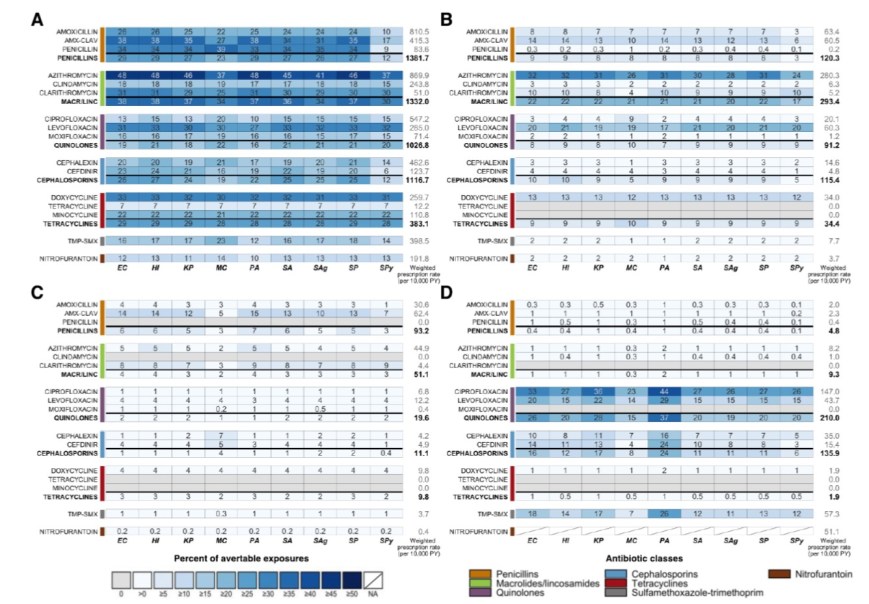
The analysis included sixteen antibiotics that are frequently prescribed in the outpatient setting and nine potentially pathogenic bacterial species that are commonly carried in the normal human microbiome. For each antibiotic-species pair, they estimated the proportion of antibiotic exposures experienced by that species that could be averted under four hypothetical scenarios.

1) Eliminate unnecessary antibiotic use across all outpatient conditions.
2) Eliminate all antibiotic use for outpatient respiratory conditions for which antibiotics are not indicated.
3) Eliminate all antibiotic use for acute sinusitis.
4) Prescribe nitrofurantoin* for all cases of cystitis in women.”

“*Nitrofurantoin- a recommended first-line therapy with good potency against common uropathogens, low levels of resistance, and decreased risk of collateral damage to the intestinal microbiome”

Results

Picture1

Heatmaps showing the estimated percentage of species exposures to each antibiotic or antibiotic class that could be averted if A: unnecessary antibiotic prescriptions across all outpatient conditions, B: all antibiotic use for outpatient respiratory conditions for which antibiotics are not indicated, C: all antibiotic use for acute sinusitis, or D: non-nitrofurantoin treatment of cystitis in women was eliminated. Drug class results include prescriptions of all antibiotics in that class, as identified by the Lexicon Plus classification system.
Abbreviations: Antibiotics (y-axis): AMX-CLAV=amoxicillin-clavulanate,, MACR/LINC=macrolides/lincosamides, TMP-SMX=sulfamethoxazole-trimethoprim;

Organisms (x-axis): EC=E. coli, HI=H. influenzae, KP=K. pneumoniae, MC=M. catarrhalis, PA=P. aeruginosa, SA=S. aureus, SAg=S. agalactiae, SP=S. pneumoniae, SPy=S. pyogenes; PY=person-years


The darker shades in panel A (scenario 1) clearly indicated that “elimination of unnecessary antibiotic prescriptions across all outpatient conditions would prevent 6 to 48% (IQR: 17 to 31%) of antibiotic-species exposures. If all unnecessary antibiotic use could be prevented, over 30% of exposures to amoxicillin-clavulanate, penicillin, azithromycin, clarithromycin, levofloxacin, and doxycycline across most potential pathogens of interest could be averted.

In panel D (scenario 4), they found that prescribing nitrofurantoin not only averted antibiotic exposure in non-causative bacterial species (bystanders) but also in causative species for cystitis in women.
Overall, 27% of ciprofloxacin use is associated with acute cystitis in women. Organisms that are not causative pathogens of cystitis have proportions of avertable exposures close to or less than 27%, but a substantially higher proportion of exposures could be averted among causative pathogens – 33%, 36%, and 44% of ciprofloxacin exposures to E. coli, K. pneumoniae, and P. aeruginosa, respectively.

The study addresses the limitations with regard to data availability and reporting in public database. Authors are cautious and point out,

It is important to note that the reduction in antibiotic exposures estimated here does not translate to the same reduction in the prevalence of resistance or in the morbidity and mortality attributable to resistance. Additionally, in this analysis, we give each exposure equal weight. However, the selective pressure imposed by a single exposure depends on a number of variables, including pharmacokinetics, pharmacodynamics, distribution of bacteria across body sites, and bacterial population size. For example, we might expect that the probability of resistance scales with population size, and thus that an exposure received by an individual with higher bacterial load will have a larger impact on resistance.

Overall, this study indeed provides evidence that “improved prescription of antibiotics has the potential to prevent antibiotic exposure experienced by bacterial species throughout microbiome.

February 2, 2020

Have a nice Sunday! Today, in this Digest we have several papers about the relationship between the microbiome and different neurological/psychological conditions, such as ASD, depression or anxiety, or about the microbiome and the inflammatory bowel disease. Enjoy!


Human and General Microbiome

Review: Host-microbiota interactions in inflammatory bowel disease – Roberta Caruso – Nature Reviews Immunology 

Review: Considering gut microbiota in treatment of type 2 diabetes mellitus – Aneseh Adeshirlarijaney – Gut Microbes

Review: Gut Dysbiosis Dysregulates Central and Systemic Homeostasis via Suboptimal Mitochondrial Function: Assessment, Treatment and Classification Implications – George Anderson – Current Topics in Medicinal Chemistry

Book Chapter: Immune-Kynurenine Pathways and the Gut Microbiota-Brain Axis in Anxiety Disorders – Alper Evrensel – Anxiety Disorders 

Book Chapter: Autism and Gut-Brain Axis: Role of Probiotics – Saravana Babu Chidambaram – Personalized Food Intervention and Therapy for Autism Spectrum Disorder Management

Review: Microbial-Based and Microbial-Targeted Therapies for Inflammatory Bowel Diseases – Akihiko Oka – Digestive Diseases and Sciences

Precision Microbiome Modulation with Discrete Dietary Fiber Structures Directs Short-Chain Fatty Acid Production – Edward C. Deehan – Cell Host and Microbe

Urinary microbiome in uncomplicated and interstitial cystitis: is there any similarity? – Süleyman Yıldırım – World Journal of Urology

The gut microbiota response to helminth infection depends on host sex and genotype – Fei Ling – The ISME Journal 

Metabolism of multiple glycosaminoglycans by Bacteroides thetaiotaomicron is orchestrated by a versatile core genetic locus – Didier Ndeh – Nature Communications

Gestational diabetes and the human salivary microbiota: a longitudinal study during pregnancy and postpartum – Mie K. W. Crusell – BMC Pregnancy and Childbirth 

Vaginal dysbiosis associated-bacteria Megasphaera elsdenii and Prevotella timonensis induce immune activation via dendritic cells – Nienke H.van Teijlingen – Journal of Reproductive Immunology

Variability in Skin Microbiota between Smokers, Former Smokers, and Non-Smokers – Katherine G. Thompson – Journal of the American Academy of Dermatology

Microbiota changes and Intestinal Microbiota Transplantation in Liver Diseases and Cirrhosis – Jasmohan S. Bajaj – Journal of Hepatology

Host-Specific Evolutionary and Transmission Dynamics Shape the Functional Diversification of Staphylococcus epidermidis in Human Skin – Wei Zhou – Cell


Animal Microbiome and Animal Experiments

Effect of probiotic administration on gut microbiota and depressive behaviors in mice – Quan Feng Liu – DARU Journal of Pharmaceutical Sciences

Deciphering the bifidobacterial population within the canine and feline gut microbiota – Giulia Alessandri – Applied and Environmental Microbiology

Dissecting the factors shaping fish skin microbiomes in a heterogeneous inland water system – Yaron Krotman – Microbiome

Prenatal exposure to glufosinate ammonium disturbs gut microbiome and induces behavioral abnormalities in mice – Tianyu Dong – Journal of Hazardous Materials

High prevalence of Phasi Charoen-like virus from wild-caught Aedes aegypti in Grenada, W.I. as revealed by metagenomic analysis – Maria E. Ramos-Nino – PLoS ONE

Common structuring principles of the Drosophila melanogaster microbiome on a continental scale and between host and substrate – Yun Wang – Environmental Microbiology Reports

Community assembly of the native C. elegans microbiome is influenced by time, substrate, and individual bacterial taxa – Julia Johnke – Environmental Microbiology 


Environmental Microbiome

Patterns of local, intercontinental and inter-seasonal variation of soil bacterial and eukaryotic microbial communities – Johan De Gruyter – FEMS Microbiology Ecology

Dynamics and ecological distributions of the Archaea microbiome from inland saline lakes (Monegros Desert, Spain) – Mateu Menéndez-Serra – FEMS Microbiology Ecology


February 1, 2020

Today’s Digest brings you an Outlook collection on human gut microbiome by Nature, a Hi-C investigation of the evolution of the gut microbiota, and be careful with the dust, there’s transferrable antimicrobial genes within!

Events

Reshaping the Microbiome through Nutrition – Nature Conference – San Diego, CA

General microbiology

Commensal Bacteroidetes protect against Klebsiella pneumoniae colonization and transmission through IL-36 signalling – Richard P. Sequeira et al. – Nature Microbiology

** The gut microbiome – Nature Outlook

Antimicrobial resistance

The negative cofactor 2 complex is a key regulator of drug resistance in Aspergillus fumigatus – Takanori Furukawa et al. – Nature Communications

Plasmid-mediated metronidazole resistance in Clostridioides difficile – Ilse M. Boekhoud et al. – Nature Communications

A Common Practice of Widespread Antimicrobial Use in Horse Production Promotes Multi-Drug Resistance – S. Álvarez–Narváez et al. – Scientific Reports

Surveys of knowledge and awareness of antibiotic use and antimicrobial resistance in general population: A systematic review – PLoS One

Antimicrobial resistance patterns and molecular resistance markers of Campylobacter jejuni isolates from human diarrheal cases – Mohamed Elhadidy et al. – PLoS One

Review: Antibiotic resistance: turning evolutionary principles into clinical reality – Dan I Andersson et al. – FEMS Microbiology Reviews

Antibiotic resistome associated with microbial communities in an integrated wastewater reclamation system – Kaifeng Yu et al. – Water Research

Human gut microbiome

** Tracking microbial evolution in the human gut using Hi-C reveals extensive horizontal gene transfer, persistence and adaptation – Eitan Yaffe & David A. Relman – Nature Microbiology

Growth effects of N-acylethanolamines on gut bacteria reflect altered bacterial abundances in inflammatory bowel disease – Nadine Fornelos et al. – Nature Microbiology

Human cancer microbiome

The Influence of Lung Microbiota on Lung Carcinogenesis, Immunity, and Immunotherapy – Ariel G. Ramírez-Labrada et al. – Trends in Cancer

Built environment microbiome

** Mobilizable antibiotic resistance genes are present in dust microbial communities – Sarah Ben Maamar et al. – PLoS Pathogens

Indoor and outdoor airborne bacterial and fungal air quality in kindergartens: seasonal distribution, genera, levels, and factors influencing their concentration – Farhad Mirkhond Chegini et al. – Building and Environment

Metabolomics

Targeted metabolomics of pellicle and saliva in children with different caries activity – Annika Schulz et al. – Scientific Reports

Animal experiments

Review: The role of the microbiota in sedentary life style disorders and ageing: Lessons from the animal kingdom – P.W. O’Toole & P.G. Shiels – Journal of Internal Medicine

Animal microbiome

Dietary effects on gut microbiota of the mesquite lizard Sceloporus grammicus (Wiegmann, 1828) across different altitudes – Nina Montoya-Ciriaco et al. – Microbiome

Late weaning is associated with increased microbial diversity and Faecalibacterium prausnitzii abundance in the fecal microbiota of piglets – Francesca Romana Massacci et al. – Animal Microbiome

Plant, root and soil microbiome

Effects of soil chemical properties and fractions of Pb, Cd, and Zn on bacterial and fungal communities – Xiaomei Pan et al. – Science of the Total Environment

Resilience of the microbial communities of semiarid agricultural soils during natural climatic variability events – Lumarie Pérez-Guzmán et al. – Applied Soil Ecology

Effects of microbial inoculants on the fermentation characteristics and microbial communities of sweet sorghum bagasse silage – Miaoyin Dong et al. – Scientific Reports

Water and extremophile microbiome

Diversity of Bacterial Community in the Oxygen Minimum Zones of Arabian Sea and Bay of Bengal as Deduced by Illumina Sequencing – Genevieve L. Fernandes et al. – Frontiers in Microbiology

Ionic Liquid Enriches the Antibiotic Resistome, Especially Efflux Pump Genes, Before Significantly Affecting Microbial Community Structure – Xiaolong Wang et al. – Environmental Science & Technology

Methane yield enhancement of mesophilic and thermophilic anaerobic co-digestion of algal biomass and food waste using algal biochar: Semi-continuous operation and microbial community analysis – Le Zhang et al. – Bioresource Technology

Characterization and co-occurrence of microbial community in epiphytic biofilms and surface sediments of wetlands with submersed macrophytes – Yuansi Liu et al. – Science of the Total Environment

Phages and viruses

** Giant virus diversity and host interactions through global metagenomics – Frederik Schulz et al. – Nature

Reassortment and adaptive mutations of an emerging avian influenza virus H7N4 subtype in China – Bingqian Qu et al. – PLoS One

Outbreak of Pneumonia of Unknown Etiology in Wuhan China: the Mystery and the Miracle – Hongzhou Lu et al. – Journal of Medical Virology

Bioinformatics

Comparing bioinformatic pipelines for microbial 16S rRNA amplicon sequencing – Andrei Prodan et al. – PLoS One

Microbes in the news

Walnuts May Benefit Gut Bacteria and Improve Heart Health – Karina Lichtenstein – Medicine Net

How to create living art with microbes – Eugenia Angulo – BBVA OpenMind

January 27, 2020

In today’s Monday morning post – establishing causality for gut microbiome using human microbiota associated rodents, gut microbiota profiling in pregnant women after bariatric surgery, proteomics changes in bacteria, discovery of core microbiome of common bean rhizosphere and many more.

General Microbiome

Establishing or Exaggerating Causality for the Gut Microbiome: Lessons from Human Microbiota-Associated Rodents – Jens Walter – Cell

Microbial Genomics and Metagenomics in India: Explorations and Perspectives– Princy Hira – Proceedings of Indian National Science Academy

Human Microbiome

Longitudinal metabolic and gut bacterial profiling of pregnant women with previous bariatric surgery – Kiana Ashley West – Gut

Identifying determinants of bacterial fitness in a model of human gut microbial succession – Lihui Feng – PNAS

16S rDNA microbiome composition pattern analysis as a diagnostic biomarker for biliary tract cancer – Huisong Lee – World Journal of Surgical Oncology

Faecal microbiota transplantations and urinary tract infections – Jean Christophe Lagier – Lancet

Animal Microbiome

Influences of a Prolific Gut Fungus (Zancudomyces culisetae) on Larval and Adult Mosquito (Aedes aegypti)-Associated Microbiota – Jonas Frankel-Bricker – Applied and Environmental Microbiology

Functional dynamics of bacterial species in the mouse gut microbiome revealed by metagenomic and metatranscriptomic analyses – Youn Wook Chung – PlosOne

Early life microbiome perturbation alters pulmonary responses to ozone in male mice – Traci A. Brown – Physiological Reports

Evolution and maintenance of microbe-mediated protection under occasional pathogen attack – Anke Kloock – BioRxiv

Plant, root and soil microbiome

Community sequencing on a natural experiment reveals little influence of host species and timing but a strong influence of compartment on the composition of root endophytes in three annual Brassicaceae – Jose G Macia-Vicente – BioRxiv

Discovery of a spatially and temporally persistent core microbiome of the common bean rhizosphere – Nejc Stopnisek – BioRxiv

Resident and phytometer plants host comparable rhizosphere fungal communities in managed grassland ecosystems – Ricardo Schöps – Scientific Reports

Evaluation of fatty acid derivatives in the remediation of aged PAH-contaminated soil and microbial community and degradation gene response – Qingling Wang – Chemosphere

Techniques

Proteomic changes in bacteria caused by exposure to environmental conditions can be detected by Matrix-Assisted Laser Desorption/Ionization – Time of Flight (MALDI-ToF) Mass Spectrometry – Denise Chac – BioRxiv

Probiotics, prebiotics

Beneficial bile acid metabolism from Lactobacillus plantarum of food origin – Roberta Prete – Scientific Reports

Microbes in the news

Could a kid’s microbiome alter their behaviour? – Health24

Microbiome Therapeutics Market Report Forecast by Capital Investment, Industry Outlook, Opportunities & Trends 2024 – Fusion Science Academy

January 22, 2020

In today’s digest read about Lactobacillus mulieris sp. nov. isolated from healthy female urinary tract, diversity of Escherichia coli phages in the Danish wastewater, PLate Coverage Algorithm (PLCA) in culture-enriched metagenomics, and more. Happy reading!

General microbiome

Microbiomes Reduce Their Host’s Sensitivity to Interspecific Interactions – Sara L. Jackrel – mBio

Gut microbiome

Klebsiella michiganensis transmission enhances resistance to Enterobacteriaceae gut invasion by nutrition competition – Rita A. Oliveira – Nature Microbiology

Long-term impact of fecal transplantation in healthy volunteers – Oleg V. Goloshchapov – BMC Microbiology

Efficacy of faecal microbiota transplantation in Crohn’sdisease: a new target treatment?– Liyuan Xiang – Microbial Biotechnology

Resident microbial communities inhibit growth and antibiotic resistance evolution of Escherichia coli in human gut microbiome samples – Michael Baumgartner – bioRxiv

Microreview: Causalities of war: The connection between type VI secretion system and microbiota – Luke P. Allsopp – Cellular Microbiology

Urinary microbiome

*Lactobacillus mulieris sp. nov., a new species of Lactobacillus delbrueckii group – Joana Rocha – International Journal of systematic and evolutionary microbiology

Vaginal microbiome

Vaginal Microbiota Transplantation: The Next Frontier – Kevin DeLong – The Journal of Law, Medicine, & Ethics

Respiratory microbiome

*Culture-enriched metagenomic sequencing enables in-depth profiling of the cystic fibrosis lung microbiota – Fiona J. Whelan – Nature Microbiology

A Refined View of Airway Microbiome in Chronic Obstructive Pulmonary Disease at Species and Strain-levels– Zhang Wang – bioRxiv

Eye microbiome

The closed eye harbors a unique microbiome in dry eye disease – Kent A. Willis – medRxiv

Plant/root/soil microbiome

Root ethylene mediates rhizosphere microbial community reconstruction when chemically detecting cyanide produced by neighbouring plants – Yan Chen – Microbiome

Warming-induced permafrost thaw exacerbates tundra soil carbon decomposition mediated by microbial community– Jiajie Feng – Microbiome

Microbiome composition differs in hybrid and inbred maize – Maggie R. Wagner – bioRxiv

Diversity and plant growth-promoting functions of diazotrophic/N-scavenging bacteria isolated from the soils and rhizospheres of two species of Solanum – Zuluaga Mya – PlosOne

Water microbiome

Molecular Characteristics of Dissolved Organic Nitrogen and Its Interaction with Microbial Communities in a Prechlorinated Raw Water Distribution System – Hang Xu – Environmental Science and Technology

Effects of geographic location and water quality on bacterial communities in full-scale biofilters across North America – Ben Ma – FEMS Microbiology Ecology

Phages and viruses

*Exploring the remarkable diversity of Escherichia coli Phages in the Danish Wastewater Environment, Including 91 Novel Phage Species – Nikoline S. Olsen – bioRxiv

Bioinformatics

Piphillin predicts metagenomic composition and dynamics from DADA2-corrected 16S rDNA sequences – Nicole R. Narayan – BMC Genomics

Network-Based Prediction of Novel CRISPR-Associated Genes in Metagenomes – Jake L. Weissman and Philip L. F. Johnson – mSystems

Review: Integrating Computational Methods to Investigate the Macroecology of Microbiomes – Rilquer Mascarenhas – Frontiers in Genetics

Assessment of single cell RNA-seq statistical methods on microbiome data – Matteo Calgaro – bioRxiv

January 17, 2020

I 100% concur with Barak about our great Microbiome Digest, and we invite YOU to join us to create useful content for our community. Today’s Digest hopefully brings you much food for thought. I would draw your attention towards two papers about insecticide and antibiotic resistance. The first is about the mechanism for malaria transmitting mosquitoes to tolerate the common pesticide, pyrethroid. The second is on a potential genetic engineering approach to replacing antibiotic resistant plasmids with artificial ones. Of course, there are many more articles and news pieces to read from. Enjoy!

Jobs and Events

MICROBIOME CONNECT SKIN USA 2020 – Global Cosmetics News

Postdoc Computational and Statistical Analysis of Microbiome Data (0.8 – 1.0 FTE) – Universiteit Utrecht

Digest this! New exhibition explores the hidden world of microbes inside — and on — you! – Ottawa Citizen

Call for papers: Cancer Evolution and Metastasis – Genome Biology

General microbiology

Setting the agenda for social science research on the human microbiome – Beth Greenhough et al. – University of Nottingham

Exploring microbial worlds – Lei Tang – Nature Methods

Community-driven Metadata Standards for Agricultural Microbiome Research – JP. Dundore-Arias et al – Phytobiomes Journal

Antimicrobial/Insecticide resistance

Mobile resistome of human gut and pathogen drives anthropogenic bloom of antibiotic resistance – Kihyun Lee et al. – Microbiome

Structures of lipoprotein signal peptidase II from Staphylococcus aureus complexed with antibiotics globomycin and myxovirescin – Samir Olatunji et al. – Nature Communications

** A sensory appendage protein protects malaria vectors from pyrethroids – Victoria A. Ingham et al. – Nature

Press: Malaria-carrying mosquitoes get a leg up on insecticides – Flaminia Catteruccia – Nature

** Potentiation of curing by a broad-host-range self-transmissible vector for displacing resistance plasmids to tackle AMR – Alessandro Lazdins et al. – PLoS One

Promising antifungal activity of new oxadiazole against Candida krusei – Daniella Renata Faria et al. – PLoS One

Impact of multi-drug resistant bacteria on economic and clinical outcomes of healthcare-associated infections in adults: Systematic review and meta-analysis – Miquel Serra-Burriel et al. – PLoS One

Pregnancy and early life

The association between dietary patterns before and in early pregnancy and the risk of gestational diabetes mellitus (GDM): Data from the Malaysian SECOST cohort – Heng Yaw Yong et al. – PLoS One

Nucleic Acid-Based Screening of Maternal Serum to Detect Viruses in Women with Labor or PROM – Ankit A. Shah et al. – Reproductive Sciences

Provision of Lipid-Based Nutrient Supplements to Mothers During Pregnancy and 6 Months Postpartum and to Their Infants from 6 to 18 Months Promotes Infant Gut Microbiota Diversity at 18 Months of Age but Not Microbiota Maturation in a Rural Malawian Setting: Secondary Outcomes of a Randomized Trial – Arox W Kamng’ona et al. – The Journal of Nutrition

Human skin microbiome

Distribution of microbial communities and core microbiome in successive wound grades of diabetic foot ulcer individuals – Apoorva Jnana et al. – Applied and Environmental Microbiology

Review: The skin microbiome as a clinical biomarker in atopic eczema: Promises, navigation, and pitfalls – Matthias Reiger et al. – The Journal of Allergy and Clinical Immunology

Characterization and Analysis of the Skin Microbiota in Acne: Impact of Systemic Antibiotics – Seo-Yeon Park et al. – Journal of Clinical Medicine

Human gut microbiome

Review: Microbial Production of Bioactive Chemicals for Human Health – Xia Wu et al. – Current Opinion in Food Science

Gut microbiota compositional profile and serum metabolic phenotype in patients with primary open-angle glaucoma – Haijun Gong et al. – Experimental Eye Research

Inulin-type fructan intervention restricts the increase in gut microbiome–generated indole in patients with peritoneal dialysis: a randomized crossover study – Li Li et al. – The American Journal of Clinical Nutrition

Human reproductive microbiome

Review: The Reproductive Microbiome: An Emerging Driver of Sexual Selection, Sexual Conflict, Mating Systems, and Reproductive Isolation – Melissah Rowe et al. – Trends in Ecology & Evolution

Press: What we’re learning about the reproductive microbiome – Cell Press – Phys.org

Cancer microbiome

Assessment of peritoneal microbial features and tumor marker levels as potential diagnostic tools for ovarian cancer – Ruizhong Miao – PLoS One

Animal experiments

Acute oral methylmercury exposure perturbs the gut microbiome and alters gut-brain axis related metabolites in rats – Xiaoying Lin et al. – Ecotoxicology & Environmental Safety

Perfluorooctane sulfonate alters gut microbiota-host metabolic homeostasis in mice – Limin Zhang et al. – Toxicology

Fecal transplant prevents gut dysbiosis and anxiety-like behaviour after spinal cord injury in rats – Emma K. A. Schmidt et al. – PLoS One

Impact of antibiotic-resistant bacteria in the mouse intestine on immune activation and Clostridioides difficile infection – James Keith et al. – Infection and Immunity

Animal microbiome

Evolutionary signal in the gut microbiomes of 74 bird species from Equatorial Guinea – Darien C. Capunitan et al. – Molecular Ecology

Whole blood transcriptomic analysis of beef cattle at arrival identifies potential predictive molecules and mechanisms that indicate animals that naturally resist bovine respiratory disease – Matthew A. Scott et al. – PLoS One

Body-site specific microbiota reflect sex and age-class among wild spotted hyenas – Connie A Rojas et al. – FEMS Microbiology Ecology

Plant, root and soil microbiome

Biochar mediates microbial communities and their metabolic characteristics under continuous monoculture – Hongmiao Wu et al. – Chemosphere

Functional Metagenomic Exploration Identifies Novel Prokaryotic Copper Resistance Genes from Soil Microbiome – Chao Xing et al. – Metallomics

** A Pathogen-Responsive Gene Cluster for Highly Modified Fatty Acids in Tomato – Ju Eun Jeon et al. – Cell

Effects of soil physicochemical properties on microbial communities in different ecological niches in coastal area – Tianyun Shao et al. – Applied Soil Ecology

Soil microbial community structure and function mainly respond to indirect effects in a multifactorial climate manipulation experiment – Evi Deltedesco et al. – Soil Biology and Biochemistry

Long term effects of management practice intensification on soil microbial community structure and co-occurrence network in a non-timber plantation – Liang Xue et al. – Forest Ecology and Management

Soil microbial and macrofauna dynamics under different green manure termination methods – Carolyn B. Marshall & Derek H. Lynch – Applied Soil Ecology

Microbial abundance, composition, and function in nectar are shaped by flower visitor identity – Megan M Morris et al. – FEMS Microbiology Ecology

Ecological clusters based on responses of soil microbial phylotypes to precipitation explain ecosystem functions – Ying Wu et al. – Soil Biology and Biochemistry

Phylogenetic Analysis of Symbiotic Bacteria Associated with Two Vigna Species under Different Agro-Ecological Conditions in Venezuela – María Daniela Artigas Ramírez et al. – Microbes and Environments

Diversity and structure of bacterial community in rhizosphere of lima bean – Regina Maria Silva Sousa et al. – Applied Soil Ecology

Distinct factors drive the assembly of quinoa-associated microbiomes along elevation – Zhiquan Cai et al. – Plant and Soil

Influence of plant fraction, soil and plant species on the microbiota: a multi-kingdom comparison – Tkacz, A et al. – mBio

Spatial Variation in Soil Fungal Communities across Paddy Fields in Subtropical China – Pengfa Li et al. – mSystems

Water and extremophile microbiome

Impacts of antimony and arsenic co-contamination on the river sedimentary microbial community in an antimony-contaminated river – Rui Xu et al. – Science of the Total Environment

Interactions of PAH-degradation and nitrate-/sulfate-reducing assemblages in anaerobic sediment microbial community – Xunan Yang et al. – Journal Hazardous Materials

Influence of wastewater microbial community on the performance of miniaturized microbial fuel cell biosensor – Nan Xiao et al. – Bioresource Technology

Intra-host symbiont diversity in eastern Pacific cold seep tubeworms identified by the 16S-V6 region, but undetected by the 16S-V4 region – Corinna Breusing et al. – PLoS One

Phages and viruses

Biogeographic study of human gut-associated crAssphage suggests impacts from industrialization and recent expansion – Tanvi P. Honap et al. – PLoS One

Bioinformatics

Gclust: A Parallel Clustering Tool for Microbial Genomic Data – Ruilin Li et al. – Genomics, Proteomics & Bioinformatics

Microbes in the news

Insomnia: When I took part in a sleep study – Yella Hewings-Martin – Medical News Today

How to Keep Your Baby’s Skin Healthy When It’s Cold Outside – Joane Amay – Ebony

Prebiotics, cosmeceuticals may improve skin condition – Ingrid Torjesen – Dermatology Times

Next frontier is to identify and use good bacteria to treat specific diseases – Namita Kohli – The Week

Five next-gen depression treatments that could revolutionize the field – Alexandra Pattillo – Inverse

Coeliac disease linked to bacteria exposure – Liam Mannix – The Sydney Morning Herald

GETTING TO KNOW YOUR MICROBIOME BETTER – Kim-Anh Lê Cao – Pursuit

Common foods can help ‘landscape’ the jungle of our gut microbiome – San Diego State University – Medical Xpress

Pioneering scientists create designer prebiotics to disrupt the microbiome health space – Nikki Hancocks – NutraIngredients

Applying knowledge of the human microbiome to pig health – The Pig Site

Your microbiome reveals more about your health than your genes do – Michael Le Page – New Scientist

UH joins new national consortium to advance microbiome research – University of Hawaiʻi at Mānoa

Check out these awesomely creepy puppets of microbial creatures – Thom Dunn – BoingBoing

Microbes on the market

Bloom Science Granted Exclusive Option to License Microbiome-Based Technology for the Development of Novel Treatments for Multiple Neurological and Oncology Conditions – Bloom Science – PR Newswire

Mawi and CosmosID Collaborate to Enable More Precise Microbiome Analysis – Business Wire – Yahoo! Finance

January 10, 2020

In today’s weekend post- maternal antibodies targeting microbiota protect mice from neonatal infection, exercise improves gestational diabetes in rodent models, bacterial signature in NAFLD and TMAO as negative predictor of human embryo quality. Happy reading and a nice weekend!

General microbiome

Adolescence and aging: impact of adolescence inflammatory stress and microbiota alterations on brain development, aging and neurodegeneration – Nour Yahfoufi – The Journal of Geronotology

Preclinical and clinical relevance of probiotics and synbiotics in colorectal carcinogenesis: a systematic review – Bruna C.S. Cruz – Nutrition Reviews

Gut microbiota: a new piece in understanding hepatocarcinogenesis – An Zhou – Cancer Letters

Gut Microbiota, Diet, and Chronic Diseases: The Role Played by Oxidative Stress – Elisardo C. Vasquez – Oxidative Medicine and Cellular Longevity

New insights on the colonization of the human gut by health-promoting bacteria – Sinead T. Morrin – Applied Microbiology and Biotechnology

Human microbiome

Salivary microbiota and inflammation‐related proteins in patients with psoriasis – Daniel Belstrøm – Oral Diseases

Oral butyrate does not affect innate immunity and islet autoimmunity in individuals with longstanding type 1 diabetes: a randomised controlled trial – Pieter F. de Groot – Diabetologia

Fusobacterium nucleatum in the colorectum, and its association with cancer risk and survival: a systematic review and meta-analysis – Christian Gethings-Behncke – Cancer Epidemiology Biomarkers and Prevention

Potential impact of removing metronidazole from treatment armamentarium of mild acute Clostridioides difficile infection – Shani Zilberman-Itskovich – Future Medicine

Intrahepatic bacterial metataxonomic signature in non-alcoholic fatty liver disease Silvia Sookoian – Gut

Microbial imbalance in inflammatory bowel disease patients at different taxonomic levels – Mohammad Tauqeer Alam – Gut Pathogens

Early life microbiota

Antibiotic Resistance Genes in the Gut Microbiota of Children with Autistic Spectrum Disorder as Possible Predictors of the Disease – Alexey S. Kovtun – Microbial Drug Resistance

Trimethylamine-N-oxide is present in human follicular fluid and is a negative predictor of embryo quality – R.A.Nagy – Human Reproduction

Animal experiments

Microbiota-targeted maternal antibodies protect neonates from enteric infection – Wen Zheng – Nature

Characterization of metabolic and inflammatory profiles of transition dairy cows fed an energy-restricted diet – Giulia Esposito – Journal of Animal Science

Microbiota dependent production of butyrate is required for the bone anabolic activity of PTH – Jau-Yi Li – Journal of Clinical Investigation

Betaine addition as a potent ruminal fermentation modulator under hyperthermal and hyperosmotic conditions in vitro – Mubarik Mahmood – Journal of the Science of Food and Agriculture

Investigating temporal microbial dynamics in the rumen of beef calves raised on two farms during early life – Eóin O’Hara – FEMS Microbial Ecology

Dietary Xanthan Gum Alters Antibiotic Efficacy against the Murine Gut Microbiota and Attenuates Clostridioides difficile Colonization – Matthew K. Schnizlein – mSphere

Post‐natal co‐development of the microbiota and gut barrier function follows different paths in the small and large intestine in piglets – Alexis Pierre Arnaud – Faseb Journal

Phellinus linteus polysaccharide extract improves insulin resistance by regulating gut microbiota composition – Yangyang Liu – Faseb Journal

Exercise improves metabolic function and alters the microbiome in rats with gestational diabetes – Dayana Mahizir – Faseb Journal

Microbial reconstitution reverses early female puberty induced by maternal high-fat diet during lactation – Mengjie Wang – Endocrinology

Fecal microbiota as a noninvasive biomarker to predict the tissue iron accumulation in intestine epithelial cells and liver – Bingdong Liu – Faseb Journal

Techniques

Systematic Analysis of Impact of Sampling Regions and Storage Methods on Fecal Gut Microbiome and Metabolome Profiles – Yali Liang – mSphere

January 8, 2020

Today’s digest features a retrospective mini-review of mothur, study on gut microbiomes of over 900 vertebrate species [Spoiler alert: birds and bats share similarities in their microbiome], findings of fifteen-thousand-year-old viruses in glacier ice, and more. Happy reading!

Gut microbiome

Recording mobile DNA in the gut microbiota using an Escherichia coli CRISPR-Cas spacer acquisition platform – Christian Munck – Nature Communications

Microbial imbalance in inflammatory bowel disease patients at different taxonomic levels – Mohammad Tauqeer Alam – Gut Pathogens

Gut dysbiosis induces the development of pre-eclampsia through bacterial translocation– Xia Chen – Gut

Analysis of gut microbiota of obese individuals with type 2 diabetes and healthy individuals – Aftab Ahmad – PlosOne

Alterations of human lung and gut microbiome in non-small cell lung carcinomas and distant metastasis – Hui Lu – bioRxiv

The interplay between host genetics and the gut microbiome reveals common and distinct microbiome features for human complex diseases – Fengzhe Xu – bioRxiv

Oral microbiome

Acquisition of Oral Microbiota is Driven by Environment, Not Host Genetics – Chiranjit Mukherjee – bioRxiv

Animal microbiome

*Comparative Analyses of Vertebrate Gut Microbiomes Reveal Convergence between Birds and Bats– Se Jin Song – mBio

Comparative Genomics of Rumen Butyrivibrio spp. Uncovers a Continuum of Polysaccharide-Degrading Capabilities – Nikola Palevich – Applied and Environmental Microbiology

Inside out: microbiota dynamics during host-plant adaptation of whiteflies – Diego Santos-Garcia – The ISME Journal

Blood Loss Leads to Increase in Relative Abundance of Opportunistic Pathogens in the Gut Microbiome of Rabbits – Junjie Yang – Current Microbiology

Probiotics

In Vitro Probiotic Potential of Hemophilin-producing Strains of Haemophilus haemolyticus – Brianna Atto – bioRxiv

Quantifying and engineering mucus adhesion of probiotics – Zachary J. S. Mays – bioRxiv

Plant/root/soil microbiome

Temporal and spatial changes in phyllosphere microbiome of acacia trees growing in super arid environments – Ashraf Al-Ashhab – bioRxiv

Secreted metabolite-mediated interactions between rhizosphere bacteria and Trichoderma biocontrol agents – Ningxiao Li – PlosOne

Water microbiome

Quantification of nosZ genes and transcripts in activated sludge microbiomes with novel group-specific qPCR methods validated with metagenomic analyses – Daehyun Daniel Kim – bioRxiv

Viruses

*Glacier ice archives fifteen-thousand-year-old viruses – Zhi-Ping Zhong – bioRxiv

Meeting report: Viruses in the Built Environment (VIBE) meeting report – Aaron J. Prussin – Microbiome

Bioinformatics

*Minireview: Reintroducing mothur: 10 Years Later – Patrick D. Schloss – Applied and Environmental Microbiology

FunGeCo : A web based tool for estimation of Functional potential of bacterial genomes and microbiomes using Gene Context information – Swadha Anand – Bioinformatics