
February 12, 2020

This Wednesday, read about the microbiome in “flammable ice”, gastric bypass surgery in a rat model, virulence genes of the coral reef phage, and more. Happy reading!

Gut microbiome

Changes in microbiome and metabolomic profiles of fecal samples stored with stabilizing solution at room temperature: a pilot study– Mi Young Lim — Scientific Reports

Fecal microbiota transplantation to maintain remission in Crohn’s disease: a pilot randomized controlled study – Harry Soko – Microbiome

Identification of Clostridioides difficile-Inhibiting Gut Commensals Using Culturomics, Phenotyping, and Combinatorial Community Assembly – Sudeep Ghimire – mySystems

Neonatal microbiota development and the effect of early life antibiotics are determined by two distinct settler types – Anat Eck – plosOne

Oral Microbiome

Patterns of Oral Microbiota Diversity in Adults and Children: A Crowdsourced Population Study – Zachary M. Burcham – Scientific Reports

Sub-species niche specialization in the oral microbiome is associated with nasopharyngeal carcinoma risk – Justine W. Debelius – bioRxiv

Animal experiments

*Gastric bypass surgery in a rat model alters the community structure and functional composition of the intestinal microbiota independently of weight loss – Sven-Bastiaan Haange – Microbiome

Growth phase-dependent responses of an in vitro gut microbiome to metformin – Zikai Hao – bioRxiv

Ursolic acid improves the bacterial community mapping of the intestinal tract in liver fibrosis mice – Sizhe Wan – bioRxiv

Animal microbiome

Beef cattle that respond differently to fescue toxicosis have distinct gastrointestinal tract microbiota – Lucas R Koester – bioRxiv

Variation in gut bacterial composition is associated with Haemonchus contortus parasite infection of sheep – Md. Abdullah Al Mamun – Animal microbiome

Water microbiome

Microbial diversity, ecological networks and functional traits associated to materials used in drinking water distribution systems – Isabel Douterelo – Water Research

Diverse Arctic lake sediment microbiota shape methane emission temperature sensitivity – Joanne B. Emerson – bioRxiv

Coral microbiome composition along the northern Red Sea suggests high plasticity of bacterial and specificity of endosymbiotic dinoflagellate communities – Eslam O. Osman – Microbiome

Extremophile microbiome

*Evidence in the Japan Sea of microdolomite mineralization within gas hydrate microbiomes – Glen T. Snyder – Scientific Reports

Textile waste and microplastic induce activity and development of unique hydrocarbon-degrading marine bacterial communities – Elsa B. Girard – bioRxiv

Plant/root/soil microbiome

Maize (Zea mays L. Sp.) varieties significantly influence bacterial and fungal community in bulk soil, rhizosphere soil, and phyllosphere – Xiao Kong – FEMS Microbiology Ecology

A Small Effort for Researchers, a Big Gain for Soil Metaproteomics– Marco Chiapello – Frontiers in Microbiology

Viruses and phages

*Genomic and ecological attributes of marine bacteriophages encoding bacterial virulence genes – Cynthia B. Silveira – BMC Genomics

Profiling of Human Gut Virome with Oxford Nanopore Technology – Jiabao Cao – bioRxiv

Bioinformatics

MICHELINdb: a web-based tool for mining of helminth-microbiota interaction datasets, and a meta-analysis of current research – Riccardo Scotti – Microbiome
Antibiotic resistance- can reducing outpatient prescription help?

Antibiotic resistance is increasing at a rapid rate making pathogens and other bacterial species resistant to currently available antibiotics. Its impact is already visible globally and clock is ticking faster than ever pushing scientists all over the world to develop better antibiotics with higher specificity (only!) for pathogens. Antibiotic consumption is directly related to antibiotic resistance and policies across the continents are underway to control the consumption and prescription of antibiotics.

A recent article in elife introduces the problem of unnecessary antibiotic use and provides data to avert it.

Inappropriate antibiotic use leads to increased risk of adverse events, disruption of colonization resistance and other benefits of the microbial flora, and bystander selection for antibiotic resistance, with little to no health gains for the patient.”

To address the problem, Christine et al. used publically available data (NAMCS/NHAMCS) and mathematical models to find what would happen if antibiotic consumption is averted in hypothetical scenarios.

What they did?
The analysis included sixteen antibiotics that are frequently prescribed in the outpatient setting and nine potentially pathogenic bacterial species that are commonly carried in the normal human microbiome. For each antibiotic-species pair, they estimated the proportion of antibiotic exposures experienced by that species that could be averted under four hypothetical scenarios.

1) Eliminate unnecessary antibiotic use across all outpatient conditions.
2) Eliminate all antibiotic use for outpatient respiratory conditions for which antibiotics are not indicated.
3) Eliminate all antibiotic use for acute sinusitis.
4) Prescribe nitrofurantoin* for all cases of cystitis in women.”

“*Nitrofurantoin- a recommended first-line therapy with good potency against common uropathogens, low levels of resistance, and decreased risk of collateral damage to the intestinal microbiome”

Results

Picture1

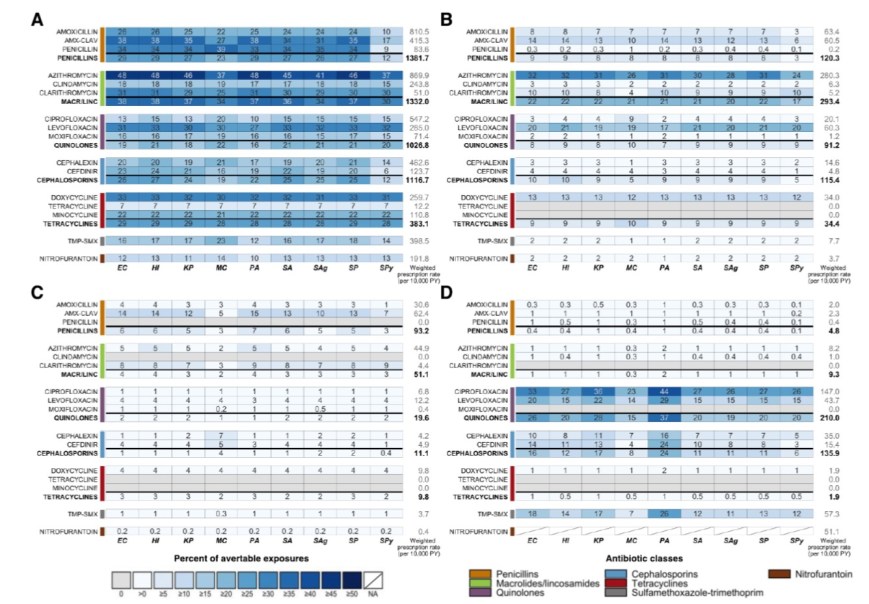
Heatmaps showing the estimated percentage of species exposures to each antibiotic or antibiotic class that could be averted if A: unnecessary antibiotic prescriptions across all outpatient conditions, B: all antibiotic use for outpatient respiratory conditions for which antibiotics are not indicated, C: all antibiotic use for acute sinusitis, or D: non-nitrofurantoin treatment of cystitis in women was eliminated. Drug class results include prescriptions of all antibiotics in that class, as identified by the Lexicon Plus classification system.
Abbreviations: Antibiotics (y-axis): AMX-CLAV=amoxicillin-clavulanate,, MACR/LINC=macrolides/lincosamides, TMP-SMX=sulfamethoxazole-trimethoprim;

Organisms (x-axis): EC=E. coli, HI=H. influenzae, KP=K. pneumoniae, MC=M. catarrhalis, PA=P. aeruginosa, SA=S. aureus, SAg=S. agalactiae, SP=S. pneumoniae, SPy=S. pyogenes; PY=person-years


The darker shades in panel A (scenario 1) clearly indicated that “elimination of unnecessary antibiotic prescriptions across all outpatient conditions would prevent 6 to 48% (IQR: 17 to 31%) of antibiotic-species exposures. If all unnecessary antibiotic use could be prevented, over 30% of exposures to amoxicillin-clavulanate, penicillin, azithromycin, clarithromycin, levofloxacin, and doxycycline across most potential pathogens of interest could be averted.

In panel D (scenario 4), they found that prescribing nitrofurantoin not only averted antibiotic exposure in non-causative bacterial species (bystanders) but also in causative species for cystitis in women.
Overall, 27% of ciprofloxacin use is associated with acute cystitis in women. Organisms that are not causative pathogens of cystitis have proportions of avertable exposures close to or less than 27%, but a substantially higher proportion of exposures could be averted among causative pathogens – 33%, 36%, and 44% of ciprofloxacin exposures to E. coli, K. pneumoniae, and P. aeruginosa, respectively.

The study addresses the limitations with regard to data availability and reporting in public database. Authors are cautious and point out,

It is important to note that the reduction in antibiotic exposures estimated here does not translate to the same reduction in the prevalence of resistance or in the morbidity and mortality attributable to resistance. Additionally, in this analysis, we give each exposure equal weight. However, the selective pressure imposed by a single exposure depends on a number of variables, including pharmacokinetics, pharmacodynamics, distribution of bacteria across body sites, and bacterial population size. For example, we might expect that the probability of resistance scales with population size, and thus that an exposure received by an individual with higher bacterial load will have a larger impact on resistance.

Overall, this study indeed provides evidence that “improved prescription of antibiotics has the potential to prevent antibiotic exposure experienced by bacterial species throughout microbiome.

February 2, 2020

Have a nice Sunday! Today, in this Digest we have several papers about the relationship between the microbiome and different neurological/psychological conditions, such as ASD, depression or anxiety, or about the microbiome and the inflammatory bowel disease. Enjoy!


Human and General Microbiome

Review: Host-microbiota interactions in inflammatory bowel disease – Roberta Caruso – Nature Reviews Immunology 

Review: Considering gut microbiota in treatment of type 2 diabetes mellitus – Aneseh Adeshirlarijaney – Gut Microbes

Review: Gut Dysbiosis Dysregulates Central and Systemic Homeostasis via Suboptimal Mitochondrial Function: Assessment, Treatment and Classification Implications – George Anderson – Current Topics in Medicinal Chemistry

Book Chapter: Immune-Kynurenine Pathways and the Gut Microbiota-Brain Axis in Anxiety Disorders – Alper Evrensel – Anxiety Disorders 

Book Chapter: Autism and Gut-Brain Axis: Role of Probiotics – Saravana Babu Chidambaram – Personalized Food Intervention and Therapy for Autism Spectrum Disorder Management

Review: Microbial-Based and Microbial-Targeted Therapies for Inflammatory Bowel Diseases – Akihiko Oka – Digestive Diseases and Sciences

Precision Microbiome Modulation with Discrete Dietary Fiber Structures Directs Short-Chain Fatty Acid Production – Edward C. Deehan – Cell Host and Microbe

Urinary microbiome in uncomplicated and interstitial cystitis: is there any similarity? – Süleyman Yıldırım – World Journal of Urology

The gut microbiota response to helminth infection depends on host sex and genotype – Fei Ling – The ISME Journal 

Metabolism of multiple glycosaminoglycans by Bacteroides thetaiotaomicron is orchestrated by a versatile core genetic locus – Didier Ndeh – Nature Communications

Gestational diabetes and the human salivary microbiota: a longitudinal study during pregnancy and postpartum – Mie K. W. Crusell – BMC Pregnancy and Childbirth 

Vaginal dysbiosis associated-bacteria Megasphaera elsdenii and Prevotella timonensis induce immune activation via dendritic cells – Nienke H.van Teijlingen – Journal of Reproductive Immunology

Variability in Skin Microbiota between Smokers, Former Smokers, and Non-Smokers – Katherine G. Thompson – Journal of the American Academy of Dermatology

Microbiota changes and Intestinal Microbiota Transplantation in Liver Diseases and Cirrhosis – Jasmohan S. Bajaj – Journal of Hepatology

Host-Specific Evolutionary and Transmission Dynamics Shape the Functional Diversification of Staphylococcus epidermidis in Human Skin – Wei Zhou – Cell


Animal Microbiome and Animal Experiments

Effect of probiotic administration on gut microbiota and depressive behaviors in mice – Quan Feng Liu – DARU Journal of Pharmaceutical Sciences

Deciphering the bifidobacterial population within the canine and feline gut microbiota – Giulia Alessandri – Applied and Environmental Microbiology

Dissecting the factors shaping fish skin microbiomes in a heterogeneous inland water system – Yaron Krotman – Microbiome

Prenatal exposure to glufosinate ammonium disturbs gut microbiome and induces behavioral abnormalities in mice – Tianyu Dong – Journal of Hazardous Materials

High prevalence of Phasi Charoen-like virus from wild-caught Aedes aegypti in Grenada, W.I. as revealed by metagenomic analysis – Maria E. Ramos-Nino – PLoS ONE

Common structuring principles of the Drosophila melanogaster microbiome on a continental scale and between host and substrate – Yun Wang – Environmental Microbiology Reports

Community assembly of the native C. elegans microbiome is influenced by time, substrate, and individual bacterial taxa – Julia Johnke – Environmental Microbiology 


Environmental Microbiome

Patterns of local, intercontinental and inter-seasonal variation of soil bacterial and eukaryotic microbial communities – Johan De Gruyter – FEMS Microbiology Ecology

Dynamics and ecological distributions of the Archaea microbiome from inland saline lakes (Monegros Desert, Spain) – Mateu Menéndez-Serra – FEMS Microbiology Ecology


January 10, 2020

In today’s weekend post- maternal antibodies targeting microbiota protect mice from neonatal infection, exercise improves gestational diabetes in rodent models, bacterial signature in NAFLD and TMAO as negative predictor of human embryo quality. Happy reading and a nice weekend!

General microbiome

Adolescence and aging: impact of adolescence inflammatory stress and microbiota alterations on brain development, aging and neurodegeneration – Nour Yahfoufi – The Journal of Geronotology

Preclinical and clinical relevance of probiotics and synbiotics in colorectal carcinogenesis: a systematic review – Bruna C.S. Cruz – Nutrition Reviews

Gut microbiota: a new piece in understanding hepatocarcinogenesis – An Zhou – Cancer Letters

Gut Microbiota, Diet, and Chronic Diseases: The Role Played by Oxidative Stress – Elisardo C. Vasquez – Oxidative Medicine and Cellular Longevity

New insights on the colonization of the human gut by health-promoting bacteria – Sinead T. Morrin – Applied Microbiology and Biotechnology

Human microbiome

Salivary microbiota and inflammation‐related proteins in patients with psoriasis – Daniel Belstrøm – Oral Diseases

Oral butyrate does not affect innate immunity and islet autoimmunity in individuals with longstanding type 1 diabetes: a randomised controlled trial – Pieter F. de Groot – Diabetologia

Fusobacterium nucleatum in the colorectum, and its association with cancer risk and survival: a systematic review and meta-analysis – Christian Gethings-Behncke – Cancer Epidemiology Biomarkers and Prevention

Potential impact of removing metronidazole from treatment armamentarium of mild acute Clostridioides difficile infection – Shani Zilberman-Itskovich – Future Medicine

Intrahepatic bacterial metataxonomic signature in non-alcoholic fatty liver disease Silvia Sookoian – Gut

Microbial imbalance in inflammatory bowel disease patients at different taxonomic levels – Mohammad Tauqeer Alam – Gut Pathogens

Early life microbiota

Antibiotic Resistance Genes in the Gut Microbiota of Children with Autistic Spectrum Disorder as Possible Predictors of the Disease – Alexey S. Kovtun – Microbial Drug Resistance

Trimethylamine-N-oxide is present in human follicular fluid and is a negative predictor of embryo quality – R.A.Nagy – Human Reproduction

Animal experiments

Microbiota-targeted maternal antibodies protect neonates from enteric infection – Wen Zheng – Nature

Characterization of metabolic and inflammatory profiles of transition dairy cows fed an energy-restricted diet – Giulia Esposito – Journal of Animal Science

Microbiota dependent production of butyrate is required for the bone anabolic activity of PTH – Jau-Yi Li – Journal of Clinical Investigation

Betaine addition as a potent ruminal fermentation modulator under hyperthermal and hyperosmotic conditions in vitro – Mubarik Mahmood – Journal of the Science of Food and Agriculture

Investigating temporal microbial dynamics in the rumen of beef calves raised on two farms during early life – Eóin O’Hara – FEMS Microbial Ecology

Dietary Xanthan Gum Alters Antibiotic Efficacy against the Murine Gut Microbiota and Attenuates Clostridioides difficile Colonization – Matthew K. Schnizlein – mSphere

Post‐natal co‐development of the microbiota and gut barrier function follows different paths in the small and large intestine in piglets – Alexis Pierre Arnaud – Faseb Journal

Phellinus linteus polysaccharide extract improves insulin resistance by regulating gut microbiota composition – Yangyang Liu – Faseb Journal

Exercise improves metabolic function and alters the microbiome in rats with gestational diabetes – Dayana Mahizir – Faseb Journal

Microbial reconstitution reverses early female puberty induced by maternal high-fat diet during lactation – Mengjie Wang – Endocrinology

Fecal microbiota as a noninvasive biomarker to predict the tissue iron accumulation in intestine epithelial cells and liver – Bingdong Liu – Faseb Journal

Techniques

Systematic Analysis of Impact of Sampling Regions and Storage Methods on Fecal Gut Microbiome and Metabolome Profiles – Yali Liang – mSphere

January 8, 2020

Today’s digest features a retrospective mini-review of mothur, study on gut microbiomes of over 900 vertebrate species [Spoiler alert: birds and bats share similarities in their microbiome], findings of fifteen-thousand-year-old viruses in glacier ice, and more. Happy reading!

Gut microbiome

Recording mobile DNA in the gut microbiota using an Escherichia coli CRISPR-Cas spacer acquisition platform – Christian Munck – Nature Communications

Microbial imbalance in inflammatory bowel disease patients at different taxonomic levels – Mohammad Tauqeer Alam – Gut Pathogens

Gut dysbiosis induces the development of pre-eclampsia through bacterial translocation– Xia Chen – Gut

Analysis of gut microbiota of obese individuals with type 2 diabetes and healthy individuals – Aftab Ahmad – PlosOne

Alterations of human lung and gut microbiome in non-small cell lung carcinomas and distant metastasis – Hui Lu – bioRxiv

The interplay between host genetics and the gut microbiome reveals common and distinct microbiome features for human complex diseases – Fengzhe Xu – bioRxiv

Oral microbiome

Acquisition of Oral Microbiota is Driven by Environment, Not Host Genetics – Chiranjit Mukherjee – bioRxiv

Animal microbiome

*Comparative Analyses of Vertebrate Gut Microbiomes Reveal Convergence between Birds and Bats– Se Jin Song – mBio

Comparative Genomics of Rumen Butyrivibrio spp. Uncovers a Continuum of Polysaccharide-Degrading Capabilities – Nikola Palevich – Applied and Environmental Microbiology

Inside out: microbiota dynamics during host-plant adaptation of whiteflies – Diego Santos-Garcia – The ISME Journal

Blood Loss Leads to Increase in Relative Abundance of Opportunistic Pathogens in the Gut Microbiome of Rabbits – Junjie Yang – Current Microbiology

Probiotics

In Vitro Probiotic Potential of Hemophilin-producing Strains of Haemophilus haemolyticus – Brianna Atto – bioRxiv

Quantifying and engineering mucus adhesion of probiotics – Zachary J. S. Mays – bioRxiv

Plant/root/soil microbiome

Temporal and spatial changes in phyllosphere microbiome of acacia trees growing in super arid environments – Ashraf Al-Ashhab – bioRxiv

Secreted metabolite-mediated interactions between rhizosphere bacteria and Trichoderma biocontrol agents – Ningxiao Li – PlosOne

Water microbiome

Quantification of nosZ genes and transcripts in activated sludge microbiomes with novel group-specific qPCR methods validated with metagenomic analyses – Daehyun Daniel Kim – bioRxiv

Viruses

*Glacier ice archives fifteen-thousand-year-old viruses – Zhi-Ping Zhong – bioRxiv

Meeting report: Viruses in the Built Environment (VIBE) meeting report – Aaron J. Prussin – Microbiome

Bioinformatics

*Minireview: Reintroducing mothur: 10 Years Later – Patrick D. Schloss – Applied and Environmental Microbiology

FunGeCo : A web based tool for estimation of Functional potential of bacterial genomes and microbiomes using Gene Context information – Swadha Anand – Bioinformatics

December 27, 2019

Today’s Digest brings you a report linking gut microbiota and metabolites, a study on dishwasher rubber as a bacterial reservoir, a news piece for your guide to probiotics, and many more. If we don’t see you again in 2019, Happy New Year! May 2020 bring much success and happiness!

General microbiology

Preprint: The Microbe Directory v2.0: An Expanded Database of Ecological and Phenotypical Features of Microbes – Maria A. Sierra et al. – bioRxiv

A novel graph theoretical approach for modeling microbiomes and inferring microbial ecological relationships – Suyeon Kim et al. – BMC Genomics

Antimicrobial resistance

Preprint: Longitudinal linked read sequencing reveals ecological and evolutionary responses of a human gut microbiome during antibiotic treatment – Morteza Roodgar et al. – bioRxiv

Human oral microbiome

Re-initiation of Oral Food Intake Following Enteral Nutrition Alters Oral and Gut Microbiota Communities – Sayaka Katagiri et al. – Frontiers in Cellular and Infection Microbiology

Human respiratory microbiome

Microbiome in Chronic Obstructive Pulmonary Disease: Role of Natural Products Against Microbial Pathogens – Alessia Santoro et al. – Current Medicinal Chemistry

Human gut microbiome

Comparison of Japanese and Indian intestinal microbiota shows diet-dependent interaction between bacteria and fungi – Siddhika Pareek et al. – npj Biofilms and Microbiomes

Review: The influence of dietary patterns on gut microbiome and its consequences for nonalcoholic fatty liver disease – Qing-Song Zhang et al. – Trends in Food Science and Technology

** Relationship between gut microbiota and circulating metabolites in population-based cohorts – Dina Vojinovic et al. – Nature Communications

Human gut microbiota is associated with HIV-reactive immunoglobulin at baseline and following HIV vaccination – Jacob A. Cram et al. – PLoS One

Preprint: The interplay between host genetics and the gut microbiome reveals common and distinct microbiome features for human complex diseases – Fengzhe Xu & Yuanqing Fu et al. – bioRxiv

Effect of Helicobacter pylori on gastrointestinal microbiota: a population-based study in Linqu, a high-risk area of gastric cancer – Yang Guo et al. – Gut

Human gut-microbiome-brain axis

The relationship between the gut microbiome and mild cognitive impairment in patients without dementia: a cross-sectional study conducted in Japan – Naoki Saji et al. – Scientific Reports

Synergistic effects of APOE and sex on the gut microbiome of young EFAD transgenic mice – Juan Maldonado Weng et al. – Molecular Neurodegeneration

Metabolomics

Tech Note: Boost that metabolomic confidence – Vivien Marx – Nature Methods

The total microbiome functions in bacteria and fungi – Robert Starke et al. – Journal of Proteomics

Animal experiments

Allergic inflammation alters the lung microbiome and hinders synergistic co-infection with H1N1 influenza virus and Streptococcus pneumoniae in C57BL/6 mice – Kim S. LeMessurier et al. – Scientific Reports

Jatrorrhizine Balances the Gut Microbiota and Reverses Learning and Memory Deficits in APP/PS1 transgenic mice – Sheng Wang et al. – Scientific Reports

The impact of gut microbiota manipulation with antibiotics on colon tumorigenesis in a murine model – Jae Gon Lee et al. – PLoS One

Maternal milk and fecal microbes guide the spatiotemporal development of mucosa-associated microbiota and barrier function in the porcine neonatal gut – Hongbin Liu et al. – BMC Biology

Built environment microbiome

** The dishwasher rubber seal acts as a reservoir of bacteria in the home environment – Jerneja Zupančič et al. – BMC Microbiology

Plant, root and soil microbiome

Development of microbial communities in organochlorine pesticide contaminated soil: A post-reclamation perspective – Helga E.Balázs et al. – Applied Soil Ecology

Towards simple tools to assess functional effects of contaminants on natural microbial and invertebrate sediment communities – Stéphane Pesce et al. – Environmental Science and Pollution Research

Core rhizosphere microbiomes of dryland wheat are influenced by location and land-use history – Daniel C Schlatter et al. – Applied and Environmental Microbiology

Water and extremophile microbiome

Single molecule sequencing reveals response of manganese-oxidizing microbiome to different biofilter media in drinking water systems – Xin Zhao et al. – Water Research

Prokaryotic Population Dynamics and Viral Predation in a Marine Succession Experiment Using Metagenomics – Jose M. Haro-Moreno et al. – Frontiers in Microbiology

Phages and viruses

News & Views: Phages build anti-defence barriers – Eugene V. Koonin & Mart Krupovic – Nature Microbiology

Microbes in the news

The Best Thing That Happened This Week: Dogs Rule Because They Drool – Sandy Hingston – Philadelphia Magazine

** A guide to the best probiotics – Louisa Richards/Katherine Marengo – Medical News Today

Having a Dog as a Child Is Tied to a Lower Risk of Schizophrenia as an Adult – Nicholas Bakalar – New York Times

Expanding virophage diversity – DOE/Joint Genome Institute

Microbes on the market

Carbiotix to partner with Italian university on neuroinflammation project – Nathan Gray – Nutraingredients

Human Microbiome Market is Expected to Touch US$ 1888.9 Mn by 2026 – Sheila Shipman – News Cast Report

The next frontier – Aaron Massecar – Today’s Veterinary Business

December 23, 2019

In today’s digest read about the subway microbiome (from surface and air samples collected at 16 subway stations in Oslo, Norway), role of Staphylococcus epidermidis in healthy maturation of the nasal microbiome, effect of storage and time on urinary microbiome, and more. Happy Holidays!

General microbiome

The emergence of microbiome centres – Jennifer B. H. Martiny – Nature Microbiology

Subway microbiome

*The subway microbiome: seasonal dynamics and direct comparison of air and surface bacterial communities– Jostein Gohli – Microbiome

Gut microbiome

Engineered E. coli Nissle 1917 for the delivery of matrix-tethered therapeutic domains to the gut– Pichet Praveschotinunt – Nature Communications

Urinary microbiome

*The urinary microbiota composition remains stable over time and under various storage conditions – Caspar Bundgaard-Nielsen – bioRxiv

Vaginal microbiome

Review: Genetic Heterogeneity and Taxonomic Diversity among Gardnerella Species – Joana Castro – Trends in Microbiology

Nasal microbiome

*Staphylococcus epidermidis Contributes to Healthy Maturation of the Nasal Microbiome by Stimulating Antimicrobial Peptide Production – Qian Liu – Cell Host & Microbes

Animal microbiome

Characterization of the Pig Gut Microbiome and Antibiotic Resistome in Industrialized Feedlots in China – Chunlai Wang – mSystems

Animal experiments

Altered microbiota composition reflects enhanced communication in 15q11-13 CNV mice– Dian Eurike Septyaningtrias – Neuroscience Research

Plant/root/soil microbiome

Time after Time: Temporal Variation in the Effects of Grass and Forb Species on Soil Bacterial and Fungal Communities – S. Emilia Hannula – mBio

Habitat filtering shapes the differential structure of microbial communities in the Xilingol grassland– Jie Yang – Scientific Reports

Water microbiome

Metagenomic Insights into the Effects of Seasonal Temperature Variation on the Activities of Activated Sludge– Chenbing Ai – Microorganisms

Viruses

Plant virome reconstruction and antiviral RNAi characterization by deep sequencing of small RNAs from dried leaves – Victor Golyaev – Scientific Reports

Bioinformatics

Identifying the causes and consequences of assembly gaps using a multiplatform genome assembly of a bird-of-paradise – Valentina Peona – bioRxiv

Transcriptome assembly from long-read RNA-seq alignments with StringTie2– Sam Kovaka – Genome Biology

Deconvoluting the diversity of within-host pathogen strains in a multi-locus sequence typing framework – Guo Liang Gan – BMC Bioinformatics

The Generalized Matrix Decomposition Biplot and Its Application to Microbiome Data – Yue Wang – mSystems

December 20, 2019

This may be our last edition of the Microbiome Digest before the holidays kick in. A rich and dynamic Digest brings you all things microbiome (apologies for the tight formatting). An encouraging report on how we can reduce antimicrobial resistance organically, an amazing recovery of a human genome and an oral microbiome from chewed birch pitch thousands of years ago, and a network analysis reveals four levels of hierarchical trophic interactions in the human gut microbiome. Enjoy Reading and Happy Holidays!
Events
BMC Medicine’s upcoming collection, New Frontiers in Diagnosis, Treatment and Management of Neuromuscular Disorders, is soliciting submissions.
Current Issue of The ISME Journal
The 9th Gut Microbiota for Health World Summit – March 7 and 8 2020 in Madrid, Spain
General microbiology
High-order interactions distort the functional landscape of microbial consortia – Sanchez-Gorostiaga & Bajić et al. – PLoS Biology
Antimicrobial resistance
Human skin microbiome
Human oral microbiome
** A 5700 year-old human genome and oral microbiome from chewed birch pitch – Theis Z. T. Jensen et al. – Nature Communications
Press: Ancient “Chewing Gum” Reveals a 5,700-Year-Old Microbiome – Jim Daley – Scientific American
Human respiratory microbiome
Press: Child asthma flare-ups coincide with microbiome changes – JULIA EVANGELOU STRAIT-WUSTL – Futurity
Human gut microbiome
Human vaginal microbiome
Human gut-microbiota-brain axis
Review: Tryptophan Metabolism: A Link Between the Gut Microbiota and Brain – Kan Gao et al. – Advances in Nutrition
Cancer microbiome
Metabolomics
The total microbiome functions in bacteria and fungi – Robert Starke et al. – Journal of Proteomics
Animal experiments
Animal microbiome
Plant, root and soil microbiome
Root microbiomes as indicators of seagrass health – Belinda C Martin et al. – FEMS Microbiology Ecology
Water and extremophile microbiome
Phages and viruses
Technology
Manipulating rod-shaped bacteria with optical tweezers – Zheng Zhang et al. – Scientific Reports
Bioinformatics
** Evidence for a multi-level trophic organization of the human gut microbiome – Tong Wang et al. – PLoS Computational Biology
Microbes in the news
The microbiome is fundamental to both health and disease – Fabian Brockotter – Poultry World
Low FODMAP Diet Helps IDB Patients – Kenny Walter – MDMAG
Oral Health: Caring for the Other Microbiome – Julia Peterman – Whole Foods Magazine
Non-microbiology pick


December 6, 2019

Today’s post is about metabolic networks of the human gut microbiota with host, how aging affects microbial world in humans, microbiome in honey bee and lifestyle dependent gut microbiota gradients in diverse Indian population. Have a nice weekend!

General microbiome

Review: Metabolic networks of the human gut microbiota – Susannah Selber-Hnatiw – Microbiology

Review: Cannabinoids and the Microbiota‐Gut‐Brain‐Axis: Emerging Effects of Cannabidiol and Potential Applications to Alcohol Use Disorders – Hollis C. Karoly – Alcoholism Clinical and Experimental Research

Review: The Unexplored World of Human Virome, Mycobiome, and Archaeome in Aging – Oscar Salvador Barrera-Vázquez – Journal of Gerontology

Review: Nanotechnology intervention of the microbiome for cancer therapy – Wantong Song – Nature Nanotechnology

Commentary: Gut microbiome influences exercise response – Claire Greenhill – Nature Reviews Endocrinology

Human microbiome

Bacterial DNA induces the formation of heat-resistant disease-associated proteins in human plasma – Victor Tetz – Scientific Reports

Lifestyle induced microbial gradients: An Indian perspective – Rashmi Singh – Frontiers in Microbiology

Microbiota, type 2 diabetes and non-alcoholic fatty liver disease: protocol of an observational study – Benedetta M. Motta – Journal of Translational Medicine

Antibiotic exposure and the risk of colorectal adenoma and carcinoma: systematic review and meta‐analysis of observational studies – Leigh N. Sanyaolu – Colorectal Disease

Higher frequency of vertebrate‐infecting viruses in the gut of infants born to mothers with type 1 diabetes – Ki Wook Kim – Pediatric Diabetes

Animal experiments

Integrative analysis of the gut microbiota and metabolome in rats treated with rice straw biochar by 16S rRNA gene sequencing and LC/MS-based metabolomics – Jie Han – Scientific Reports

Division of labor in honey bee gut microbiota for plant polysaccharide digestion – Hao Zheng – PNAS

The effect of carbohydrate sources: Sucrose, invert sugar and components of mānuka honey, on core bacteria in the digestive tract of adult honey bees (Apis mellifera) – Michelle A. Taylor – PlosOne

Seven-day Green Tea Supplementation Revamps Gut Microbiome and Caecum/Skin Metabolome in Mice from Stress – Eun Sung Jung – Scientific Reports

Cattle intestinal microbiota shifts following Escherichia coli O157:H7 vaccination and colonization travel – Raies A. Mir – PlosOne

Characterization of the cecal microbiome composition of Wenchang chickens before and after fattening – Zhen Tan – PlosOne

SOD1 deficiency alters gastrointestinal microbiota and metabolites in mice – Haruka Sagi – Experimental Gerontology

Plant, soil, root microbiome

Host-mediated microbiome engineering (HMME) of drought tolerance in the wheat rhizosphere – Michael D. Jochum – PlosOne

Arctic tundra soil bacterial communities active at subzero temperatures detected by stable isotope probing – Preshita S. Gadkari – FEMS Microbiology Ecology

Techniques

Comparison of extraction methods for recovering ancient microbial DNA from paleofeces – Richard W. Hagan – American Journal of Physical Anthropology

Microbes in the news

How Microbiomes Affect Fear – Quanta Magazine

Rainforest Dwellers and Urbanites Have Consistently Different Microbiomes – Scientific American

Human Microbiome Modulators Market is Furbishing worldwide with Bayer, BioGaia, Chr. Hansen Holding, DowDuPont – News Description

November 23, 2019

In today’s digest read about the Darobactin (a new antibiotic that selectively kills Gram-negative pathogens by binding to the BamA protein, located in the external membrane of Gram-negative bacteria), temporal stability of the rumen microbiota, and Gardnerella species (Gardnerella leopoldii, G. swidsinskii, G. piotii, and G. vaginalis) in the vaginal microbiome. And, check out 2019 Holiday Gift Guide For Microbe Lovers. Happy weekend!

General microbiome

*A new antibiotic selectively kills Gram-negative pathogens – Yu Imai – Nature

Read the story behind the paper by Roberto Molar Candanosa, Northeastern University.

Gut microbiome

Review: The human gut bacteria Christensenellaceae are widespread, heritable, and associated with health – Jillian L. Waters & Ruth E. Ley – BMC Biology

The gut microbiota influences how circulating immune cells in humans change from one day to the next – Jonas Schluter – bioRxiv

Vaginal microbiome

*Resolution and Cooccurrence Patterns of Gardnerella leopoldii, G. swidsinskii, G. piotii, and G. vaginalis within the Vaginal Microbiome – Janet E. Hill – Infection and Immunity

Clinical validation of the Aptima Bacterial Vaginosis and Aptima Candida/Trichomonas Vaginitis Assays: results from a prospective multi-center clinical study – Jane R. Schwebke – Journal of Clinical Microbiology

Review: Understanding and interpreting community sequencing measurements of the vaginal microbiome – HL Berman – BJOG : an International Journal of Obstetrics and Gynaecology

Endocervical microbiome

Diversity of endocervical microbiota associated with genital Chlamydia trachomatis infection and infertility among women visiting obstetrics and gynecology clinics in Malaysia – Heng Choon Cheong – PlosOne

Uterine microbiome

Does dysbiotic endometrium affect blastocyst implantation in IVF patients? – Tomoko Hashimoto & Koichi Kyono – Journal of Assisted Reproduction and Genetics

Oral microbiome

Oral microbial community composition is associated with pancreatic cancer: A case‐control study in Iran – Emily Vogtmann – Cancer Medicine

Animal microbiome

*Temporal stability of the rumen microbiota in beef cattle, and response to diet and supplements – Timothy J. Snelling – Animal Microbiome

Development of the duodenal, ileal, jejunal and caecal microbiota in chickens – Laura Glendinning – Animal Microbiome

Mammary microbiome of lactating organic dairy cows varies by time, tissue site, and infection status – Tucker Andrews – PlosOne

Inulin improves the egg production performance and affects the cecum microbiota of laying hens – Hongmei Shang – International Journal of Biological Macromolecules

Animal experiments

Effects of Debaryomyces hansenii treatment on intestinal mucosa microecology in mice with antibiotic-associated diarrhea – Ao Zeng – PlosOne

Microbe-metabolite associations linked to the rebounding murine gut microbiome post-colonization with vancomycin resistant Enterococcus faecium – Andre Mu – bioRxiv

Hepatitis B Virus Infection Alters Gut Microbiota Composition in Mice – Qingfeng Zhu – Front. Cell. Infect. Microbiol.

Human Gut Microbiome Transplantation in Ileitis Prone Mice: A Tool for the Functional Characterization of the Microbiota in Inflammatory Bowel Disease Patients – Abigail R Basson – Inflammatory Bowel Diseases

Effects of an Escherichia coli exopolysaccharide on human and mouse gut microbiota in vitro – Baiyuan Li – International Journal of Biological Macromolecules

Ion Transport Basis of Diarrhea in a Mouse Model of Adoptive T Cell Transfer Colitis – Dulari Jayawarden – Digestive Diseases and Sciences

Water microbiome

Rewetting of three drained peatlands drives congruent compositional changes in pro- and eukaryotic microbiomes through environmental filtering – Micha Weil – bioRxiv

Phages and viruses

Herpes Simplex Virus Infection, Acyclovir and IVIG Treatment All Independently Cause Gut Dysbiosis – Chandran Ramakrishna – bioRxiv

Svetlana’s pick

Gift guide for this holiday season!
by Justine Dees