
February 28, 2020

Good morning/afternoon y’all! today’s digest features some interesting-to-read genral biotech and ecology papers, as weel as the first gene catalouge of the vaginal microbiome, American pets microbiome revealed, cool microbiome engineering for biocontrol purpose in agriculture, a bunch of salt- and sweet-water microbiome studies and more!

Have a great weekend! put the guilt aside and enjoy some time with your spouse, family, pets, hobbies and anything else that you enjoy!

General Science

is is a very cool paper, beuatifuly presenting the connection and applicatino of two very ‘hot’ topics in today biotechnology world- AI and drug discovery:A Deep Learning Approach to Antibiotic Discovery- A Deep Learning Approach to Antibiotic Discovery, Jonathan M. Stokes, Cell

** Novel Outlook in Microbial Ecology: Nonmutualistic Interspecies Electron Transfer, Roman Moscoviz, Trends in Microbiology

A solution to minimum sample size for regressions, David J. Jenkins , PLOS One

The relationship between the host genome, microbiome, and host phenotype, Harald Brussow, Env. Micro.

Human microbiome

** A comprehensive non-redundant gene catalog reveals extensive within-community intraspecies diversity in the human vagina, Bing Ma, Nature Communications

Gut microbiota plasticity is correlated with sustained weight loss on a low-carb or low-fat dietary intervention, Jessica A. Grembi, Sci. Rep.

Analysis of healthy reference ranges for clinically relevant gut microbial indicators: A large web-based cohort study in Japan, Satoshi Watanabe , bioRxiv

Short chain fatty acids produced by colonizing intestinal commensal bacterial interaction with expressed breast milk are anti-inflammatory in human immature enterocytes, Nan Zheng, PLOS One

Animal microbiome

Characterization of gut microbiomes of household pets in the United States using a direct-to-consumer approach, Aashish R. Jha, PLOS One

Repeated sleep disruption in mice leads to persistent shifts in the fecal microbiome and metabolome, Samuel J. Bowers, PLOS One

Insect microbiome

**Engineering bacterial symbionts of nematodes improves biocontrol potential of the western corn rootworm, Ricardo A. R. Machado, Nature Biotechnology

Plant and soil microbiome

Genome wide association study reveals plant loci controlling heritability of the rhizosphere microbiome, Siwen Deng , bioRxiv

Differentiation strategies of soil rare and abundant microbial taxa in response to changing climatic regimes, Yuting Liang , Env. Micro.

Network analysis infers the wilt pathogen invasion associated with non-detrimental bacteria, Qiolong Hu , npj biofims and microbiomes

Marine microbiome

Exploring the resistome, virulome and microbiome of drinking water in environmental and clinical settings, Marcela Franca Dias, Water Research

Niche partitioning of methane-oxidizing bacteria along the oxygen–methane counter gradient of stratified lakes, Magdalena J. Mayr, ISME

A metagenomic assessment of microbial eukaryotic diversity in the global ocean, Aleix Obiol, Mol. Eco. Res.

Ocean acidification affects microbial community and invertebrate settlement on biofilms, Katie S. Nelson, Sci. Rep.

Understanding and creating biocementing beachrocks via biostimulation of indigenous microbial communities, Asha A. Ramachandran , Env. Biotech.
February 21, 2020

This Friday, read about the potential influence of microbiomes in hominin evolution, gut microbiome in patients with Sjögren’s syndrome, new antibiotics discovered through comparative genomics, and more. Happy reading!

General microbiome

*The Internal, External and Extended Microbiomes of Hominins – Robert R. Dunn – Front. Ecol. Evol.

A Deep Learning Approach to Antibiotic Discovery– Jonathan M. Stokes – Cell

Review: Next-generation physiology approaches to study microbiome function at single cell level – Roland Hatzenpichler – Nature Reviews Microbiology

Patterns of partnership: surveillance and mimicry in host-microbiota mutualisms – Travis J Wiles & Karen Guillemin – Current Opinion in Microbiology

Review: Innovative and rapid antimicrobial susceptibility testing systems – Alex van Belkum – Nature Reviews Microbiology

Gut microbiome

*Gut dysbiosis is prevailing in Sjögren’s syndrome and is related to dry eye severity– Jayoon Moon – PlosOne

Review: Healthy Human Gastrointestinal Microbiome: Composition and Function After a Decade of Exploration – Wenly Ruan – Digestive Diseases and Sciences

Review: Gut microbiota-derived metabolites as key actors in inflammatory bowel disease– Aonghus Lavelle & Harry Sokol – Nature Reviews Gastroenterology & Hepatology

Review: Microbiome in Colorectal Cancer: How to Get from Meta-omics to Mechanism?–Dominik Ternes – Trends in Microbiology

Urinary microbiome

Review: Urinary tract infections: microbial pathogenesis, host–pathogen interactions and new treatment strategies – Roger D. Klein & Scott J. Hultgren – Nature Reviews Microbiology

Vaginal microbiome

The microbiome and gynaecological cancer development, prevention and therapy – Paweł Łaniewski – Nature Reviews Urology

Animal microbiome

Coordinated transformation of the gut microbiome and lipidome of bowhead whales provides novel insights into digestion – Carolyn A. Miller – The ISME Journal

Animal experiment

*Evolution-guided discovery of antibiotics that inhibit peptidoglycan remodelling – Elizabeth J. Culp – Nature

The Gene Expression Profile of Uropathogenic Escherichia coli in Women with Uncomplicated Urinary Tract Infections Is Recapitulated in the Mouse Model – Arwen E. Frick-Cheng – bioRxiv

Sustained IFN-I stimulation impairs MAIT cell responses to bacteria by inducing IL-10 during chronic HIV-1 infection – X. Tang – Science Advance

Bioinformatics

Microbial resolution of whole genome shotgun and 16S amplicon metagenomic sequencing using publicly available NEON data– Kyle D. Brumfield – PlosOne

Viruses & Phages

Respiratory viruses in mechanically ventilated patients: a pilot study – Raquel Nazareth – BMC Pulmonary Medicine

February 18, 2020

Highlights for today’s Digest: a study takes us deep into bacterial community of the dermal compartment of the skin, skin microbiota predicts chronological age most accurately, and a review on network analyses using multi-omics data. Enjoy!

General microbiology

A biphasic growth model for cell pole elongation in mycobacteria – Mélanie T. M. Hannebelle et al. – Nature Communications

Press: Bacteria under the microscope: A new growth model for tuberculosis – Lionel Pousaz, Ecole Polytechnique Federale de Lausanne – Phys.org

Metabolic dependencies govern microbial syntrophies during methanogenesis in an anaerobic digestion ecosystem – Xinyu Zhu et al. – Microbiome

Antimicrobial resistance

Stepwise evolution and convergent recombination underlie the global dissemination of carbapenemase-producing Escherichia coli – afael Patiño-Navarrete et al. – Genome Medicine

Pregnancy and early life

The effect of legume supplementation on the gut microbiota in rural Malawian infants aged 6 to 12 months – M Isabel Ordiz et al. – The American Journal of Clinical Nutrition

Human skin microbiome

** Universal Dermal Microbiome in Human Skin – Lene Bay et al. – mBio

Human cancer microbiome

Opinion: The Cancer Microbiome: Distinguishing Direct and Indirect Effects Requires a Systemic View – Joao B. Xavier et al. – Trends in Cancer

Human gut microbiome

Interactions between the gut microbiome and host gene regulation in cystic fibrosis – Gargi Dayama et al. – Genome Medicine

Human multi-site microbiome

Review: Blood Microbiota and Circulating Microbial Metabolites in Diabetes and Cardiovascular Disease – Ganesan Velmurugan et al. – Trends in Endocrinology & Metabolism

** Human Skin, Oral, and Gut Microbiomes Predict Chronological Age – Shi Huang et al. – mSystems

Press: Human Skin, Oral Microbiomes Can Estimate People’s Ages to Within Few Years – GenomeWeb

Animal experiments

Self-reinoculation with fecal flora changes microbiota density and composition leading to an altered bile-acid profile in the mouse small intestine – Said R. Bogatyrev et al. – Microbiome

Mouse: It’s the fiber, not the fat: significant effects of dietary challenge on the gut microbiome – Kathleen E. Morrison et al. – Microbiome

Animal microbiome

Trait-Based Comparison of Coral and Sponge Microbiomes – Cara L. Fiore et al. – Scientific Reports

Plant, root and soil microbiome

Functional relationships between aboveground and belowground spinach (Spinacia oleracea L., cv. Racoon) microbiomes impacted by salinity and drought – A. Mark Ibekwe et al. – Science of the Total Environment

Water and extremophile microbiome

Constraints on microbial communities, decomposition and methane production in deep peat deposits – Laurel A. Kluber et al. – PLoS One

Machine learning-aided analyses of thousands of draft genomes reveal specific features of activated sludge processes – Lin Ye et al. – Microbiome

Phages and viruses

Pearls: Virus interactions with bacteria: Partners in the infectious dance – Ursula Neu & Bernardo A. Mainou – PLoS Pathogens

Coronavirus: hospitals must learn from past pandemics – Nahid Bhadelia – Nature

Review: Phage diversity, genomics and phylogeny – Moïra B. Dion et al. – Nature Reviews Microbiology

Technology

Uncovering a hidden diversity: optimized protocols for the extraction of dsDNA bacteriophages from soil – Pauline C. Göller et al. – Microbiome

Review: Combining omics technologies with CRISPR-based genome editing to study food microbes – Meichen Pan & Rodolphe Barrangou – Current Opinion in Biotechnology

Complete, closed bacterial genomes from microbiomes using nanopore sequencing – Eli L. Moss et al. – Nature Biotechnology

Press: Closing bacterial genomes from the human gut microbiome using long-read sequencing – Dylan Maghini – Nature Bioengineering Community

Bioinformatics

A pipeline for targeted metagenomics of environmental bacteria – Anissa Grieb et al. Microbiome

** Review: Network analyses in microbiome based on high-throughput multi-omics data – Zhaoqian Liu et al. – Briefings in Bioinformatics

Microbes in the news

Getting the Band (of Microbes) Back Together – Jessica Messier – Worcester Polytechnic Institute

Gut microbe imbalance may stunt CF babies’ growth – Leila Gray – University of Washington

The Big Idea: The Microbiome – Purdue University

Moscow’s Subway Microbiome Looks Similar to that of New York’s – GenEngNews

A guide to caring for the Indian gut – Cherylann Mollan – Hindustan Times
 

February 12, 2020

This Wednesday, read about the microbiome in “flammable ice”, gastric bypass surgery in a rat model, virulence genes of the coral reef phage, and more. Happy reading!

Gut microbiome

Changes in microbiome and metabolomic profiles of fecal samples stored with stabilizing solution at room temperature: a pilot study– Mi Young Lim — Scientific Reports

Fecal microbiota transplantation to maintain remission in Crohn’s disease: a pilot randomized controlled study – Harry Soko – Microbiome

Identification of Clostridioides difficile-Inhibiting Gut Commensals Using Culturomics, Phenotyping, and Combinatorial Community Assembly – Sudeep Ghimire – mySystems

Neonatal microbiota development and the effect of early life antibiotics are determined by two distinct settler types – Anat Eck – plosOne

Oral Microbiome

Patterns of Oral Microbiota Diversity in Adults and Children: A Crowdsourced Population Study – Zachary M. Burcham – Scientific Reports

Sub-species niche specialization in the oral microbiome is associated with nasopharyngeal carcinoma risk – Justine W. Debelius – bioRxiv

Animal experiments

*Gastric bypass surgery in a rat model alters the community structure and functional composition of the intestinal microbiota independently of weight loss – Sven-Bastiaan Haange – Microbiome

Growth phase-dependent responses of an in vitro gut microbiome to metformin – Zikai Hao – bioRxiv

Ursolic acid improves the bacterial community mapping of the intestinal tract in liver fibrosis mice – Sizhe Wan – bioRxiv

Animal microbiome

Beef cattle that respond differently to fescue toxicosis have distinct gastrointestinal tract microbiota – Lucas R Koester – bioRxiv

Variation in gut bacterial composition is associated with Haemonchus contortus parasite infection of sheep – Md. Abdullah Al Mamun – Animal microbiome

Water microbiome

Microbial diversity, ecological networks and functional traits associated to materials used in drinking water distribution systems – Isabel Douterelo – Water Research

Diverse Arctic lake sediment microbiota shape methane emission temperature sensitivity – Joanne B. Emerson – bioRxiv

Coral microbiome composition along the northern Red Sea suggests high plasticity of bacterial and specificity of endosymbiotic dinoflagellate communities – Eslam O. Osman – Microbiome

Extremophile microbiome

*Evidence in the Japan Sea of microdolomite mineralization within gas hydrate microbiomes – Glen T. Snyder – Scientific Reports

Textile waste and microplastic induce activity and development of unique hydrocarbon-degrading marine bacterial communities – Elsa B. Girard – bioRxiv

Plant/root/soil microbiome

Maize (Zea mays L. Sp.) varieties significantly influence bacterial and fungal community in bulk soil, rhizosphere soil, and phyllosphere – Xiao Kong – FEMS Microbiology Ecology

A Small Effort for Researchers, a Big Gain for Soil Metaproteomics– Marco Chiapello – Frontiers in Microbiology

Viruses and phages

*Genomic and ecological attributes of marine bacteriophages encoding bacterial virulence genes – Cynthia B. Silveira – BMC Genomics

Profiling of Human Gut Virome with Oxford Nanopore Technology – Jiabao Cao – bioRxiv

Bioinformatics

MICHELINdb: a web-based tool for mining of helminth-microbiota interaction datasets, and a meta-analysis of current research – Riccardo Scotti – Microbiome

February 8, 2020

Have a nice Saturday, everyone! Today, in this Digest: several reviews, including some of them about the microbiome and Irritable Bowel Syndrome, Autism, Chemotherapy, C. difficile infection and more. Additionally, there is a very interesting study (Obata et al., Nature), showing new evidence about the relationship between the microbiota, the gut, and the nervous system. 


Human and General Microbiome

Neuronal programming by microbiota regulates intestinal physiology – Yuuki Obata – Nature

Fecal metatranscriptomics and glycomics suggest that bovine milk oligosaccharides are fully utilized by healthy adults – Samuel T. Westreich – The Journal of Nutritional Biochemistry

Review: Microbiome and Its Role in Irritable Bowel Syndrome – Mark Pimentel – Digestive Diseases and Sciences 

Review: Gut microbiota changes in children with autism spectrum disorder: a systematic review – Lucius Kang Hua Ho – Gut Pathogens

Review: Relationship Between the Gut Microbiome and Systemic Chemotherapy – Samantha M. Ervin – Digestive Diseases and Sciences 

Review: The infant gut microbiome as a microbial organ influencing host well-being – Francesca Turroni – Italian Journal of Pediatrics

Review: Increasing incidence of inflammatory bowel disease in children and adolescents: the significance of the environmental factors – Sowon Park – CEP

Review: Insights into the Role of Human Gut Microbiota in Clostridioides difficile Infection – Melina Kachrimanidou – Microorganisms (MDPI)

Review: Role of Dietary Nutrients in the Modulation of Gut Microbiota: A Narrative Review – Qi Yang – Nutrients

Opinion: Food, microbes, sex and old age: on the plasticity of gastrointestinal innervation – Tomotsune Ameku – Current Opinion in Neurobiology

The effects of proton pump inhibitors on the microbiome in young children – EI Levy – Acta Paedriatica

Targeted Approaches for In Situ Gut Microbiome Manipulation – Gail A. M. Cresci – JPEN

Dysbiosis of the Oral Ecosystem in Severe Congenital Neutropenia Patients – Egija Zaura – Proteomics Clinical Applications

Comparing Analytical Methods for the Gut Microbiome and Aging: Gut Microbial Communities and Body Weight in the Osteoporotic Fractures in Men (MrOS) Study – Michelle Shardell – The Journals of Gerontology: Series A

Oral and Gut Microbial Diversity and Immune Regulation in Patients with HIV on Antiretroviral Therapy – Medini K. Annavajhala – mSphere

Characteristics and Dysbiosis of the Gut Microbiome in Renal Transplant Recipients – J. Casper Swarte – Journal of Clinical Medicine

Comparison of serum microbiome composition in bipolar and major depressive disorders – Sang Jin Rhee – Journal of Psychiatric Research


Animal Microbiome / Animal Experiments

Review: Ruminal microbiome and microbial metabolome: effects of diet and ruminant host – C. J. Newbold – Animal

Review: Comparative methane production in mammalian herbivores – M. Clauss – Animal

Review: Regulation of gastrointestinal and renal transport of calcium and phosphorus in ruminants – M. R. Wilkens – Animal

Degeneration of the intestinal microbial community in PI3Kγ-knockout mice – Yi Li – Microbial Pathogenesis

Toxicity, gut microbiota and metabolome effects after copper exposure during early life in SD rats – Juan Dai – Toxicology

Evaluation of the effects of anthelmintic administration on the fecal microbiome of healthy dogs with and without subclinical Giardia spp. and Cryptosporidium canis infections – Madeline A. Fujishiro – PLoS ONE

Time of Feeding Alters Obesity-Associated Parameters and Gut Bacterial Communities, but Not Fungal Populations, in C57BL/6 Male Mice – Marie van der Merwe – CDN

Moderation effects of food intake on the relationship between urinary microbiota and urinary interleukin-8 in female type 2 diabetic patients – Fengping Liu – PeerJ


Beneficial Microbes and Compounds

Review: Surface components and metabolites of probiotics for regulation of intestinal epithelial barrier – Qing Liu – Microbial Cell Factories 

Polysaccharides from Polygonatum kingianum improve glucose and lipid metabolism in rats fed a high fat diet – Wen Gu – Biomedicine & Pharmacotherapy

Structural modulation of gut microbiota during alleviation of non-alcoholic fatty liver disease with Gynostemma pentaphyllum in rats – Shu-Hua Shen – BMC Complementary Medicine and Therapies


Plant Microbiome

Metagenomics methods for the study of plant-associated microbial communities: A review – Ayomide Emmanuel Fadiji – Journal of Microbiological Methods

Duckweed hosts a taxonomically similar bacterial assemblage as the terrestrial leaf microbiome – Kenneth Acosta – PLoS ONE


Bioinformatics

Computational Modeling of the Human Microbiome – Shomeek Chowdhury – Microorganisms (MDPI)

Unique k-mers as Strain-Specific Barcodes for Phylogenetic Analysis and Natural Microbiome Profiling – Valery V. Panyukov – International Journal of Molecular Sciences

Antibiotic resistance- can reducing outpatient prescription help?

Antibiotic resistance is increasing at a rapid rate making pathogens and other bacterial species resistant to currently available antibiotics. Its impact is already visible globally and clock is ticking faster than ever pushing scientists all over the world to develop better antibiotics with higher specificity (only!) for pathogens. Antibiotic consumption is directly related to antibiotic resistance and policies across the continents are underway to control the consumption and prescription of antibiotics.

A recent article in elife introduces the problem of unnecessary antibiotic use and provides data to avert it.

Inappropriate antibiotic use leads to increased risk of adverse events, disruption of colonization resistance and other benefits of the microbial flora, and bystander selection for antibiotic resistance, with little to no health gains for the patient.”

To address the problem, Christine et al. used publically available data (NAMCS/NHAMCS) and mathematical models to find what would happen if antibiotic consumption is averted in hypothetical scenarios.

What they did?
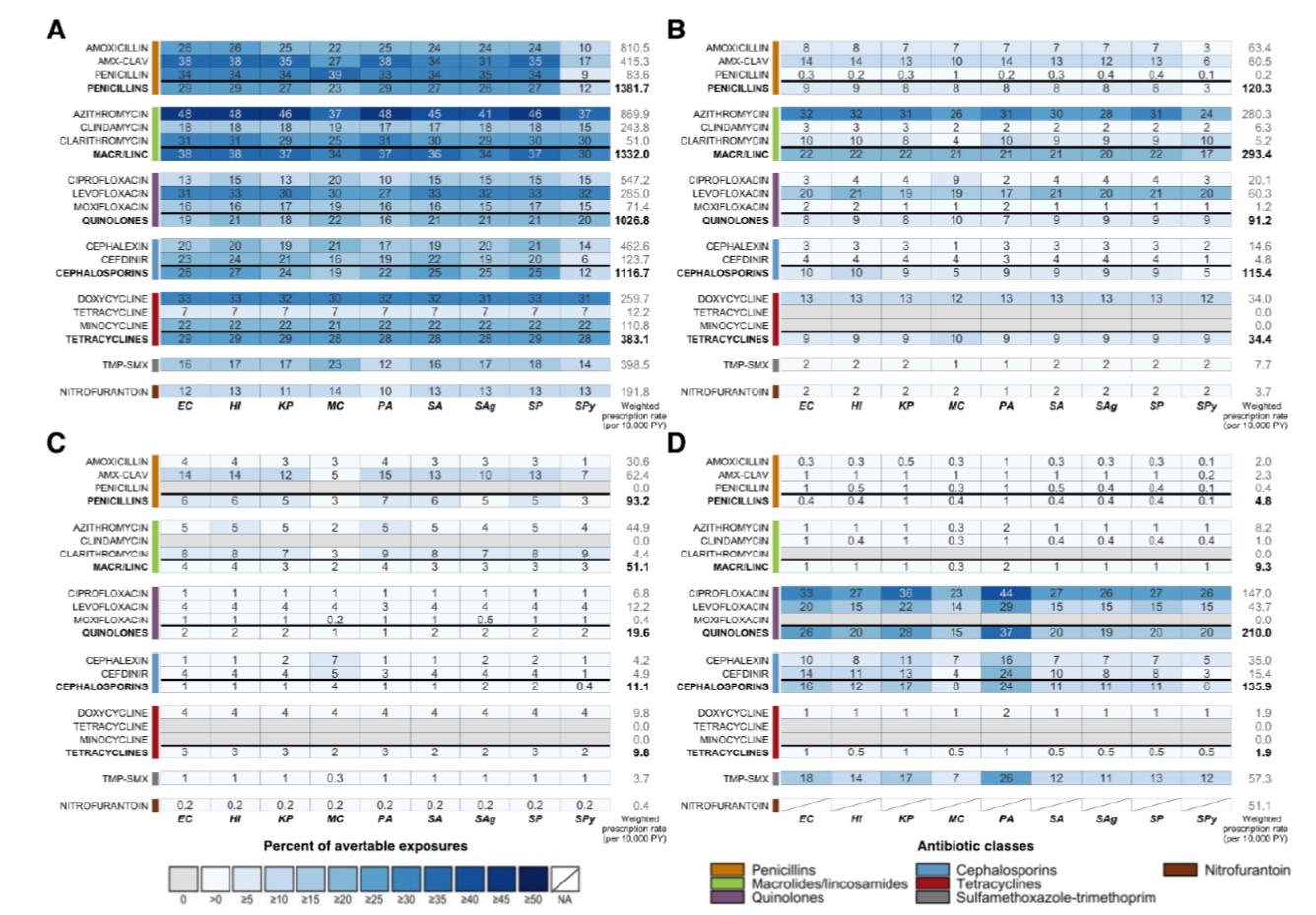
The analysis included sixteen antibiotics that are frequently prescribed in the outpatient setting and nine potentially pathogenic bacterial species that are commonly carried in the normal human microbiome. For each antibiotic-species pair, they estimated the proportion of antibiotic exposures experienced by that species that could be averted under four hypothetical scenarios.

1) Eliminate unnecessary antibiotic use across all outpatient conditions.
2) Eliminate all antibiotic use for outpatient respiratory conditions for which antibiotics are not indicated.
3) Eliminate all antibiotic use for acute sinusitis.
4) Prescribe nitrofurantoin* for all cases of cystitis in women.”

“*Nitrofurantoin- a recommended first-line therapy with good potency against common uropathogens, low levels of resistance, and decreased risk of collateral damage to the intestinal microbiome”

Results

Picture1

Heatmaps showing the estimated percentage of species exposures to each antibiotic or antibiotic class that could be averted if A: unnecessary antibiotic prescriptions across all outpatient conditions, B: all antibiotic use for outpatient respiratory conditions for which antibiotics are not indicated, C: all antibiotic use for acute sinusitis, or D: non-nitrofurantoin treatment of cystitis in women was eliminated. Drug class results include prescriptions of all antibiotics in that class, as identified by the Lexicon Plus classification system.
Abbreviations: Antibiotics (y-axis): AMX-CLAV=amoxicillin-clavulanate,, MACR/LINC=macrolides/lincosamides, TMP-SMX=sulfamethoxazole-trimethoprim;

Organisms (x-axis): EC=E. coli, HI=H. influenzae, KP=K. pneumoniae, MC=M. catarrhalis, PA=P. aeruginosa, SA=S. aureus, SAg=S. agalactiae, SP=S. pneumoniae, SPy=S. pyogenes; PY=person-years


The darker shades in panel A (scenario 1) clearly indicated that “elimination of unnecessary antibiotic prescriptions across all outpatient conditions would prevent 6 to 48% (IQR: 17 to 31%) of antibiotic-species exposures. If all unnecessary antibiotic use could be prevented, over 30% of exposures to amoxicillin-clavulanate, penicillin, azithromycin, clarithromycin, levofloxacin, and doxycycline across most potential pathogens of interest could be averted.

In panel D (scenario 4), they found that prescribing nitrofurantoin not only averted antibiotic exposure in non-causative bacterial species (bystanders) but also in causative species for cystitis in women.
Overall, 27% of ciprofloxacin use is associated with acute cystitis in women. Organisms that are not causative pathogens of cystitis have proportions of avertable exposures close to or less than 27%, but a substantially higher proportion of exposures could be averted among causative pathogens – 33%, 36%, and 44% of ciprofloxacin exposures to E. coli, K. pneumoniae, and P. aeruginosa, respectively.

The study addresses the limitations with regard to data availability and reporting in public database. Authors are cautious and point out,

It is important to note that the reduction in antibiotic exposures estimated here does not translate to the same reduction in the prevalence of resistance or in the morbidity and mortality attributable to resistance. Additionally, in this analysis, we give each exposure equal weight. However, the selective pressure imposed by a single exposure depends on a number of variables, including pharmacokinetics, pharmacodynamics, distribution of bacteria across body sites, and bacterial population size. For example, we might expect that the probability of resistance scales with population size, and thus that an exposure received by an individual with higher bacterial load will have a larger impact on resistance.

Overall, this study indeed provides evidence that “improved prescription of antibiotics has the potential to prevent antibiotic exposure experienced by bacterial species throughout microbiome.

February 2, 2020

Have a nice Sunday! Today, in this Digest we have several papers about the relationship between the microbiome and different neurological/psychological conditions, such as ASD, depression or anxiety, or about the microbiome and the inflammatory bowel disease. Enjoy!


Human and General Microbiome

Review: Host-microbiota interactions in inflammatory bowel disease – Roberta Caruso – Nature Reviews Immunology 

Review: Considering gut microbiota in treatment of type 2 diabetes mellitus – Aneseh Adeshirlarijaney – Gut Microbes

Review: Gut Dysbiosis Dysregulates Central and Systemic Homeostasis via Suboptimal Mitochondrial Function: Assessment, Treatment and Classification Implications – George Anderson – Current Topics in Medicinal Chemistry

Book Chapter: Immune-Kynurenine Pathways and the Gut Microbiota-Brain Axis in Anxiety Disorders – Alper Evrensel – Anxiety Disorders 

Book Chapter: Autism and Gut-Brain Axis: Role of Probiotics – Saravana Babu Chidambaram – Personalized Food Intervention and Therapy for Autism Spectrum Disorder Management

Review: Microbial-Based and Microbial-Targeted Therapies for Inflammatory Bowel Diseases – Akihiko Oka – Digestive Diseases and Sciences

Precision Microbiome Modulation with Discrete Dietary Fiber Structures Directs Short-Chain Fatty Acid Production – Edward C. Deehan – Cell Host and Microbe

Urinary microbiome in uncomplicated and interstitial cystitis: is there any similarity? – Süleyman Yıldırım – World Journal of Urology

The gut microbiota response to helminth infection depends on host sex and genotype – Fei Ling – The ISME Journal 

Metabolism of multiple glycosaminoglycans by Bacteroides thetaiotaomicron is orchestrated by a versatile core genetic locus – Didier Ndeh – Nature Communications

Gestational diabetes and the human salivary microbiota: a longitudinal study during pregnancy and postpartum – Mie K. W. Crusell – BMC Pregnancy and Childbirth 

Vaginal dysbiosis associated-bacteria Megasphaera elsdenii and Prevotella timonensis induce immune activation via dendritic cells – Nienke H.van Teijlingen – Journal of Reproductive Immunology

Variability in Skin Microbiota between Smokers, Former Smokers, and Non-Smokers – Katherine G. Thompson – Journal of the American Academy of Dermatology

Microbiota changes and Intestinal Microbiota Transplantation in Liver Diseases and Cirrhosis – Jasmohan S. Bajaj – Journal of Hepatology

Host-Specific Evolutionary and Transmission Dynamics Shape the Functional Diversification of Staphylococcus epidermidis in Human Skin – Wei Zhou – Cell


Animal Microbiome and Animal Experiments

Effect of probiotic administration on gut microbiota and depressive behaviors in mice – Quan Feng Liu – DARU Journal of Pharmaceutical Sciences

Deciphering the bifidobacterial population within the canine and feline gut microbiota – Giulia Alessandri – Applied and Environmental Microbiology

Dissecting the factors shaping fish skin microbiomes in a heterogeneous inland water system – Yaron Krotman – Microbiome

Prenatal exposure to glufosinate ammonium disturbs gut microbiome and induces behavioral abnormalities in mice – Tianyu Dong – Journal of Hazardous Materials

High prevalence of Phasi Charoen-like virus from wild-caught Aedes aegypti in Grenada, W.I. as revealed by metagenomic analysis – Maria E. Ramos-Nino – PLoS ONE

Common structuring principles of the Drosophila melanogaster microbiome on a continental scale and between host and substrate – Yun Wang – Environmental Microbiology Reports

Community assembly of the native C. elegans microbiome is influenced by time, substrate, and individual bacterial taxa – Julia Johnke – Environmental Microbiology 


Environmental Microbiome

Patterns of local, intercontinental and inter-seasonal variation of soil bacterial and eukaryotic microbial communities – Johan De Gruyter – FEMS Microbiology Ecology

Dynamics and ecological distributions of the Archaea microbiome from inland saline lakes (Monegros Desert, Spain) – Mateu Menéndez-Serra – FEMS Microbiology Ecology


February 1, 2020

Today’s Digest brings you an Outlook collection on human gut microbiome by Nature, a Hi-C investigation of the evolution of the gut microbiota, and be careful with the dust, there’s transferrable antimicrobial genes within!

Events

Reshaping the Microbiome through Nutrition – Nature Conference – San Diego, CA

General microbiology

Commensal Bacteroidetes protect against Klebsiella pneumoniae colonization and transmission through IL-36 signalling – Richard P. Sequeira et al. – Nature Microbiology

** The gut microbiome – Nature Outlook

Antimicrobial resistance

The negative cofactor 2 complex is a key regulator of drug resistance in Aspergillus fumigatus – Takanori Furukawa et al. – Nature Communications

Plasmid-mediated metronidazole resistance in Clostridioides difficile – Ilse M. Boekhoud et al. – Nature Communications

A Common Practice of Widespread Antimicrobial Use in Horse Production Promotes Multi-Drug Resistance – S. Álvarez–Narváez et al. – Scientific Reports

Surveys of knowledge and awareness of antibiotic use and antimicrobial resistance in general population: A systematic review – PLoS One

Antimicrobial resistance patterns and molecular resistance markers of Campylobacter jejuni isolates from human diarrheal cases – Mohamed Elhadidy et al. – PLoS One

Review: Antibiotic resistance: turning evolutionary principles into clinical reality – Dan I Andersson et al. – FEMS Microbiology Reviews

Antibiotic resistome associated with microbial communities in an integrated wastewater reclamation system – Kaifeng Yu et al. – Water Research

Human gut microbiome

** Tracking microbial evolution in the human gut using Hi-C reveals extensive horizontal gene transfer, persistence and adaptation – Eitan Yaffe & David A. Relman – Nature Microbiology

Growth effects of N-acylethanolamines on gut bacteria reflect altered bacterial abundances in inflammatory bowel disease – Nadine Fornelos et al. – Nature Microbiology

Human cancer microbiome

The Influence of Lung Microbiota on Lung Carcinogenesis, Immunity, and Immunotherapy – Ariel G. Ramírez-Labrada et al. – Trends in Cancer

Built environment microbiome

** Mobilizable antibiotic resistance genes are present in dust microbial communities – Sarah Ben Maamar et al. – PLoS Pathogens

Indoor and outdoor airborne bacterial and fungal air quality in kindergartens: seasonal distribution, genera, levels, and factors influencing their concentration – Farhad Mirkhond Chegini et al. – Building and Environment

Metabolomics

Targeted metabolomics of pellicle and saliva in children with different caries activity – Annika Schulz et al. – Scientific Reports

Animal experiments

Review: The role of the microbiota in sedentary life style disorders and ageing: Lessons from the animal kingdom – P.W. O’Toole & P.G. Shiels – Journal of Internal Medicine

Animal microbiome

Dietary effects on gut microbiota of the mesquite lizard Sceloporus grammicus (Wiegmann, 1828) across different altitudes – Nina Montoya-Ciriaco et al. – Microbiome

Late weaning is associated with increased microbial diversity and Faecalibacterium prausnitzii abundance in the fecal microbiota of piglets – Francesca Romana Massacci et al. – Animal Microbiome

Plant, root and soil microbiome

Effects of soil chemical properties and fractions of Pb, Cd, and Zn on bacterial and fungal communities – Xiaomei Pan et al. – Science of the Total Environment

Resilience of the microbial communities of semiarid agricultural soils during natural climatic variability events – Lumarie Pérez-Guzmán et al. – Applied Soil Ecology

Effects of microbial inoculants on the fermentation characteristics and microbial communities of sweet sorghum bagasse silage – Miaoyin Dong et al. – Scientific Reports

Water and extremophile microbiome

Diversity of Bacterial Community in the Oxygen Minimum Zones of Arabian Sea and Bay of Bengal as Deduced by Illumina Sequencing – Genevieve L. Fernandes et al. – Frontiers in Microbiology

Ionic Liquid Enriches the Antibiotic Resistome, Especially Efflux Pump Genes, Before Significantly Affecting Microbial Community Structure – Xiaolong Wang et al. – Environmental Science & Technology

Methane yield enhancement of mesophilic and thermophilic anaerobic co-digestion of algal biomass and food waste using algal biochar: Semi-continuous operation and microbial community analysis – Le Zhang et al. – Bioresource Technology

Characterization and co-occurrence of microbial community in epiphytic biofilms and surface sediments of wetlands with submersed macrophytes – Yuansi Liu et al. – Science of the Total Environment

Phages and viruses

** Giant virus diversity and host interactions through global metagenomics – Frederik Schulz et al. – Nature

Reassortment and adaptive mutations of an emerging avian influenza virus H7N4 subtype in China – Bingqian Qu et al. – PLoS One

Outbreak of Pneumonia of Unknown Etiology in Wuhan China: the Mystery and the Miracle – Hongzhou Lu et al. – Journal of Medical Virology

Bioinformatics

Comparing bioinformatic pipelines for microbial 16S rRNA amplicon sequencing – Andrei Prodan et al. – PLoS One

Microbes in the news

Walnuts May Benefit Gut Bacteria and Improve Heart Health – Karina Lichtenstein – Medicine Net

How to create living art with microbes – Eugenia Angulo – BBVA OpenMind