One of the topics discussed today on Twitter was a set of four very similar papers by the same group from Malaysia, all published around the same time, but with different titles and in different journals. The problems were first spotted by Dave Williamson on Twitter:

Soon followed other tweets by Stuart Cantrill, Christophe Leterrier, Alexis Verger, and many others, who found more and more problems with papers by this group.
As already pointed out in posts in Retraction Watch, For Better Science by Leonid Schneider, and other blog posts, there are a lot of apparent problems with these studies. Not only do these papers contain a lot of very similar looking figures, most of the figures themselves appear to contain duplicated panels or parts of panels.
These 4 papers contain very similar examples of inappropriate image duplication as Arturo Casadevall, Ferric Fang and I wrote about in our paper that was published earlier this week in mBio:
The Prevalence of Inappropriate Image Duplication in Biomedical Research Publications – Elisabeth M. Bik, Arturo Casadevall, Ferric C. Fang – mBio
In our paper, we scanned over 20,000 published papers that contained the term “Western Blot” and screened all photographic images for duplicated panels, or lanes within panels. About 1:25 of the papers contained inappropriately duplicated images. That suggests that peer review and journal editors need to do a better job in catching these problems before publication.
The 4 papers that attracted attention today had very similar problems as the ones we encountered in our paper, but they also looked very similar to each other. The four-some were published respectively in Frontiers in Pharmacology, PeerJ, Scientific Reports, and Recent Patents on Anti-Cancer Drug Discovery. At the bottom of this post I will show the side-by-side screenshots of the 4 paper, showing how similar their figures are. But there are also a lot of potential problems with the figures, such as photos representing different cell lines that share similar features, or bands within the same Western Blot panel that look very similar to each other. What makes these papers unique is that they have so many apparent problems within one paper. Here are some examples (colored boxes are mine to point out similar looking features such as cells or bands):
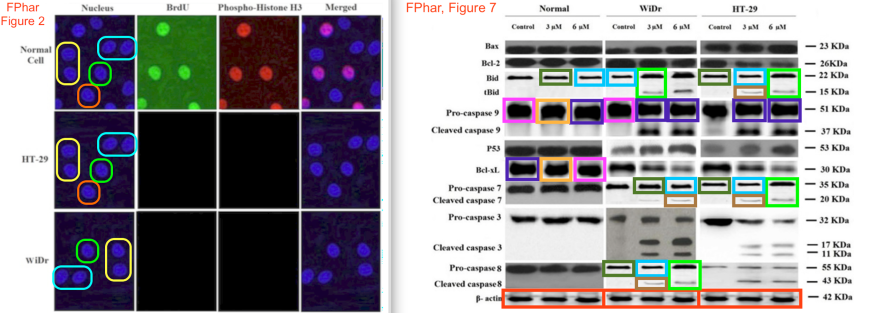
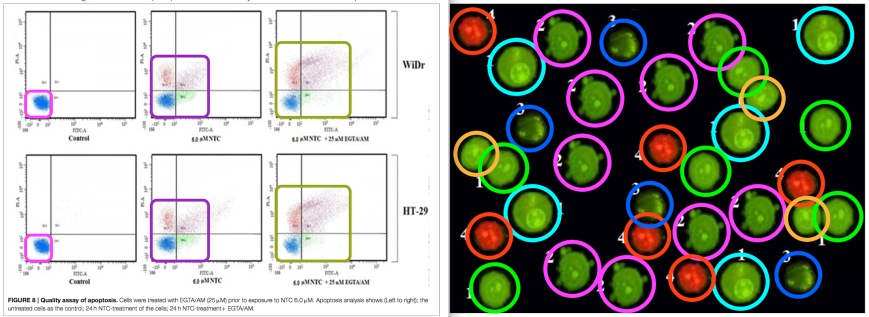
You can see more examples of what-seem-to-be inappropriate duplications on the PubPeer website, for the Frontiers in Pharmacology paper, and the Scientific Reports paper. Several people, including I, have left comments and concerns about the figures. I hope that by showing these examples, peer reviewers and editors will better recognize potential figure problems, and pay more attention in capturing these mistakes before they are published. I also hope that the authors will respond to our concerns.
To show how similar the papers are to each other, I have made screenshots of a side-by-side comparison of the 4 papers. In all screenshots below, you will see from left-t0-right: Frontiers in Pharmacology, PeerJ, Scientific Reports, and the Patents paper. Note that although the papers represent studies on different cell lines or chemicals, their figures look unexpectedly similar to each other.

FPh Fig 2 – PeerJ Fig 2 – SciRep Fig 1 – Patent Fig 2

FPh Fig 3 – PeerJ Fig 3 – SciRep Fig 2 – Patent Fig 3
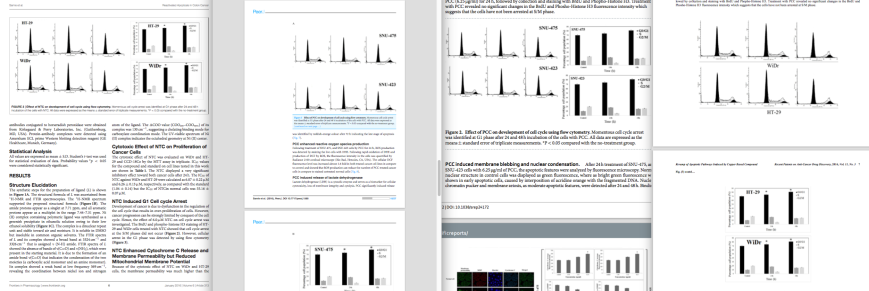
FPh, Fig 4 – PeerJ Fig 4 – SciRep Fig 3 – Patent Fig 4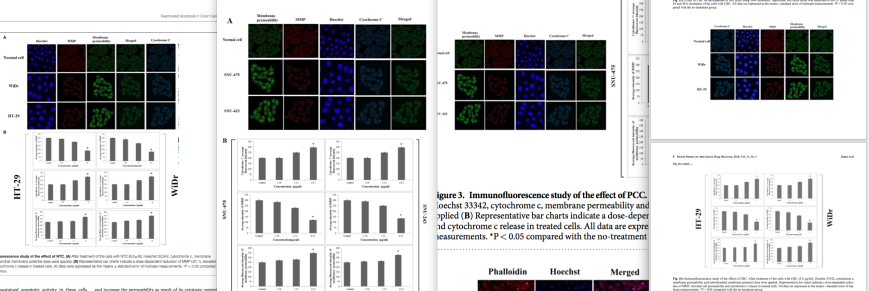
NA -PeerJ Fig 5 – SciRep Fig 4 – Patent Fig 5

NA -PeerJ Fig 6 – SciRep Fig 5 – Patent Fig 6

NA – PeerJ Fig 7 – SciRep Fig 6 – Patent Fig 7

NA – PeerJ Fig 8 – SciRep Fig 8 – Patent Fig 8
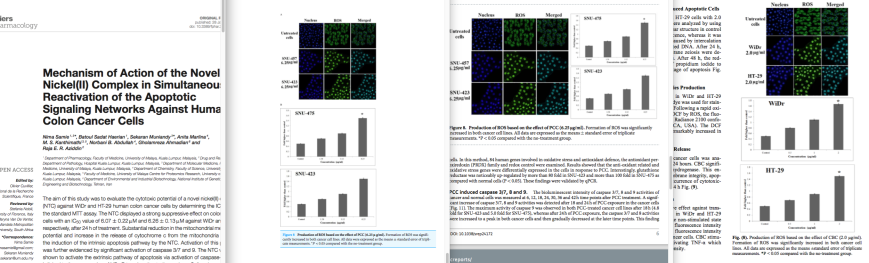
FPh, Fig 5 – PeerJ Fig 10 – SciRep Fig 10 – Patent Fig 10
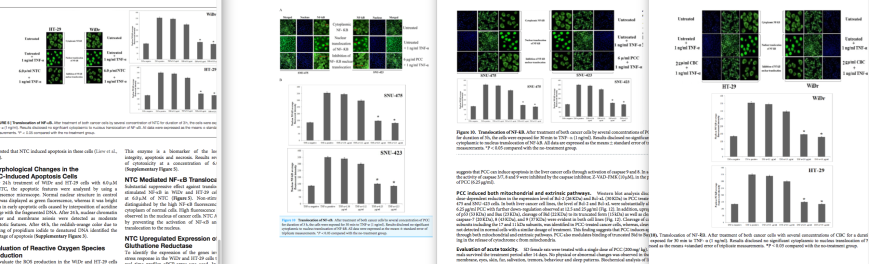
FPh, Fig 6 – PeerJ Fig 11 – SciRep Fig 11 – Patent Fig 11

FPh, Fig 7 – PeerJ Fig 12 – SciRep Fig 12 – Patent Fig 12
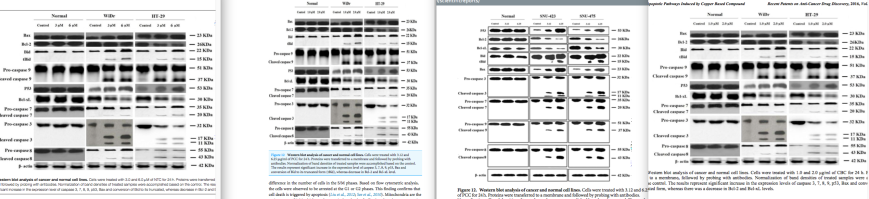
FPh, Fig 8 – PeerJ Fig 13 – SciRep Fig 7 – Patent Fig 13



 Microbiome Digest - Bik's Picks