
July 26, 2017

General microbiome

Microbiome analysis and confocal microscopy of used kitchen sponges reveal massive colonization by Acinetobacter, Moraxella and Chryseobacterium species – Massimiliano Cardinale – Scientific Reports

Review: The mother–offspring dyad: microbial transmission, immune interactions and allergy development – Maria C. Jenmalm – Journal of Internal Medicine

Human skin microbiome

The Skin Microbiome of Cohabiting Couples – Ashley A. Ross – mSystems

Animal microbiome

Influence of Host Plant on Thaumetopoea pityocampa Gut Bacterial Community – Cinzia P. Strano – Microbial Ecology

The time-course of broiler intestinal microbiota development after administration of cecal contents to incubating eggs – Erin E. Donaldson – PeerJ

Plant, root, and soil microbiome

Review: Sphingomonads in Microbe-Assisted Phytoremediation: Tackling Soil Pollution – Michael Gatheru Waigi – Trends in Biotechnology

Response of soil microbial community composition and function to a bottomland forest restoration intensity gradient – Michael S. Strickland – Applied Soil Ecology

Changes of soil microbial communities during decomposition of straw residues under different land uses – Hong Zhang – Journal of Arid Land

Water and extremophile microbiome

Metagenomics of urban sewage identifies an extensively shared antibiotic resistome in China – Jian-Qiang Su – Microbiome

An anaerobic ~3400 Ma shallow-water microbial consortium: presumptive evidence of Earth’s Paleoarchean anoxic atmosphere – J. William Schopf – Precambrian Research

Iron oxides alter methanogenic pathways of acetate in production water of high-temperature petroleum reservoir – Pan Pan – Applied Microbiology and Biotechnology

Food Microbiology

Editorial: Microbiology of Ethnic Fermented Foods and Alcoholic Beverages of the World – Jyoti P. Tamang – Frontiers in Microbiology

Probiotics / prebiotics

Specific signatures of the gut microbiota and increased levels of butyrate in children treated with fermented cow’s milk containing heat-killed Lactobacillus paracasei CBA L74 – Roberto Berni Canani – Applied and Environmental Microbiology

Phages and viruses

Review : The Human Virome – Implications for Clinical Practice in Transplantation Medicine – Susanna K. Tan – Journal of Clinical Microbiology

Anitha’s non-microbiology picks

Quantum tunneling takes time, new study shows

Perovskites power up the solar industry

Scientists develop fast chemistry that unlocks a new class of polymers

Medicine’s Movable Feast: What Jumping Genes Can Teach Us about Treating Disease
July 5, 2017

General microbiome

Letter to the editor: Introducing the sporobiota and sporobiome – George Tetz – Gut Pathogens

Human oral microbiome

Oropharyngeal and Sputum Microbiomes Are Similar Following Exacerbation of Chronic Obstructive Pulmonary Disease – Hai-Yue Liu – Frontiers in Microbiology

Human respiratory microbiome

Review: Respiratory microbiota and lower respiratory tract disease – Miguel Lanaspa – Expert Review of Anti-infective Therapy

Human gut microbiome

Review: Feeding the microbiota: transducer of nutrient signals for the host – Fergus Shanahan – Gut

Animal microbiome

Early Postnatal Diets Affect the Bioregional Small Intestine Microbiome and Ileal Metabolome in Neonatal Pigs – Brian D Piccolo – The Journal of Nutrition

Variation between the oral and faecal microbiota in a free-living passerine bird, the great tit (Parus major) – Lucie Kropáčková – Plos One

Temperature variation, bacterial diversity, and fungal infection dynamics in the amphibian skin – Ana V. Longo – Molecular Ecology

Early-Life Diet Affects Host Microbiota and Later-Life Defenses Against Parasites in Frogs – Sarah A. Knutie – Integrative & Comparitive Biology

Animal experiments

Relative variations of gut microbiota in disordered cholesterol metabolism caused by high-cholesterol diet and host genetics – Tao Bo – Microbiology Open

Plant, root, and soil microbiome

Nutrient and Rainfall Additions Shift Phylogenetically Estimated Traits of Soil Microbial Communities – Kelly Gravuer – Frontiers in Microbiology

Long-term rock phosphate fertilization impacts the microbial communities of maize rhizosphere – Ubiana C. Silva – Frontiers in Microbiology

Global change and the soil microbiome: A human-health perspective – Raúl Ochoa-Hueso – Frontiers in Ecology and Evolution

The Impact of Hydration and Temperature on Bacterial Diversity in Arid Soil Mesocosms – Adam Št’ovíček – Frontiers in Microbiology

Contrasting bacterial communities in two indigenous Chionochloa (Poaceae) grassland soils in New Zealand – Jocelyn C. Griffith – Plos One

Water and extremophile microbiome

Bacterial diversity and population shifts driven by spotlight wastewater micropollutants in low-temperature highly nitrifying activated sludge – Antonina Kruglova – JScience of The Total Environment

Probiotics / prebiotics

The potential synergistic behaviour of inter- and intra-genus probiotic combinations in the pattern and rate of short chain fatty acids formation during fibre fermentation – Warnakulasuriya M. A. D. B. Fernando – International Journal of Food Sciences and Nutrition

Review: Structural features underlying prebiotic activity of conventional and potential prebiotic oligosaccharides in food and health – Subin R. C. K. Rajendran – Journal of Food Biochemistry

Phages and viruses

Case control comparison of enteric viromes in captive rhesus macaques with acute or idiopathic chronic diarrhea – Beatrix Kapusinszky – Journal of Virology

A viral metagenomic approach on a non-metagenomic experiment: Mining next generation sequencing datasets from pig DNA identified several porcine parvoviruses for a retrospective evaluation of viral infections – Samuele Bovo – Plos One

Bioinformatics

Does colorectal cancer significantly influence the assembly of gut microbial communities? – Lin Dai – PeerJ

Review: Using metagenomics to investigate human and environmental resistomes – Johan Bengtsson-Palme – Journal of Antimicrobial Chemotherapy

RRmix: A method for simultaneous batch effect correction and analysis of metabolomics data in the absence of internal standards – Stephen Salerno Jr – Plos One

Predicting the ecological quality status of marine environments from eDNA metabarcoding data using supervised machine learning – Tristan Cordier – Environmental Science and Technology

Anitha’s non-microbiology picks

AI is changing how we do science. Get a glimpse

Scientists explain ancient Rome’s long-lasting concrete

February 23, 2017

Today’s selection includes an interesting review on how bacteria keep their time. Long term ceftriaxon sodium usage alters gut microbiota and immune system. Clostridium perfringens toxin genes in the gut microbiota of autistic children. Taxonomic and functional microbial communities of seawater and sea ice from the Canadian Arctic. Enjoy!

General microbiome

Distinct signatures of dental plaque metabolic byproducts dictated by periodontal inflammatory status. – Akito Sakanaka – Scientific Reports

*Review: Timing the day: what makes bacterial clocks tick? – Carl Hirschie Johnson – Nature Reviews Microbiology

Human urinary microbiome

Review: The female urinary microbiota, urinary health and common urinary disorders. – Linda Brubaker – Annals of Translational Medicine

Review: Questions and challenges associated with studying the microbiome of the urinary tract – Yige Bao – Annals of Translational Medicine

Review: The association between bacteria and urinary stones. – Andrew L. Schwaderer – Annals of Translational Medicine

Human nearly-sterile sites 

The Conserved Phylogeny of Blood Microbiome – Malay Bhattacharyya – Molecular Phylogenetics and Evolution

Human gut microbiome

Review: The gut microbiome in human neurological disease: A review. – Helen Tremlett – Annals of Neurology

Review: Gut microbiome-based medical methodologies for early-stage disease prevention – Jing-Zhang Wang – Microbial Pathogenesis

Review: Gut microbiome and chronic prostatitis/chronic pelvic pain syndrome. – Hans C. Arora – Annals of Translational Medicine

*Long-term use of ceftriaxone sodium induced changes in gut microbiota and immune system. – Yanjie Guo – Scientific Reports

Note Elies Bik: This study was not performed in humans but in a horrible rat model that can only be qualified as torture. This does not test for depression but for extreme stress. Should not have performed. Proceed with extreme caution. Variations in gut microbiota and fecal metabolic phenotype associated with depression by 16S rRNA gene sequencing and LC/MS-based metabolomics. – Meng Yu – Journal of Pharmaceutical and Biomedical Analysis

Specific inulin-type fructan fibers protect against autoimmune diabetes by modulating gut immunity, barrier function and microbiota homeostasis. – Kang Chen – Molecular Nutrition and Food Research

Gut microbiota and oxalate homeostasis. – Marguerite Hatch – Annals of Translational Medicine

Tryptophan: A gut microbiota-derived metabolites regulating inflammation. – Lucie Etienne-Mesmin –  World Journal of Gastrointestestinal Pharmacology

*Detection of Clostridium perfringens toxin genes in the gut microbiota of autistic children. – Sydney M. Finegold – Anaerobe

Animal experiments

Butyrate restores HFD induced adaptations in brain function and metabolism in mid-adult obese mice – Ilse A. C. Arnoldussen – International Journal of Obesity

Toxin-positive Clostridium difficile latently infect mouse colonies and protect against highly pathogenic C. difficile. – Lucie Etienne-Mesmin – Gut

Animal microbiome

Individual Signatures Define Canine Skin Microbiota Composition and Variability. – Anna Cuscó – Frontiers in Veterinary Science

Plant, root, and soil microbiome

Differential sharing and distinct co-occurrence networks among spatially close bacterial microbiota of bark, mosses and lichens‬‬. – Ines Aline Aschenbrenner – Molecular Ecology

Links between soil microbial communities and plant traits in a species-rich grassland under long-term climate change. – Lin Li – Ecology and Evolution

Water and extremophile microbiome

*Metagenomic survey of the taxonomic and functional microbial communities of seawater and sea ice from the Canadian Arctic. – Etienne Yergeau – Scientific Reports

High-resolution sequencing reveals unexplored archaeal diversity in freshwater wetland soils. – Adrienne Narrowe – Environmental Microbiology

Food microbiology

Enhanced Control of Listeria monocytogenes by Enterococcus faecium KE82, a Multiple Enterocin–Producing Strain, in Different Milk Environments. – Elpinki Vandera – Journal of food protection

Probiotics / prebiotics

Review: Probiotics for prevention of urinary stones. – John C. Lieske – Annals of Translational Medicine

Review: Review of the mechanisms of probiotic actions in the prevention of colorectal cancer. – Sandra A. dos Reis – Nutrition Research

Phages and viruses

The Baltic Sea Virome: Diversity and Transcriptional Activity of DNA and RNA Viruses – Lisa Zeigler Allen – mSystems

Microbes in the news 

The Future Of Skin Care: Lotions That Feed Our Microbiome

Collapse of Aztec society linked to catastrophic salmonella outbreak

Smart’ bacteria remodel their genes to infect our intestines

Smallest CRISPR So Far Comes from Food Poisoning Bacteria

Anitha’s non-microbiology picks 

An epigenetics gold rush: new controls for gene expression

Scientists discover 7 ‘Earthlike’ planets orbiting a nearby star

Problems with paper on Bread and Mental Diseases

A Storify Story of my tweets today about this paper:

Screen Shot 2016-04-13 at 12.13.44 AM.png

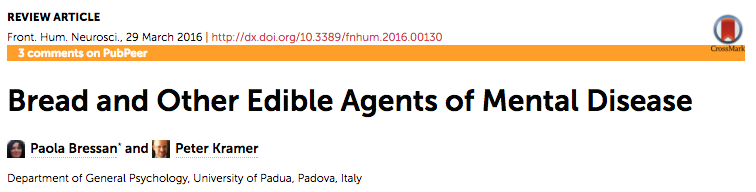
Bread and Other Edible Agents of Mental Disease – Paola Bressan* and Peter Kramer – Department of General Psychology, University of Padua, Padova, Italy – Frontiers in Human Neuroscience.

Abstract: Perhaps because gastroenterology, immunology, toxicology, and the nutrition and agricultural sciences are outside of their competence and responsibility, psychologists and psychiatrists typically fail to appreciate the impact that food can have on their patients’ condition. Here we attempt to help correct this situation by reviewing, in non-technical, plain English, how cereal grains—the world’s most abundant food source—can affect human behavior and mental health. We present the implications for the psychological sciences of the findings that, in all of us, bread (1) makes the gut more permeable and can thus encourage the migration of food particles to sites where they are not expected, prompting the immune system to attack both these particles and brain-relevant substances that resemble them, and (2) releases opioid-like compounds, capable of causing mental derangement if they make it to the brain. A grain-free diet, although difficult to maintain (especially for those that need it the most), could improve the mental health of many and be a complete cure for others.

I tried to embed the Storify Story here, but this Embedding is Trickier Than I Thought (or maybe I ate too much bread?). Ah well, I apologize. You will just have to click on the link: