
CRISPR-Cas9 system that kills targeted pathogenic bacteria may be microbiome friendly.

By: Puck deRoos

Please join me in welcoming our new contributor Puck deRoos. She will be writing short articles about the latest microbiome papers. I am so excited to have you on the team! – Elisabeth Bik

New research has highlighted a potential system that can specifically target pathogenic bacteria without disturbing the rest of the microbial community1.  

Currently, the ways to treat pathogenic bacterial infections are non-specific and may have unintentional longer lasting effects because they often alter the composition of the gut microbiome. The rise of multi-drug resistant bacteria has shown the limitations of general broad-spectrum antibiotics2, while phage-based therapy has been associated with  a smaller but similar rise in phage resistant bacteria3,.  Stool transplants have shown promising results in treatment of particular intestinal conditions, but are not suitable for many other diseases. In addition, they completely alter the patients gut microbiome, which may have unknown long-term effects4


The CRISPR (Clustered Regularly Interspaced Short Palindromic Repeats) Cas-9 (CRISPR ASsociated protein-9) system is able to target specific microbial species, and cause cell death due to double stranded breaks in the microbial DNA. In a recent paper published in Nature Communications, researchers have developed a method to specifically target microbial pathogens using a cis-conjugative CRISPR system where all the necessary machinery is encoded within one plasmid, or bacterial DNA sequence.

The cis-conjugative plasmid system has much higher rate of conjugation, which is how bacteria transfer genetic material between different cells, than its trans-conjugative counterpart, which has the CRISPR and conjugative sequences on different plasmids. One of the reasons the cis-conjugative system is more effective is that it is able to continue to work throughout multiple conjugations, so its effect increases exponentially throughout time. In contrast,  the trans system only works once. 

The rates of conjugation were measured from host bacteria Escherichia coli to bacterial recipient Salmonella enterica. The rate for the cis system continually increased and reached a maximum of 1 X 10⁻² at 24hour, while the trans system maxed out early at ~1 X 10⁻³ but decreased to ~1 X 10⁻⁵ at 24hours. These results showed a ~1000-fold increase in the rates of the new cis-conjugative system compared to previous trans-conjugative system. 
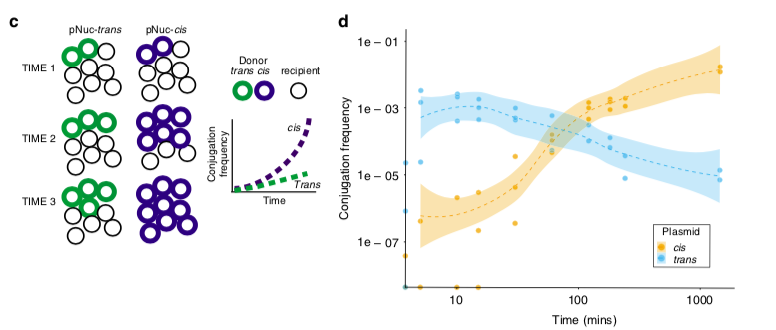
Macintosh HD:Users:puck:Desktop:Screen Shot 2019-10-04 at 3.51.57 PM.png


This new tool for targeting specific bacteria can be extremely useful within the human microbiome. Most microbial communities in our body exists as a biofilm, a community of different microorganisms that stick together on a surface. The new cis-conjugative system developed by researchers at Schulich School of Medicine and Dentistry has up to a potential 100% effective rate of conjugation with bacteria grown in a biofilm. The same cis system in a regular bacterial assay or filter based assay shows a ~500 to 1000-fold decrease in the rate of conjugation, increasing the systems usefulness in regards to the microbiome. 

In conclusion, this new method of specifically delivering a CRISPR-Cas-9 system to pathogenic bacteria without disrupting the composition of the entire microbial community is an exciting new direction for the targeted  treatment of microbial infections. 


1. Hamilton TA et al. Efficient inter-species conjugative transfer of a CRISPR nuclease for targeted bacterial killing. Nature Communications. 10, 4544 (2019). https://doi.org/10.1038/s41467-019-12448-3

2. Theuretzbacher, U. Antibiotic innovation for future public health needs. Clin. Microbiol. Infect. 23, 713–717 (2017). 

3. Chatain-Ly, M. H. The factors affecting effectiveness of treatment in phages therapy. Front. Microbiol. 5, 51 (2014). 

4. Khanna, S. et al. Changes in microbial ecology after fecal microbiota transplantation for recurrent C. difficile infection affected by underlying inflammatory bowel disease. Microbiome 5, 55 (2017). 


October 7, 2019

Good Morning! Highlights of today’s digest include investigation about early childhood microbiota assembly in mother-infant participants from the Tsimane indigenous population from Amazon and with findings suggesting that socioeconomic changes may be altering interactions of highly abundant members of the microbiota in the host. Results from a gut-brain axis rat model showed possibility of novel biomarkers development for stress response based on abundance of genes in microbiomes. Finally, another study is aiming to access biologically active small molecules with antibacterial activity derived from human microbiota by sequencing of metagenomes and the use of computational and synthetic biology methods.

Pregnancy and early life
Prenatal and postnatal contributions of the maternal microbiome on offspring programming – Jasarevic and Bale – Frontiers in Neuroendocrinology

Multi-site human microbiome
*Microbiota Assembly, Structure, and Dynamics Among Tsimane Horticulturalists of the Bolivian Amazon – Sprockett et al. – bioRxiv

Human vaginal microbiome
Oncogenic Virome Benefits from the Different Vaginal Microbiome-Immune Axes – Campisciano et al. – MDPI Microorganisms

Non-optimal vaginal microbiota after azithromycin treatment for Chlamydia trachomatis infection – Tamarelle et al. – The Journal of Infectious Diseases

Human nearly-sterile sites
Targeted High-Throughput Sequencing Identifies Predominantly Fungal Pathogens in Patients with Clinically Infectious, Culture-Negative Endophthalmitis in South India – Gandhi et al. – MDPI Microorganisms

Human gut microbiome
Review: Synthetic ecology of the human gut microbiota – Vrancken et al. – Nature Reviews Microbiology

Review: The interaction between gut microbiome and nutrients on development of human disease through epigenetic mechanisms – Ho-Sun Lee – Genomics & Informatics

Adaptation of Syntenic Xyloglucan Utilization Loci of Human Gut Bacteroidetes to Polysaccharide Side Chain Diversity – Dejean et al. – Applied and Environmental Microbiology

Pre‐and post‐serial metagenomic analysis of gut microbiota as a prognostic factor in patients undergoing haematopoietic stem cell transplantation – Kusakabe et al. – British Journal of Haematology

Animal experiments
Experimental evidence for adaptation to species-specific gut microbiota in house mice – Moeller et al. – mSphere

Low‐calcium diet in mice leads to reduced gut colonization by Enterococcus faecium – Top et al. – MicrobiologyOpen

Letrozole treatment of pubertal female mice results in activational effects on reproduction, metabolism and the gut microbiome – Arroyo et al. – PLOS ONE

Transplanting Fecal Virus-Like Particles Reduces High-Fat Diet-Induced Small Intestinal Bacterial Overgrowth in Mice – Lin et al. – Frontiers in Cellular and Infection Microbiology

*Metabolome and microbiome profiling of a stress-sensitive rat model of gut-brain axis dysfunction – Bassett et al. – Nature Scientific Reports

Animal microbiome
The composition and stability of the faecal microbiota of Merino sheep – Al Mamun et al. – Journal of Applied Microbiology

Faecal microbiota and functional capacity associated with weaning weight in meat rabbits – Fang et al. – Microbial Biotechnology

Review: Feline Virome—A Review of Novel Enteric Viruses Detected in Cats – Martino et al. – MDPI Viruses

Phylogeography and ecological niche shape the cichlid fish gut microbiota in Central American and African lakes – Baldo et al. – Frontiers in Microbiology

Plant, root and soil microbiome
Biocontrol activities of rhizobacteria associated with apple, apricot and kiwi rhizosphere against bacterial canker caused by Clavibacter michiganensis – Gautam et al. – Indian Phytopathology

Distinct Drivers of Core and Accessory Components of Soil Microbial Community Functional Diversity under Environmental Changes – Zhang et al. – mSystems

Antarctic tundra soil metagenome as useful natural resources of cold-active lignocelluolytic enzymes – Oh et al. – Journal of Microbiology

Microbial communities in bioswale soils and their relationships to soil properties, plant species, and plant physiology – Brodsky et al. – Frontiers in Microbiology

Soil prokaryotes associated with decreasing pathogen density during anaerobic soil disinfestation – Lee et al. – bioRxiv

Water and extremophile microbiome
Bacterial Communities of Microbial Mats of the White Sea Supralittoral and of the Littoral of the Lakes Separated from the Sea – Burganskaya et al. – Microbiology

Microbial community dynamics and coexistence in a sulfide-driven phototrophic bloom – Bhatnagar et al. – bioRxiv

Bioinformatics
*A metagenomic strategy for harnessing the chemical repertoire of the human microbiome – Sugimoto et al. – Science

Techniques
Protocol: Open-Source Software Tools, Databases, and Resources for Single-Cell and Single-Cell-Type Metabolomics – Biswapriya B. Misra – Single Cell Metabolism

An Entropy-Based Graph Construction Method for Representing and Clustering Biological Data – Ariza-Jimenez et al. – Latin American Conference on Biomedical Engineering

Microbes in the news
Artificial gut aims to expose the elusive microbiome – Anne McGovern – MIT PHYS.ORG

September 30, 2019

Monday morning digest covers exciting updates in microbiome with – meta analysis on role of probiotics in human depression , stool banking guidelines for fecal microbiota transplant, expert view on translation of gut microbiome to clinics and a historical peek into use of ceramic baby milk bottles in prehistoric times. Enjoy reading!

General microbiome

Translating the gut microbiome: ready for the clinic? – Susan V. Lynch – Nature Reviews Gatroenterology and Hepatology

Uterine immunity and microbiota: A shifting paradigm – Chiara Agostinis – Frontiers in Immunology

Human microbiome

Cigarette smoking and oral microbiota in low-income and African-American populations – Yaohua Yang – Journal of Epidemiology and Community Health

International consensus conference on stool banking for faecal microbiota transplantation in clinical practice – Giovanni Cammarota – Gut

Animal experiments

The intestinal microbiota programs diurnal rhythms in host metabolism through histone deacetylase 3 – Zheng Kuang – Science

Transfusional iron overload and intravenous iron infusions modify the mouse gut microbiota similarly to dietary iron – Francesca La Carpia – Biofilms and Microbiomes

Proteome modifications of gut microbiota in mice with activity-based anorexia and starvation: Role in ATP production – Jonathan Breton – Nutrition

Molecular ecology of the yet uncultured bacterial Ct85-cluster in the mammalian gut – Ulla Hynönen – Anaerobe

Intestinal inflammation increases convulsant activity and reduces antiepileptic drug efficacy in a mouse model of epilepsy – Carmen De Caro – Scientific Reports

The fecal resistome of dairy cattle is associated with diet during nursing – Jinxin Liu – Nature Communications

Neohesperidin Prevents Colorectal Tumorigenesis by Altering the Gut Microbiota – Yanling Gong – Pharmacological Research

Changes of serum lipopolysaccharide, inflammatory factors, and cecal microbiota in obese rats with type 2 diabetes induced by Roux-en-Y gastric bypass – Jiao Wu – Nutrition

Plant, root, soil microbiome

A bioinformatics guide to plant microbiome analysis – Rares Lucaciu – Frontiers in Plant Science

Beyond pathogens: microbiota interactions with the plant immune system – Paulo José PL Teixeira – Current Opinion in Microbiology

Water microbiome

Microbial communities of the Mediterranean rocky shore: ecology and biotechnological potential of the sea‐land transition – Esther Molina-Menor – Microbial Biotechnology

Probiotics

Bacillus coagulans R11 maintained intestinal villus health and decreased intestinal injury in lead-exposed mice by regulating the intestinal microbiota and influenced the function of faecal microRNAs – Si-Cheng Xing – Environmental Pollution

Effect of probiotics on depressive symptoms: A meta-analysis of human studies – Kah Kheng Goh – Psychiatry Research

Non Microbiology Picks

Milk of ruminants in ceramic baby bottles from prehistoric child graves – J. Dunne – Nature


September 28, 2019

Dear microbiome digest readers, on this weekend we have covered interesting review articles focusing on factors that influence the temporal development of the infant microbiome, and  the role of gut microbiota in colorectal cancer, and research articles shows the role of microbiome in managing constipation, in Atopic Dermatitis, microbiome-host interaction in Respiratory Syncytial Virus Infection, Successful fecal microbiota transplantation for the treatment of recurrent Clostridium difficile infection, sputum microbiome in asthma and COPD and various research articles from Animal microbiome/Animal experiments section including fine-scale spatial structuring of the microbial composition and diversity along the length of murine colon. Enjoy reading.

General microbiome

Impact of a Plant Sterol- and Galactooligosaccharide-Enriched Beverage on Colonic Metabolism and Gut Microbiota Composition Using an In Vitro Dynamic Model – Virginia Blanco-Morales – Journal of Agricultural and Food Chemistry

Review: Temporal development of the infant gut microbiome – Rebecca E. Moore – Open Biology

Stool sampling and DNA isolation kits affect DNA quality and bacterial composition following 16S rRNA gene sequencing using MiSeq Illumina platform – Petra Videnska – Scientific Reports

The Honeybee Gut Microbiota Is Altered after Chronic Exposure to Different Families of Insecticides and Infection by Nosema ceranaeRégis Rouzé – Microbes and Environments

Human gut microbiome

Abundance of Probiotics and Butyrate‐Production Microbiome Manages Constipation Via Short‐Chain Fatty Acids Production and Hormones Secretion – Min Zhuang – Molecular Nutrition & Food Research

Review: Gut microbiota in colorectal cancer: mechanisms of action and clinical applications – Sunny H. Wong – Nature Reviews Gastroenterology & Hepatology

Changes in the gut microbiota during and after commercial helium-oxygen saturation diving in China – Yuan Y – Occupational and Environmental Medicine

Ninety-eight years old female successfully successfully treated with fecal microbiota transplantation after recurrent Clostridium difficile infection – Bermejo Boixareu C – Medicina Clínica

Human respiratory microbiome

Sputum microbiomic clustering in asthma and COPD reveals a Haemophilus‐predominant subgroup – Sarah Diver – Allergy

Microbiome-Transcriptome Interactions Related to Severity of Respiratory Syncytial Virus Infection – Abhijeet R. Sonawane – Scientific Reports

Human skin microbiome

Cheek Microbial Communities Vary in Young Children with Atopic Dermatitis in China – Song L. – Dermatology

Animal microbiome / Animal experiments

Dietary supplementation with the extract from Eucommia ulmoides leaves changed epithelial restitution and gut microbial community and composition of weanling piglets – Peng M – PLoS One

Geographical location influences the composition of the gut microbiota in wild house mice (Mus musculus domesticus) at a fine spatial scale – Sarah Goertz – PLoS One

Protective activities of polysaccharides from Cipangopaludina chinensis against high-fat-diet-induced atherosclerosis via regulating gut microbiota in ApoE-deficient mice – Qingping Xiong – Food & Function

2-O-beta-D-Glucopyranosyl-L-ascorbic acid, an Ascorbic Acid Derivative Isolated from the Fruits of Lycium Barbarum L., Modulates Gut Microbiota and Palliates Colitis in Dextran Sodium Sulfate-induced Colitis in Mice – Kaiyin Huang – Journal of Agricultural and Food Chemistry

Anti‐TNF‐α therapy alters the gut microbiota in proteoglycan‐induced ankylosing spondylitis in mice – Bin Liu – MicrobiologyOpen

A fiber-deprived diet disturbs the fine-scale spatial architecture of the murine colon microbiome – Alessandra Riva – Nature Communication

Antibiotic exposure disturbs the gut microbiota and its metabolic phenotype differently in rats with advanced-stage type 1 diabetes and age-matched controls – Hong Zheng – Journal of Proteome Research

Gut Microbiota and Metabolome Response of Decaisnea insignis Seed Oil on Metabolism Disorder Induced by Excess Alcohol Consumption – Xiaoxia LiuJournal of Agricultural and Food Chemistry

Microbiome news

Vaginal Microbiome and Women’s Health: More Research Needed

NAU researchers aim to find microbial link between two common respiratory diseases

September 24, 2019

Today’s digest is about diet-microbiota interactions in personalized  nutrition, interesting story on single bacterium association with fatty liver disease and how the gut microbiota adapt to red meat consumption.

General microbiome

Diet–microbiota interactions and personalized nutrition – Aleksandra A. Kolodziejczyk – Nature Reviews Microbiology

Citrobacter rodentium–host–microbiota interactions: immunity, bioenergetics and metabolism – Caroline Mullineaux-Sanders – Nature Reviews Microbiology

The interaction between the gut Microbiota and herbal medicines – Xuedong An – Biomedicine & Pharmacotherapy

Gut microbiota: what is its place in pharmacology? – Aleksandra Tarasiuk – Expert Review of Clinical Pharmacology

Human microbiome

Fatty Liver Disease Caused by High-Alcohol-Producing Klebsiella pneumoniae – Jing Yuan – Cell Metabolism

Association of Alterations in Intestinal Microbiota With Impaired Psychological Function in Patients With Inflammatory Bowel Diseases in Remission – Fabienne Humbel – Clinical Gastroenterology and Hepatology

Butyrate‐Producing Gut Bacteria and Viral Infections in Kidney Transplant Recipients: A Pilot Study – John R. Lee – Transplant Infectious Disease

Metabolomics and Microbial Composition Increase Insight into the Impact of Dietary Differences in Cirrhosis – I. Jane Cox – Liver International

Animal experiments

Gut bacteria responding to dietary change encode sialidases that exhibit preference for red meat-associated carbohydrates – Livia S. Zaramela – Nature Microbiology

A processive endoglucanase with multi-substrate specificity is characterized from porcine gut microbiota – Weijun Wang – Scientific Reports

Comparative analysis of the fecal microbiota from different species of domesticated and wild suids – Florencia Correa-Fiz – Scientific Reports

Escherichia coli clonobiome: assessing the strains diversity in feces and urine by deep amplicon sequencing – Sofiya G. Shevchenko- Applied and Environmental Microbiology

Saponins from Clematis mandshurica Rupr. regulates gut microbiota and its metabolites during alleviation of collagen-induced arthritis in rats – Lin-Xiu Guo – Pharamacological Research

MHC Class II Antigen Presentation by the Intestinal Epithelium Initiates Graft-versus-Host Disease and Is Influenced by the Microbiota – Motoko Koyama – Immunity

Metformin Alters the Duodenal Microbiome and Decreases the Incidence of Pancreatic Ductal Adenocarcinoma Promoted by Diet-induced Obesity – Tien S Dong – American Journal of Physiology

Effects from diet-induced gut microbiota dysbiosis and obesity can be ameliorated by fecal microbiota transplantation: A multiomics approach – Maria Guirro – PlosOne

Short-chain fatty acids and microbiota metabolites attenuate ghrelin receptor signaling – Cristina Torres-Fuentes – Faseb Journal

Effects of berberine and metformin on intestinal inflammation and gut microbiome composition in db/db mice – Wang Zhang – Biomedicine & Pharmacotherapy

Plant, root, soil microbiome

Water-soluble mercury induced by organic amendments affected microbial community assemblage in mercury-polluted paddy soil – Hualing Hu – Chemosphere

Phyllosphere colonisation by a soil Streptomyces sp. promotes plant defense responses against fungal infection – Sophie Vergnes – Molecular Plant-Microbe Interactions

Water microbiome 

Heat‐induced shift in coral microbiome reveals several members of the Rhodobacteraceae family as indicator species for thermal stress in Porites lutea – Wirulda Pootakham – Microbiology Open

Probiotics
Metabolomic profiling of oxalate-degrading probiotic Lactobacillus acidophilus and Lactobacillus gasseri – Casey A. Chamberlain – PlosOne

Probiotic Bifidobacterium bifidum G9‐1 ameliorates phytohemagglutinin‐induced diarrhea caused by intestinal dysbiosis -Yutaka Makizaki – Microbiology and Immunology

September 9, 2019

Good Morning! Many research articles are posted! Highlights include a study describing hyper targeted phages in the human gut and a virome database, and construction of a pathway in a heterologus organism to pruduce secondary bile molecules for efforts to engineer and control bacterial metabolites in diseases. Happy readings!

Human oral microbiota
Identification of Initial Colonizing Bacteria in Dental Plaques from Young Adults Using Full-Length 16S rRNA Gene Sequencing – Ihara et al. – mSystems

Human vaginal microbiome
Life history recorded in the vagino-cervical microbiome – Jie et al. – bioRvix

Human gut microbiome
*A metabolic pathway for bile acid dehydroxylation by the gut microbiome – Funabashi et al. – bioRxiv

Probiotics for Gastrointestinal Symptoms and Quality of Life in Autism: A Placebo-Controlled Pilot Trial – Arnold et al. – Journal of Child and Adolescent Psychopharmacology

Animal experiments
The characteristics of gut microbiota and commensal Enterobacteriaceae isolates in tree shrew (Tupaia belangeri) – Gu et al. – BMC Microbiology

Modulation of high fat diet-induced microbiome changes, but not behaviour, by minocycline – Hasebe et al. – Brain, Behavior, and Immunity

Batch effect exerts a bigger influence on the rat urinary metabolome and gut microbiota than uraemia: a cautionary tale – Randall et al. – Microbiome

Animal microbiome
Linking pollen foraging of megachilid bees to their nest bacterial microbiota – Voulgari-Kokota et al. – Ecology and Evolution

Plant, root and soil microbiome
Consequences of microbial diversity in forest nitrogen cycling: diverse ammonifiers and specialized ammonia oxidizers – Isobe et al. – The ISME Journal

Historical Drought Affects Microbial Population Dynamics and Activity During Soil Drying and Re-Wet – Veach and Zeglin – Microbial Ecology

Stable Microbial Community and Specific Beneficial Taxa Associated with Natural Healthy Banana Rhizosphere – Europe PMC Journal of Microbiology and Biotechnology

Copepod carcasses in the subtropical convergence zone of the Sargasso Sea: implications for microbial community composition, system respiration and carbon flux – Tang et al. – Journal of Plankton Research

Predominance of soil vs root effect in rhizosphere microbiota reassembly – Zhao et al. – FEMS Microbiology Ecology

Bacterial rhizosphere community profile at different growth stages of Umorok (Capsicum chinense) and its response to the root exudates – Devi et al. – International Microbiology

The Burning of Sugarcane Plantation in the Tropics Modifies the Microbial and Enzymatic Processes in Soil and Rhizosphere – Trujillo-Narcia et al. – Journal of Soil Science and Plant Nutrition

Biocontrol and plant growth-promoting ability of plant-associated bacteria from tomato (Lycopersicum esculentum) under field condition – Amaresan et al. – Microbial Pathogenesis

Time-series analysis of phosphorus-depleted microbial communities in carbon/nitrogen-amended soils – Mise et al. – Applied Soil Ecology

The Bacterial Microbiome Associated with Arid Biocrusts and the Biogeochemical Influence of Biocrusts upon the underlying Soil – Moreira-Grez et al. – Frontiers in Microbiology

The Origin, Succession, and Predicted Metabolism of Bacterial Communities Associated with Leaf Decomposition – Jackrel et al. – mBio

Water and extremophile microbiome
Copepod carcasses in the subtropical convergence zone of the Sargasso Sea: implications for microbial community composition, system respiration and carbon flux – Tang et al. – Journal of Plankton Research

Built-environment
Genome-centered omics insight into the competition and niche differentiation of Ca. Jettenia and Ca. Brocadia affiliated to anammox bacteria – Zhao et al. – Applied Microbiology and Biotechnology

Food microbiology
Modeling and regulation of higher alcohol production through the combined effects of the C/N ratio and microbial interaction – Jiang et al. – Journal of Agricultural and Food Chemistry

Phages and viruses
*CRISPR-Cas System of a Prevalent Human Gut Bacterium Reveals Hyper-targeting against Phages in a Human Virome Catalog – Cell Host & Microbe

Bioinformatics
MITRE: inferring features from microbiota time-series data linked to host status – Bogart et al. – BMC Genome Biology

Phylogenetic Tree-based Microbiome Association Test – Kim et al. – Bioinformatics

September 2, 2019

Good Morning! Highlights of today’s digest include an investigation with childern’s oral microbiota to show that consumption of licorice lollipop effectively reduces dental caries risk, another study showed the use of lantibiotic-producing colon commensal, Blautia producta BPSCSK, as a better probiotic agent against vancomycin-resistant gut pathogen Enterococcus faecium, and finally, to help reduce indoor air pollution, formaldehyde removal was measured to determine effectiveness of a plant-microbe technology with cultured microbes.

General Microbiology
Formation of the Francisella tularensis Biofilm is Affected by Cell Surface Glycosylation, Growth Medium, and a Glucan Exopolysaccharide – Champion et al. – Nature Research Scientific Reports

Gene expression of Porphyromonas gingivalis ATCC 33277 when growing in an in vitro multispecies biofilm – Romero-Lastra et al. – PLOS ONE

General microbiome
MiniReview: The necessity to revise Koch’s postulates and its application to infectious and non-infectious diseases: a mini-review – Hosainzadegan et al. – European Journal of Clinical Microbiology & Infectious diseases

Biofilm formation inhibition and dispersal of multi-species communities containing ammonia-oxidising bacteria – Keshvardoust et al. – Biofilms and Microbiomes

Human oral microbiome
*Lollipop containing Glycyrrhiza uralensis extract reduces Streptococcus mutans colonization and maintains oral microbial diversity in Chinese preschool children – Chen et al. – PLOS ONE

Human gut microbiome
Review: Therapeutic Opportunities in Inflammatory Bowel Disease: Mechanistic Dissection of Host-Microbiome Relationships – Plichta et al. – Cell

Age-dependent association of gut bacteria with coronary atherosclerosis: Tampere Sudden Death Study – Tuomisto et al. – PLOS ONE

Pathobiome driven gut inflammation in Pakistani children with Environmental Enteric Dysfunction – Iqbal et al. – PLOS ONE

Animal experiments
Gut microbiota from NLRP3-deficient mice ameliorates depressive-like behaviors by regulating astrocyte dysfunction via circHIPK2 – Zhang et al. – Microbiome

Chronic wound microbiome colonization on mouse model following cryogenic preservation – Tipton et al. – PLOS ONE

Ozone-induced changes in the serum metabolome: Role of the microbiome – Cho et al. – PLOS ONE

Comparison of metaproteomics workflows for deciphering the functions of gut microbiota in an animal model of obesity – Guirro et al. – Journal of Proteomics

*Microbiota-derived lantibiotic restores resistance against vancomycin-resistant Enterococcus – Kim et al. – Nature

Plant, root and soil microbiome
Metabolome and microbiome signatures in the roots of citrus affected by Huanglongbing – Padhi et al. – Phytopathology

*An efficient plant–microbe phytoremediation method to remove formaldehyde from air – Yang et al. – Environmental Chemistry Letters

Built-environment (subways, indoor surfaces)
Review: From one species to another: A review on the interaction of chemistry and microbiology in relation to cleaning in the built environment – Velazquez et al. – Indoor Air

Phages and viruses
Analyses of virus/viroid communities in nectarine trees by next-generation sequencing and insight into viral synergisms implication in host disease symptoms – Xu et al. – Nature Research Scientific Reports

Characterization of the viral genomes present in commercial batches of horse serum obtained by high-throughput sequencing – Paim et al. – Biologicals

Myoviridae Phage PDX Kills Enteroaggregative Escherichia coli without Human Microbiome Dysbiosis – Cepko et al. – bioRxiv

Phylogenetics
The number of domains in the ribosomal protein S1 as a hallmark of the phylogenetic grouping of bacteria – Machulin et al. – PLOS ONE

TreeCluster: Clustering biological sequences using phylogenetic trees – Balaban et al. – PLOS ONE

Techniques
Bayesian hierarchical negative binomial models for multivariable analyses with applications to human microbiome count data – Pendegraft et al. – PLOS ONE

Automated “Cells-To-Peptides” Sample Preparation Workflow for High-Throughput, Quantitative Proteomic Assays of Microbes – Chen et al. – J. Proteome Res.

Variations of gut microbiome profile under different storage conditions and preservation periods: A multi-dimensional evaluation – Ma et al. – bioRxiv

Microbes in the news
Depression researchers rethink popular mouse swim tests – S. Reardon – Nature News

August 26, 2019

Good Morning! Highlights of today’s digest include two spearate studies on carrions, one analyzed microbial community of carcasses at Grassy Mountain region of Utah and the second quantified cytotoxicity of carcasses along ocean beaches to determine risk associated peak points for threatened iconic scavenger animals. And, a study characterized taxonomic diversity of less known marine fungi associated with a seagrass in the Bodega Bay. Finally, many reviews are posted! Check out the Research Review on plasmid-based tools for your favorite host microorganisms!

General Microbiology
Evolution of resistance in vitro reveals a novel mechanism of artemisinin activity in Toxoplasma gondii – Rozenberg et al. – biorxiv

General microbiome
Review: Microbiota-Nourishing Immunity: A Guide to Understanding Our Microbial Self – Litvak and Baumler – Immunity

Human gut microbiome
Review: Pursuing Human-Relevant Gut Microbiota-Immune Interactions – Spencer et al. – Immunity

Gut Microbiome Biomarkers in Adolescent Obesity:a Regional Study – Gao et al. – biorxiv

Animal experiments
Review: Commensal microbiota regulate vertebrate innate immunity – insights from the zebrafish – Murdoch and Rawls – Frontiers in Immunology

Animal microbiome
*Succession of bacterial communities on carrion is independent of vertebrate scavengers – Dangerfield et al. – biorxiv

*Not all rotten fish stink: Microbial changes in decaying carcasses increase cytotoxicity and potential risks to animal scavengers – Blandford et al. – Estuarine, Coastal and Shelf Science

Plant, root and soil microbiome
*Characterization of the mycobiome of the seagrass, Zostera marina, reveals putative 2 associations with marine chytrids – Ettinger and Eisen – bioRxiv

Built-environment
The occurrence of Listeria monocytogenes is associated with built environment microbiota in three tree fruit processing facilities – Tan et al. – Microbiome

Bioinformatics
The importance of genome sequence quality to microbial comparative genomics – Smits – BMC Genomics

Techniques
*Research Review: Recent advances in plasmid-based tools for establishing novel microbial chassis – Czamanski Nora et al. – Biotechnology Advances

High-throughput multi-parallel enteropathogen quantification via nano-liter qPCR – Grembi et al. – biorxiv

Longitudinal bioluminescent imaging of HIV-1 infection during antiretroviral therapy and treatment interruption in humanized mice – Ventura et al. – biorxiv

CRISPR-Cas9 mediated genome editing in vancomycin resistant Enterococcus faecium – de Maat et al. – biorxiv

August 19, 2019

Monday’s digest is about microbiota as biomarker in diverse human diseases such as alopecia areata and bladder cancer, how arabinoxylan and grape pomace affects microbiota in rodents and microbial characterization of multi-strain probiotic VSL3 .

General microbiome

What Pediatricians Should Know Before Studying Gut Microbiota – Lorenzo Drago – Journal of Clinical Medicine

The role of gut microbiota for the activity of medicinal plants traditionally used in the European Union for gastrointestinal disorders – Timo A. Thumann – Journal of Ethnopharmacology

Human microbiome

The sex-specific interaction of the microbiome in neurodegenerative diseases – Laura M. Cox – Brain Research

Analysis of the gut microbiota in alopecia areata: identification of bacterial biomarkers – Oscar M. Moreno-Arrenos – Journal of the European Academy of Dermatology and Venereology

The dynamics of the oral microbiome and oral health among patients receiving clear aligner orthodontic treatment – Rui Zhao – Oral Diseases

Urinary microbiota – a potential biomarker and therapeutic target for bladder cancer – Hai Bi – Journal of Medical Microbiology

Animal experiments

Effect of arabinoxylan on colonic bacterial metabolites and mucosal barrier in high‐fat diet‐induced rats – Shanshan Li – Food Science and Nutrition

The Signature Microbiota Driving Rumen Function Shifts in Goat Kids Introduced Solid Diet Regimes – Xiaokang Lv – BioRxiv

Effects of grape pomace and seed polyphenol extracts on the recovery of gut microbiota after antibiotic treatment in high‐fat diet‐fed mice – Feng Lu – Food Science and Nutrition

Microbiota-driven gut vascular barrier disruption is a prerequisite for non-alcoholic steatohepatitis development – Juliette Mouries – Journal of Hepatology

Identification of rumen microbial biomarkers linked to methane emission in Holstein dairy cows – Yuliaxis Ramayo‐Caldas – Journal of Animal Breeding and Genetics

The gastrointestinal fate of limonin and its effect on gut microbiota in mice – Min Gu – Food and Function

Plant, root, soil microbiome

Environmental pollution effects on plant microbiota: the case study of poplar bacterial-fungal response to silver nanoparticles – Francesco Vitali – Applied Microbiology and Biotechnology

Salinity-induced changes in the rhizosphere microbiome improve salt tolerance of Hibiscus hamabo – Yongge Yuan – Plant and Soil

Water and extremophile microbiome

Metagenomic characterization of creek sediment microbial communities from a major agricultural region in Salinas, California – Brittany J. Suttner – BioRxiv

Probiotics

Development of omics-based protocols for the microbiological characterization of multi-strain formulations marketed as probiotics: the case of VSL#3 – Diego Mora – Microbial Biotechnology

Fecal microbiome and metabolome of infants fed bovine MFGM supplemented formula or standard formula with breast-fed infants as reference: a randomized controlled trial – Xuan He – Scientific Reports

Probiotic L. gasseri strain (LG21) for the upper gastrointestinal tract acting through improvement of indigenous microbiota – Yasuhiro Koga – BMJ Open Gastroenterology

Non Microbiology Picks

First cells may have emerged because building blocks of proteins stabilized membranes – Science Daily

August 17, 2019

Highlights: Role of microbiome in drug response, station and train surface microbiome, fish microbiome, bioreactor based microbial communities, many more articles and some news.


General microbiome

Microbial Taxon-Specific Isotope Incorporation with DNA Quantitative Stable Isotope Probing – Brianna K. Finley – Stable Isotope Probing

The Role of the Microbiome in Drug Response – Rosina Pryor – Annual Review of Pharmacology and Toxicology

Station and train surface microbiomes of Mexico City’s metro (subway/underground) – Apolinar Misael Hernández – bioRxiv

Animal experiments 

Alterations of the brain proteome and gut microbiota in D-galactose-induced brain aging mice with krill oil supplementation – Qinqin Jiang – ACS

Animal microbiome 

Low-load pathogen spillover predicts shifts in skin microbiome and survival of a terrestrial-breeding amphibian – C. Guilherme Becker – Proceedings B

Comparative analysis of the gut microbial communities between two dominant amphipods from the Challenger Deep, Mariana Trench – Xiang-yu Cheng – Deep Sea Research Part I: Oceanographic Research Papers

A microbial sea of possibilities: current knowledge and prospects for an improved understanding of the fish microbiome – Thibault P.R.A. Legrand – Reviews in Aquaculture

The microbiota in spider mite faeces potentially reflects intestinal bacterial communities in the host – Yu‐Xi Zhu – Insect Science

Plant, root, and soil microbiome

Agroforestry alters the rhizosphere soil bacterial and fungal communities of moso bamboo plantations in subtropical ChinaXiaoping Zhang – Applied Soil Ecology

Enhanced tomato plant growth in soil under reduced P supply through microbial inoculants and microbiome shifts – Namis Eltlbany – FEMS Microbiology Ecology

Microbiome in Plant Health and Disease: Challenges and Opportunities – Ranjini Ramesh – Microbiome in Plant Health and Disease

Exploring the Phyllosphere Bacterial Community for Improving Tree Crop Protection – Diogo Mina – Microbiome in Plant Health and Disease

Influence of the Rhizospheric Microbiome in Plant Health Management – Vankayalapati Vijaya Kumar – Microbiome in Plant Health and Disease

Circadian Rhythms in Plant-Microbe Interaction: For Better Performance of Bioinoculants in the Agricultural Fields – Raghavendra Maddur Puttaswamy –Biofertilizers for Sustainable Agriculture and Environment

Dynamics of the rice rhizosphere microbial community under continuous and intermittent flooding treatment – HaiLong Li – Journal of Environmental Management

Differential dynamics of microbial community networks help identify microorganisms interacting with residue-borne pathogens: the case of Zymoseptoria tritici in wheat – Lydie Kerdraon – bioRxiv

Water and extremophile microbiome 

Characterization of novel metagenomic–derived lipase from Indian hot spring – Rajesh Kumar Sahoo – International Microbiology

Built environment 

Multi-omics analysis reveals niche and fitness differences in typical denitrification microbial aggregations – Yale Deng – Environment International

Electricity generation and microbial community of single-chamber microbial fuel cells in response to Cu2O nanoparticles/reduced graphene oxide as cathode catalyst – ShuaishuaiXin – Chemical Engineering Journal

Effects of current intensities on the performances and microbial communities in a combined bio-electrochemical and sulfur autotrophic denitrification (CBSAD) system – Hongyu Wang – Science of The Total Environment

Sustained organic loading perturbation inhibits nitrite oxidation in bioreactors unveiling variable resistance and resilience of nitrification and nitrifiers – E. Santillan – bioRxiv

Food microbiology

Characterization of the Microbial Resistome in Conventional and “Raised Without Antibiotics” Beef and Dairy Production Systems – Pablo Rovira – Frontiers in Microbiology

Transcription Profiling Reveals Cooperative Metabolic Interactions in a Microbial Cheese-Ripening Community Composed of Debaryomyces hansenii, Brevibacterium aurantiacum, and Hafnia alvei – Nguyen-Phuong PHAM – Frontiers in Microbiology

Techniques

Culture of salivary methanogens assisted by chemically produced hydrogen – CO Guindo – bioRxiv

Escherichia coli clonobiome: assessing the strains diversity in feces and urine by deep amplicon sequencing – Sofiya G. Shevchenko – bioRxiv

A new technique for use in the study of the microbiome: An evaluation of a three-dimensional cell culture technique in maintaining the gastrointestinal microbiome of four Balb/c female mice and implications for future studies – Everest Uriel Castaneda – bioRxiv

Microbes in the news

Genetic census of the human microbiome – ScienceDaily

When It Comes To Gut Health, Trust Science, Not Gimmicks – Futurism

UNSW unveils Microbiome Research Centre – What’s New in Food Technology & Manufacturing

MICROBIOME IN CHILDREN ASSOCIATED WITH MODE OF DELIVERY AT BIRTH -MedicalResearch.com

UCSF, Stanford Receive $35 Million From Marc and Lynne Benioff – PND, Candid

Antiseptic resistance in bacteria ‘could lead to next generation of plastics’ – Dumbarton Reporter