October 17, 2025

Gut Microbiome & Health

Lactic acid produced by optimal vaginal Lactobacillus spp. potently and specifically inactivates HIV-1 in vitro by targeting the viral RNA genome and reverse transcriptase
– Muriel Aldunate – PLOS Pathogens

Differential composition of the pulmonary microbiome in HIV-positive versus HIV-negative patients with Pneumocystis jirovecii
– Chang-Run Zhang – PLOS ONE

Risk of atopic dermatitis in periodontitis patients with and without dental scaling: A retrospective cohort study
– Ming-Che Chiang – PLOS ONE

Fecal carriage and associated factors of extended-spectrum beta-lactamase-producing Enterobacteriaceae in children under five years old with diarrhea at a tertiary hospital in Tanzania
– Emily M. Jackson – PLOS ONE

Pathogens, Immunity & Host Interactions

Dietary tannic acid promotes intestinal clearance of Candida albicans by cross-linking hyphal chitosan
– Jia Feng – PLOS Pathogens

Trends in Clostridioides difficile infection prevalence among pediatric cancer patients: A systematic review and meta-analysis
– Muluneh Assefa – PLOS ONE

Multiplex serology for Streptobacillus moniliformis and other ‘rat bite fever-like’ microorganisms for seroprevalence studies in rodents
– Katja Schmidt – PLOS ONE

Animal & Environmental Microbiomes

Effects of rumen-protected or unprotected Clostridium butyricum on growth performance, rumen fermentation, immunity and antioxidation in fattening goats
– Caixia Zhang – PLOS ONE

The intracellular symbiont Wolbachia alters Drosophila development and metabolism to buffer against nutritional stress
– Amelia R. I. Lindsey – PLOS Genetics

Interactive effects of developmental and adult nutrition on lifespan and fecundity in a genetically diverse Drosophila population
– Andrew Jones – PLOS ONE

Metabolism, Health & Disease

Alterations in the serum metabolome in patients with the COVID-19 Omicron variant and in recovered cases
– Feng Gao – PLOS ONE

Humanized monoacylglycerol acyltransferase 2 mice on a high-fat diet exhibit impaired liver detoxification during metabolic dysfunction-associated steatotic liver disease
– J. Jose Corbalan – PLOS ONE

Current and future burden of gynecological cancers attributable to high body-mass index: A comprehensive global analysis and projection study
– Xuanyu Zhao – PLOS ONE

Developing and experimentally validating a glucocorticoid signaling-related gene signature to evaluate the prognosis and immunotherapeutic response in kidney renal clear cell carcinoma
– Yu Zhang – PLOS ONE

Computational & Bioinformatics Advances

ArcDFI: Attention regularization guided by CYP450 interactions for predicting drug–food interactions
– Mogan Gim – PLOS Computational Biology

Advanced deep learning-based brain tumor classification using a novel customized CNN and optimized residual network
– Mehwish Rasheed – PLOS ONE

Microbiome Digest, July 25

A year worth of oral/stool samples shows relative stability, antibiotics and preterm infants, reagent contamination, and 42. Have a great weekend!


Oral and gut microbiome

Screen Shot 2014-07-25 at 9.45.01 PMHost lifestyle affects human microbiota on daily timescales – Lawrence A David – Genome Biology

“Here, we link over 10,000 longitudinal measurements of human wellness and action to the daily gut and salivary microbiota dynamics of two individuals over the course of one year. These time series show overall microbial communities to be stable for months. However, rare events in each subjects’ life rapidly and broadly impacted microbiota dynamics. “

Pregnancy and Birth

Screen Shot 2014-07-25 at 9.44.20 PMThe impact of postnatal antibiotics on the preterm intestinal microbiome – Majd Dardas – Pediatric Research

“Rectal (fecal) swabs were collected at 10 and 30 d and analyzed by 16S rRNA pyrosequencing. At both time points, we examined the rectal microbiome from infants who received only 2 d of antibiotics and those who received at least 7 d of antibiotics.”

Techniques

Screen Shot 2014-07-25 at 9.45.50 PMReagent contamination can critically impact sequence-based microbiome analyses – Susannah Salter – BioRxiv (preprint)

“In this study we demonstrate that contaminating DNA is ubiquitous in commonly used DNA extraction kits, varies greatly in composition between different kits and kit batches, and that this contamination critically impacts results obtained from samples containing a low microbial biomass. “

Dengue

Speaking about “matter of timing”, seems like this paper came out a bit too late.
Screen Shot 2014-07-25 at 9.46.14 PMDengue and the World Football Cup: A Matter of Timing – Christovam Barcellos, Rachel Lowe – PLOS Neglected Tropical Diseases

“We provide a nationwide risk map, averaging June dengue incidence rates for 2001–2012. The areas along the Amazonian rivers and in the inner portions of southernmost states are actually low-risk areas, while elevated dengue risk is found in the central Brazilian plateau.”

Infection and host response

Don’t forget your towel! Even the issue number, 1004201, contains the “The Answer to the Ultimate Question of Life, the Universe, and Everything”. Perfection.
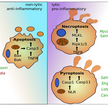
Screen Shot 2014-07-25 at 9.46.22 PMMicrobial Egress: A Hitchhiker’s Guide to Freedom – Ana Traven, Thomas Naderer – PLOS Pathogens

“The Restaurant at the End of the Infection — Macrophages as Host Cells”
“So Long and Thanks for All the Inflammatory Cell Death”

Dr. Bik’s Picks

crowSmarter than a first-grader? Crows can perform as well as 7- to 10-year-olds on cause-and-effect water displacement tasks

“New research conducted by UC Santa Barbara’s Corina Logan, with her collaborators at the University of Auckland in New Zealand, demonstrates the birds’ intellectual prowess may be more fact than fiction.”

JBC Journal of Biological ChemistryFour billion-year-old chemistry in cells today – Phys.org

“Parts of the primordial soup in which life arose have been maintained in our cells today according to scientists at the University of East Anglia.”

Screen Shot 2014-07-25 at 9.47.50 PMDustup Over Lionfish Science Fair Project – Bob Grant – The Scientist

A former graduate student says he feels slighted by a failure to attribute his contributions to a line of research regarding the salinity tolerances of an invasive species. “I’m not sure what happened, but my main issue is that the national media has presented a story that is sensationalized, and has left me out of the picture.”

[hr]