Microbes and Art: BioArtography, Shasti O’Leary Soudant, Microbes on Etsy, LuxArt

Finding Beauty Through a Microscope: BioArtography initiative – University of Michigan

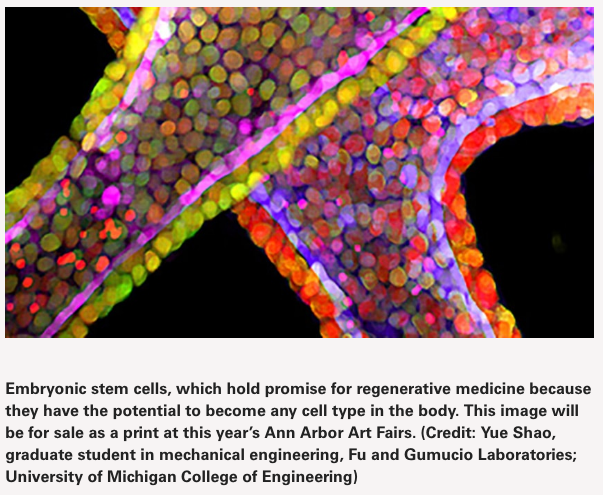
An outdoor art fair may seem like an unlikely place to find stem cells. Or mouse kidneys. Or brain tumor cells. (…) But for a growing number of researchers, art fairs and galleries have become a way to reach the public. They’re taking the images they make in their labs and presenting — or even selling — them as art. One of the longest-running examples of this trend is the BioArtography initiative at the University of Michigan.
Screen Shot 2016-07-27 at 10.06.23 PM.png


Albright-Knox director: public art initiative helps create, strengthen biz partnerships – Tracey Drury – Bizjournals

Three new public art works announced Thursday by the Albright-Knox Art Gallery are providing additional opportunities for partnership and relationships in the region. (…) Also under development this summer is the Gut Flora sculpture by artist Shasti O’Leary Soudant. A half dozen 11-foot tall stainless steel structures will be installed at the new Allen Street NFTA Metro Rail station that will open into the new University at Buffalo School of Medicine. The works are inspired by the human body and serve as an analogy of how the public transit system connects the city and its people.

Screen Shot 2016-07-27 at 10.13.24 PM.png


10 Ways To Boost Your Microbiota On Etsy – Chris Taylor  – The Vexed Muddler

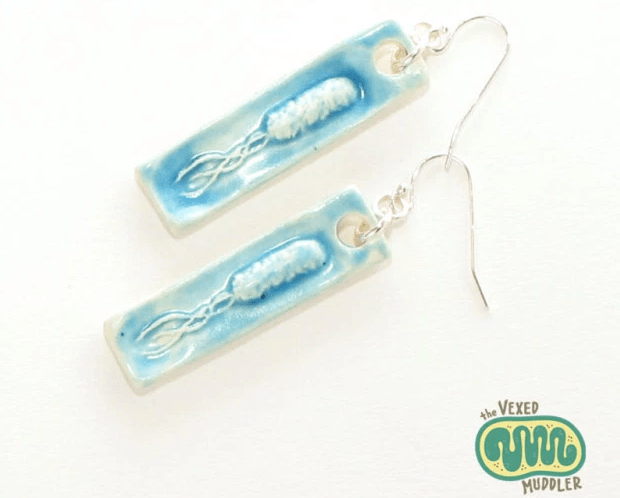
Each of us is a walking world of microbes… read on, though, before you start scrubbing! The few dangerous microorganisms tend to get all of the press, but the vast majority of the bacteria, protozoans, archaea, fungi and viruses are indifferent, or even beneficial to us. Artists draw inspiration from all sorts of unlikely sources – even your gut flora! This ‘probiotic’ collection of work created by scientifically minded crafters, is designed to foster appreciation and understanding of this hidden world, which we are just beginning to understand.
Screen Shot 2016-07-27 at 10.20.30 PM.png


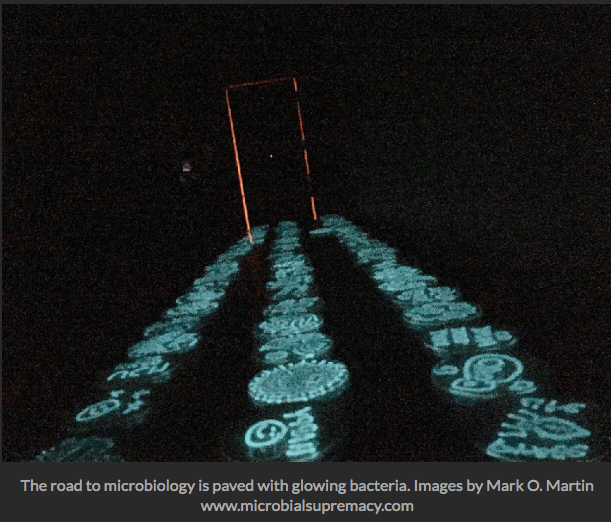
Let it Glow – Let it Glow – It Can’t Hold it Back Anymore! – Anne Estes – Mostly Microbes

At first, the room is pitch black. My eyes adjust to the darkness and I see two eerie blue-green glowing columns of plastic petri dishes stacked on a table. “Ready? Hold still for 15 seconds”. Click…..click. “Lights”. So began the first #LuxArt portraiture session at the American Society for Microbiology Conference for Undergraduate Educators (ASMCUE) with Dr. Mark O. Martin, University of Puget Sound.
Screen Shot 2016-07-27 at 10.24.53 PM.png

Microbiome Paper Collection updates

Happy Independence Day!

I have mentioned this before, but this website not only contains blog posts, but pages with more static information as well. These pages include lists that I compiled of important papers on particular microbiome topics. I call this my Microbiome Paper Collection, and they are listed as pages (not posts) under the Microbiome Collection button in the grey bar under the picture at the top of this page.

Tonight, I’ve updated the collections on the following topics:

Feel free to browse the Collection pages. The lists are not complete, but should be a good start for an overview of important papers. You can always let me know if I missed a paper by leaving a comment.

June 27, 2016

A short Monday post. Bronchiolitis and virome milestones in infants, and playing drums.

Pregnancy and birth

The Fecal Microbiota Profile and Bronchiolitis in Infants – Kohei Hasegawa – Pediatrics

Editorial: Do Bacteria in the Gut Set the Stage for Who Gets Viral Bronchiolitis and Its Severity? – Patrick C. Seed – Pediatrics

Research Highlight: Distinct Fecal Microbiota Pattern Associated with Infant Bronchiolitis – Christine Judge – NEJM Journal Watch

The Bacterial Microbiome and Virome Milestones of Infant Development – Efrem S. Lim – Trends in MIcrobiology

More microbiology

Is there an Infection Risk when Playing Drums Contaminated with Bacillus anthracis?
A M Bennett – Journal of Applied Microbiology

Microbes in the news

UI researcher finds link between gut bacteria and MS. MS patients show lower levels of good bacteria – EurekAlert

Microbes in extreme heat and cold hold lessons about life on Earth, and beyond – Don Cowan – The Conversation

Olympic rowers unveil special suits to combat bacteria in Rio – WHEC

Pineapples Can Stop Harmful Bacteria In The Gut – Diane Palmer – Parent Herald

List of papers on Synthetic Microbial Communities

Today I found this new article in Wiley’s Environmental Microbiology:

Web Alert: Synthetic microbial communities: An annotated selection of World Wide Web sites relevant to the topics in environmental microbiology – Lawrence P. Wackett – Environmental Microbiology

Screen Shot 2016-06-24 at 02.58PM, Jun 24.png

As is made clear in the title, this is not a regular review or research article, but a list of links to websites on this topic. Unfortunately, some of these links are more helpful than others: not all will take you to the paper itself, some lead to websites of research groups, and one was not written in English. But what is most disturbing to me is that Wiley put this article behind a paywall, so many people will have to pay $38 to have access to this list of links.

This is not the first Link-Fest article that this author wrote; there are now 5 of these published in Environmental Microbiology. I wrote about another one from the same author in April on MicroBE.net. All of these “Web Alert” articles are listed as regular publications in PubMed. It looks as if this author has found an easy way to expand his publication list, and as if Environmental Microbiology has found an easy way to fill their pages and earn more money

If you are interested in this particular topic but don’t have access to this paper, here is MicrobiomeDigest to the rescue. I have copied the list, improved all links to directly go to the publisher’s website, and updated the list with some missing relevant papers. This collection of papers on synthetic microbial consortia is freely available on a new page called Synthetic Microbial Communities.

This might also be a  good moment to point out that I have made several of these lists of papers on a particular topic, and that you can find all of them here on my page called Microbiome Collection. You will find many topics here that might be of interest, or a good start to a literature search on a particular subject.  And all of them are free! Also note that these are Pages, not Posts. Enjoy!

ASM assumes your mom is dumb

Update Monday, June 20th at 8 AM: ASM has removed the video from YouTube. Scroll to the end of this post to see ASM’s responses on Twitter.

Update Monday, June 20th at 11 AM: ASM has edited the video to make it solely about explaining your science to a lay person in 30 seconds. See new version here

I’m a bit upset tonight because of a video by the American Society for Microbiology (ASM). It was brought to my attention by a tweet by @Yersinia / Jane EB Smith:

Screen Shot 2016-06-20 at 1.25.50 AM.png

So I checked out the link, and it leads to a video that ASM has uploaded to YouTube called “Can you explain your science in 30 seconds to your mom?(UPDATE: link no longer works; video has been removed). The video was created by two ASM staff members (a video producer and a media specialist) during last week’s ASM Microbe 2016 meeting in Boston. It starts with a cartoon of a young male scientist and a voice over with the challenge to “explain your science in 30 seconds”, followed by a dramatic pause, followed by: “TO YOUR MOM?”

Screen Shot 2016-06-20 at 1.17.53 AM.png

The two ASM staff members then enter the Boston conference building and challenge 8 young scientists to do an elevator pitch. Most of them fail the test. But one scientist does really well, and she wins the contest.

But back to the title of the video. The question apparently assumes that moms are, well, not that smart. And that moms will look completely puzzled when you tell them your science. And that moms wear purple flowery dresses.

Screen Shot 2016-06-20 at 1.55.52 AM.png

Since the ASM conference was during the Father’s Day weekend, why didn’t the video makers use the title “Can you explain your science in 30 seconds to your dad?” Did they think that that challenge would sound easier?

Screen Shot 2016-06-20 at 1.56.01 AM.png

Anyway, it’s just a little annoyance. Just one of those many tiny disappointments women in science feel almost daily. By itself, it’s not even worth mentioning. But all these tiny sad moments do add up, especially when we see that biology labs and conference halls are filled with at least 50% women, but when the speaker podiums and panel tables only filled up with less than 30% women.

Dear American Society for Microbiology, I really love you for all you have done for women in science, but this video sets you back at least 20 years, and is a disappointment for the many women who are a member of the ASM.

Next morning update: ASM has removed the video. They don’t offer any apologies to moms, but they will try to do better in the future. Here are their replies on Twitter.

Screen Shot 2016-06-20 at 8.11.39 AM.png

And here is their official reply on the Youtube comments: Screen Shot 2016-06-21 at 06.03PM, Jun 21 1.png


June 18, 2016

Your Saturday Microbiome Digest: CSF metagenomics in multiple sclerosis, Caenorhabditis elegans responses to bacteria, and archaeal communities in permafrost.

Infection and microbes

Only microbial contamination foundMetagenomic Analysis of Cerebrospinal Fluid from Patients with Multiple Sclerosis – Karol Perlejewski – Advances in Experimental Medicine and Biology

Review: The regulation of host defences to infection by the microbiota – Rebecca L. Brown – Immunology

Animal and in vitro experiments

Microbial Community Transplant Results in Increased and Long-Term Oxalate Degradation – Aaron W. Miller – Microbial Ecology

Differential Utilization of Basic Proline-Rich Glycoproteins During Growth of Oral Bacteria in Saliva – Yuan Zhou – Applied and Environmental Microbiology

Caenorhabditis elegans responses to bacteria from its natural habitats – Buck S. Samuel – PNAS

Plant, root, and soil microbiome

Presence and persistence of viable, clinically relevant Legionella pneumophila bacteria in garden soil in the Netherlands – E. van Heijnsbergen – Applied and Environmental Microbiology

Size Matters: Assessing Optimum Soil Sample Size for Fungal and Bacterial Community Structure Analyses Using High Throughput Sequencing of rRNA Gene Amplicons – C. Ryan Pento – Frontiers in Microbiology

Monitoring fungi in ecological restorations of coastal Indiana, U.S.A. – Peter G. Avis – Restoration Ecology

Review: Resilience of Soil Microbial Communities to Metals and Additional Stressors: DNA-Based Approaches for Assessing “Stress-on-Stress” Responses – Hamed Azarbad – MDPI International Journal of Molecular Sciences

Water and extremophile microbiome

Archaeal communities of Arctic methane-containing permafrost – Victoria Shcherbakova – FEMS Microbiology Ecology

Microbial community diversity, structure, and assembly across oxygen gradients in meromictic marine lakes, Palau – Matthew S. Meyerhof – Environmental Microbiology

Bioreactor microbiology

An integrated metagenome and -proteome analysis of the microbial community residing in a biogas production plant – Vera Ortseifen – Journal of Biotechnology

Bioinformatics

Finds microbial interactions based on PubMed abstracts, so basically finding interactions that were already published (???)@MInter: Automated Text-mining of Microbial Interactions – Lim Kun Ming Kenneth – Bioinformatics

More microbiology

In situ replication rates for uncultivated bacteria in microbial communities – Christopher T Brown – bioRxiv

Pervasive Selection for Cooperative Cross-Feeding in Bacterial Communities – Sebastian Germerodt – PLOS Computational Biology

Microbes in the news

UWM professor taking a deeper dive on beach pollution data – Milwaukee-Wisconsin Journal Sentinel

The medical revolution that delves into humans’ inner aliens – Robert Matthews – The National

Brewing on the wild side: IU’s Dr. Matthew L. Bochman – Rita Kohn – Nuvo.net

Fecal bacteria and antibiotic resistance genes found in water samples from fly-in Northern Manitoba – Ian Graham – Thompson Citizen

CosmosID, BioCollective Collaborate on Microbiome Analysis Kit – GenomeWeb

Lab Stock Photo Fail: New York Times

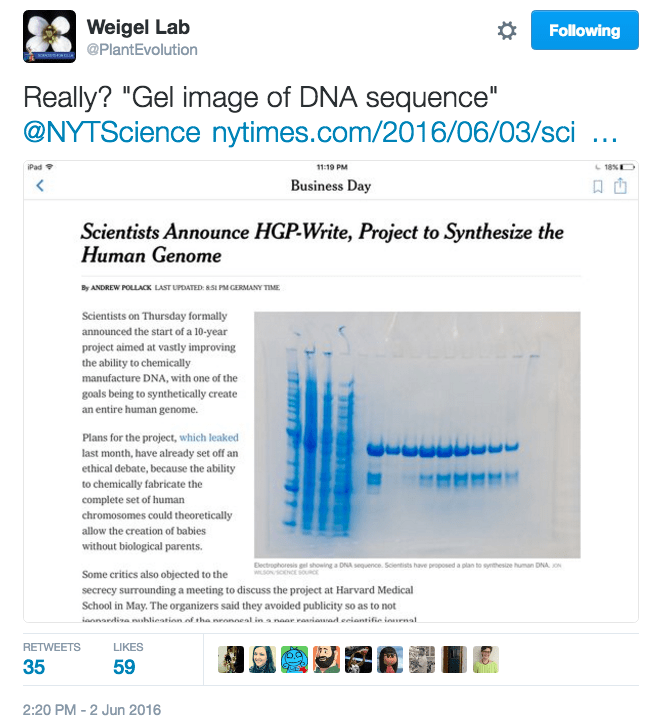
Detlef Weigel (@PlantEvolution) attended me on Twitter to a nice #LabStockPhotoFail in the New York Times – who should know better than to blindly use stock photos with incorrect labels. His tweet included a screenshot of the New York Times article, in which an image of a protein gel is used to portray a DNA sequence.


Screen Shot 2016-06-03 at 11.30AM, Jun 03.png

The source of the stock photo was listed as Science Source, which describes themselves as “The best in stock photography, specializing in Science, Medical and Nature images and video”. Not a site where you would expect to see this:

CkACShkUgAU4kLI.jpg

Note: the “DNA gel” photo has been quickly replaced as of today in both the New York Times article as well as on the Science Source website.

Here is a link to the New York Times article as it appeared yesterday, as archived by the WayBack Machine on Archive.org.


Microbes and art: Danino and Goodsell

Two beautiful examples of the intersection of microbes and art:A Synthetic Biologist’s Beautiful Palette of Bacteria Art – Noémie Jennifer – The Creators Project

Tal Danino grows various strains of bacteria into detailed, microscopic patterns that pull you in close. During a recent residency at Eyebeam in New York City, he researched how bacteria could be used as inks in various printing processes, like silkscreening or stamping. The resulting series of works, Microuniverses, is a marriage of nature and engineering—in the artist’s words, “you can control these patterns, but then they evolve on their own.” The concept of “controlling universes” is part of Danino’s day job. As the director of the Synthetic Biological Systems Laboratory at Columbia University, Danino is figuring out how to program bacteria so it can detect and treat diseases in our bodies.


Screen Shot 2016-06-02 at 9.54.19 PM.png

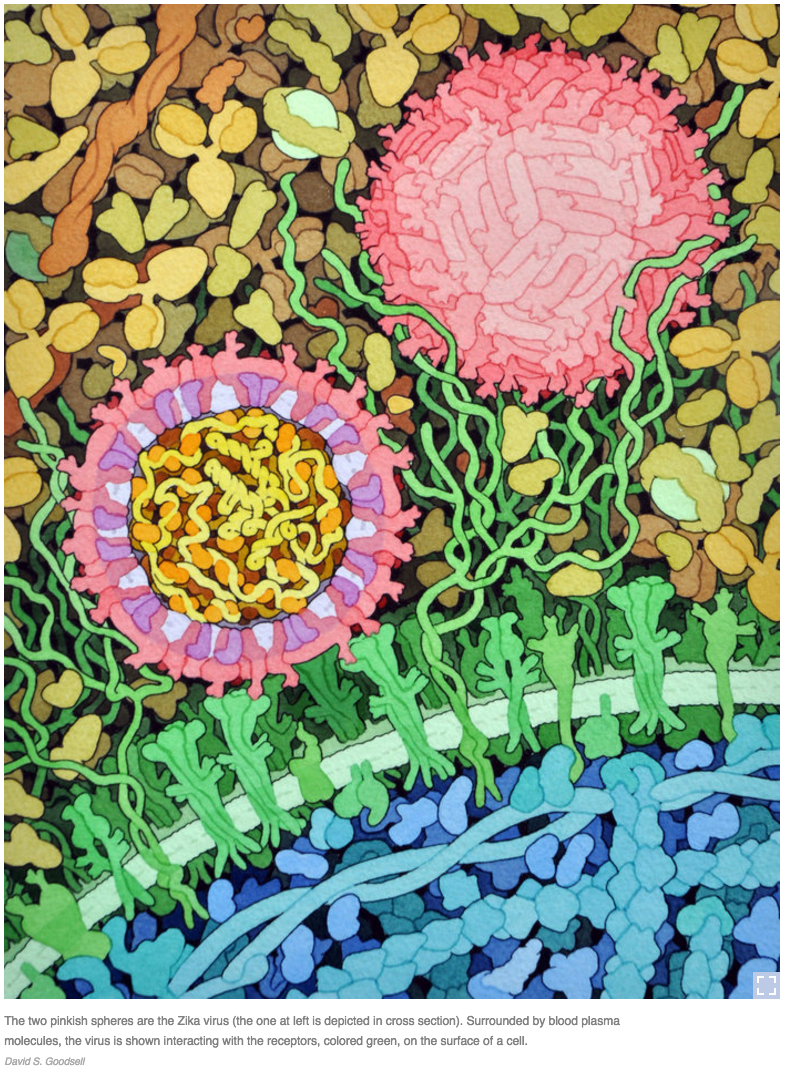
It’s The Zika Virus In Action, Drawn By A Scientist-Artist – Maggie Zackowitz – NPR

A watercolor by scientist-artist David S. Goodsell just might make the Zika virus easier to visualize. The painting, which depicts an area about 110 nanometers wide (a nanometer is a billionth of a meter), shows the virus in the process of infecting a cell. (…) Of course the comic book-bright structures shown in the painting aren’t so simple and colorful in real, microscopic life. “These things are actually smaller than the wavelength of light, so they don’t really have a color,” Goodsell says. He chose his own color palette to highlight the function of each component — and to make them look beautiful.

Screen Shot 2016-06-02 at 9.55.59 PM.png