
Phages in cow dung, genome of a bumble-bee symbiont, and the microbiome of beach sand.
Mammal microbiomes
 Differing Populations of Endemic Bacteriophages in Cattle Shedding High and Low Numbers of Escherichia coli O157:H7 Bacteria in Feces – J. Hallewell – Applied and Environmental Microbiology
“Based on genome size estimated by pulsed-field gel electrophoresis and morphology determined by transmission electron microscopy, T4- and O1-like phages of Myoviridae and T1-like phage of Siphoviridae were isolated. “
Insect microbiomes
 Genomic Features of a Bumble Bee Symbiont Reflect Its Host Environment – Vincent G. Martinson – Applied and Environmental Microbiology
“Here, we report the genome of one gammaproteobacterial member of the gut microbiota, for which we propose the name “Candidatus Schmidhempelia bombi,” that was inadvertently sequenced alongside the genome of its host, the bumble bee, Bombus impatiens.”
Plant microbiomes
 In Situ Evaluation of Paenibacillus alvei in Reducing Carriage of Salmonella enterica Serovar Newport on Whole Tomato Plants – Sarah Allard – Applied and Environmental Microbiology
“Long-term intervention measures to reduce Salmonella prevalence on tomatoes remain elusive for growing and postharvest environments. A naturally occurring bacterium identified by 16S rRNA gene sequencing as Paenibacillus alvei was isolated epiphytically from plants native to the Virginia Eastern Shore tomato-growing region. “
 Streptomyces sp. strain PGPA39 alleviates salt stress and promotes growth of ‘Micro Tom’ tomato plants – Sasikumar Arunachalam Palaniyandi – Journal of Applied Microbiology
“A significant increase in plant biomass and chlorophyll content, and a reduction in leaf proline content were observed in PGPA39-inoculated tomato plants under salt stress compared to control and salt stressed non-inoculated plants.”
 Microscopy, Culture, and Quantitative Real-Time PCR Examination Confirm Internalization of Mycobacteria in Plants – M. Kaevska – Applied and Environmental Microbiology
” The substrate into which plants were seeded was previously contaminated with different strains of Mycobacterium avium (108to 1010 cells/g of soil) and feces from animals with paratuberculosis. We detected M.avium subsp. avium, hominissuis, and paratuberculosis in the stems and leaves of the plants by both culture and real-time quantitative PCR. “
Environmental microbiomes

Soil and groundwater microbiomes
Use of Silicate Minerals for pH Control during Reductive Dechlorination of Chloroethenes in Batch Cultures of Different Microbial Consortia – Elsa Lacroix – Applied and Environmental Microbiology
“The consortia showed significant differences in sensitivities toward acidic pH for the different dechlorination steps. Molecular analysis indicated that Dehalococcoides spp. that were present in all consortia were the most pH-sensitive organohalide-respiring guild members compared to Sulfurospirillum spp. and Dehalobacter spp.”
 Variables Influencing Extraction of Nucleic Acids from Microbial Plankton (Viruses, Bacteria, and Protists) Collected on Nanoporous Aluminum Oxide Filters – Jaclyn A. Mueller – Applied and Environmental Microbiology
“Anodic aluminum oxide (AAO) filters have high porosity and can be manufactured with a pore size that is small enough to quantitatively capture viruses. These properties make the filters potentially useful for harvesting total microbial communities from water samples for molecular analyses, but their performance for nucleic acid extraction has not been systematically or quantitatively evaluated. “
 MS2 Bacteriophage Reduction and Microbial Communities in Biosand Filters – Hanting Wang – Environmental Science & Technology
” In the upper layers, “CandidatusNitrosopumilus maritimus” and “Ca. Nitrospira defluvii” were found as dominant populations, while significant amounts of Thiobacillus-related OTUs were detected in the lower layers. “
Ponds, lakes, and ocean microbiomes
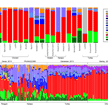
 Diversity and Transport of Microorganisms in Intertidal Sands of the California Coast – Alexandria B. Boehm – Applied and Environmental Microbiology
“The present study uses next-generation massively parallel sequencing to characterize the microbial community present at 49 beaches along the coast of California. In addition, we characterize the transport of microorganisms within intertidal sands using laboratory column experiments. We identified extensive diversity in the beach sands.”
 From Metagenomics to Pure Culture: Isolation and Characterization of the Moderately Halophilic Bacterium Spiribacter salinus gen. nov., sp. nov. – María José León – Applied and Environmental Microbiology
“We report the isolation and taxonomic characterization of this new, never before cultured microorganism, designated M19-40T, isolated from a saltern located in Isla Cristina, Spain, using a medium with a mixture of 15% salts, yeast extract, and pyruvic acid as the carbon source. “
 The Pattern of Change in the Abundances of Specific Bacterioplankton Groups Is Consistent across Different Nutrient-Enriched Habitats in Crete – Stilianos Fodelianakis – Applied and Environmental Microbiology
“Here, we investigated the bacterial community changes at three different nutrient-enriched and adjacent undisturbed habitats along the north coast of Crete, Greece: a fish farm, a closed bay within a town with low water renewal rates, and a city port where the level of nutrient enrichment and the trophic status of the habitat were different. “
[hr]






 Microbiome Digest - Bik's Picks