Winners of the “Best Microbiome Papers of 2016”

The voting results are in, and we have a surprising winner. Not a paper I would have predicted to win, but one that definitely had a huge fan base. Thank you all for voting, and all the best wishes for 2017. Happy New Year!

The winner of the “Best Microbiome Paper of 2016” is……

Second place:

Shared third/fourth place:

Fifth place:

Shared 6th-10th place:


Vote for the best microbiome papers of 2016

(post updated December 28 with some good additions suggested by voters – thank you all!

(Post open till Friday 30 December)

It’s the end of another year chockfull of microbiome papers, and I’ve seen them all! But which one do you think were the best? I’ll take nominations, and I will post the best 5 or 10 next week.

Here are some of 2016’s most discussed research papers to refresh your memories. I tried to pick a range of papers from different environments and hosts, including some very controversial ones. I also included a couple that were nominated through Twitter.

While I was going through the past Microbiome Digests from this year, I had many “Oh, yes, I forgot about that one” moments, and I hope you have those too! And, if you have not been keeping up with the literature this year, this will be a great list to start. So take a look at the list below, also think of papers I forgot to include, and vote of  your three favorite papers by using this form.

At the bottom of this post, you can vote for a maximum of three papers (unranked), and the paper(s) do not have to be on the list below. Yes, you may self-nominate (I did that too – see February). No, I will not misuse your email address!

January

February

March

April

May

June

July

August

September

October

November

December

Vote here

Nominate your favorites for Best Microbiome Papers of 2016 using this form. Rules: Vote for a maximum of 3 papers published in 2016, research papers only (no reviews), self-nominations are acceptable, and you can also nominate papers not included on the list above. I promise I will not use your email address for evil purposes 🙂

Go back

Your message has been sent

Warning
Warning
Warning
Warning
Warning

Warning.

El Palo Alto – the Stanford Tree

Today, life finally brought me to a tree that I’d wanted to visit for a while: El Palo Alto.

As I learned quickly when I moved to the San Francisco Bay area almost 15 years ago, Palo Alto, the city where Stanford University is located, means “tall stick” or “tall tree” in Spanish. Palo Alto is also well known for Silicon Valley icons such as the garage-birthplace of Hewlett Packard, the PostIt tributes on the Apple Store after Steve Jobs’ death, and Tesla Motor’s headquarters. Of note, the city seal contains a tree:

Palo_Alto_Seal.gif

And two of the official Stanford University logos contain a tree as well:

Screen Shot 2016-08-05 at 1.25.36 AM.png

Finally, the unofficial mascot of the Stanford University Cardinals sports events is ….. – you guessed it right! – a tree. The Stanford Tree is, according to Wikipedia,  has been called “one of America’s most bizarre and controversial college mascots”. Every year, a new person gets chosen to become The Stanford Tree in a gruesome competition called Tree Week. And a nice factoid for my microbiology crowd: Bob Siegel, currently professor of Microbiology and Immunology at Stanford, once was The Tree too! Every year a new Tree costume is made.

Screen Shot 2016-08-05 at 1.46.38 AM.png

Some of The Stanford Tree costumes of years past. Source: http://www.thepostgame.com

Taking all these things into account, several questions have been on my mind for a long time: Has there ever been a real Palo Alto Tree, and if so, does it still exist?

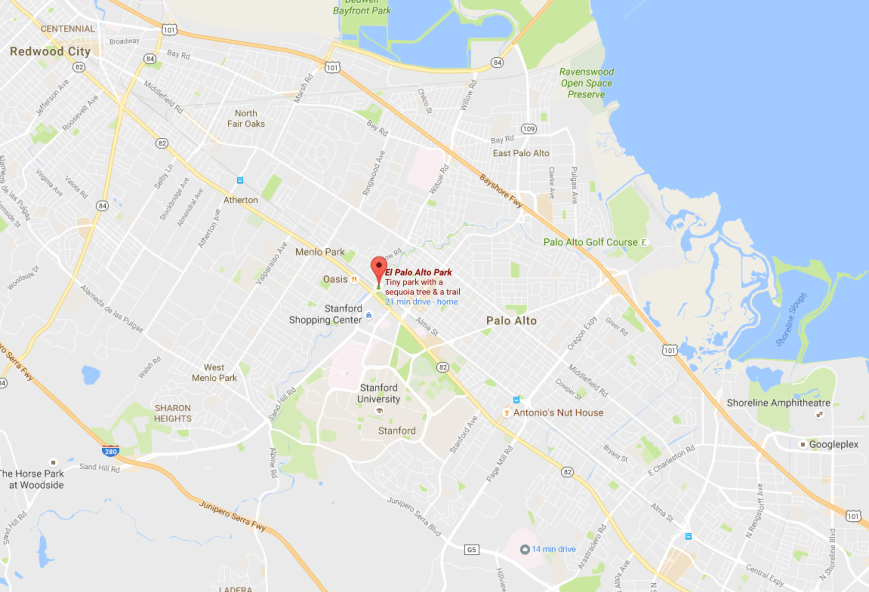
As it turns out, the answers to both of these questions are: Yes! The Tree is real, it still exists, and it’s over 1000 years old. After some digging around, I found out that El Palo Alto is located in El Palo Alto park just North of the Stanford Shopping Center. The tree, a Coastal Redwood (Sequoia sempervirens), was the location of a campsite for the Portola Expedition Party in 1769. In 1776, it was described by a Spanish missionary as ““I beheld in the distance a tree of immense stature rising above the plain of oaks like a grand tower.”

Screen Shot 2016-08-05 at 2.27.41 AM

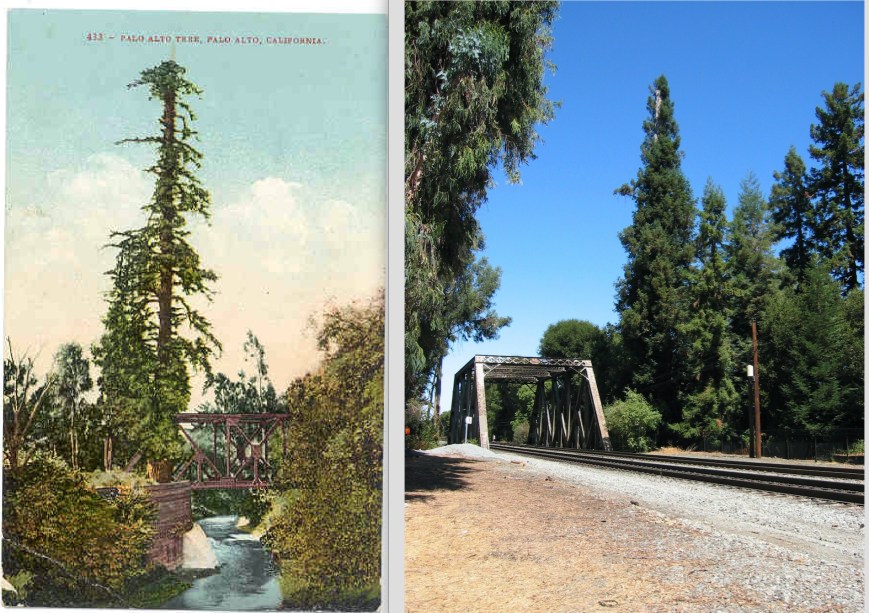
Left: El Palo Alto, ca. 1910. Right: El Palo Alto, ca. 2004. Source: Wikipedia.

There are several pages on the history of El Palo Alto, including a Wikipedia page and one from at PaloAltoHistory.org, where you can read how tall the tree was, and how its health declined in the 18th and 19th century due to lack of water because of the demands of growing industry – and Stanford University! – nearby. Around 1988, efforts by Jim Johnson and many others improved conditions for the tree, and it began to show new growth.

And today, I finally was able to pay a visit to the tree. El Palo Alto is located in El Palo Alto Park, a small park right next to the CalTrain tracks.

Screen Shot 2016-08-05 at 1.21.45 AM.png

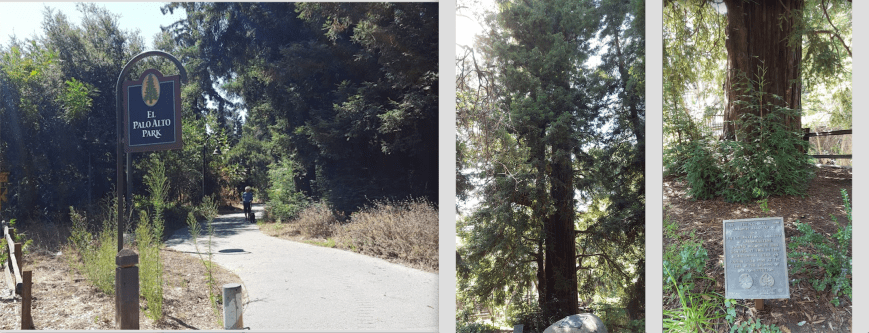
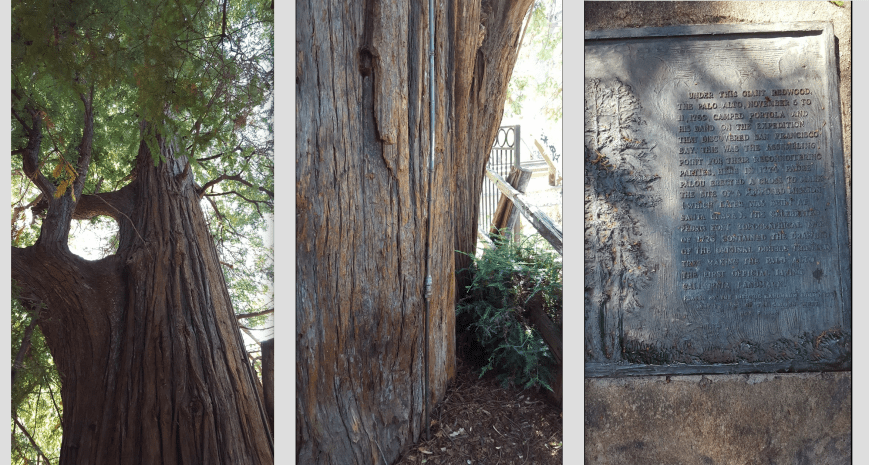
Walking in the small park, this was almost a case of “can’t see the forest for the trees”. The tree does not really stand out because it is surrounded by a lot of other trees. But it has been well marked with several plaques at the base of the thick tree trunk.

Screen Shot 2016-08-05 at 2.34.14 AM

A pipe that brings water to spray the top of the tree has been installed a couple of years ago. Today, the tree is only 68% of its old height, but still very much alive and over 1000 years old. I stood a couple of minutes by its trunk, contemplating its rich history and old age. It was wonderful.

Screen Shot 2016-08-05 at 2.42.12 AM.png


Bik’s Brain: Monet

Welcome in my brain, which is full of completely useless associations. Here is another edition of #ICouldNotResist.

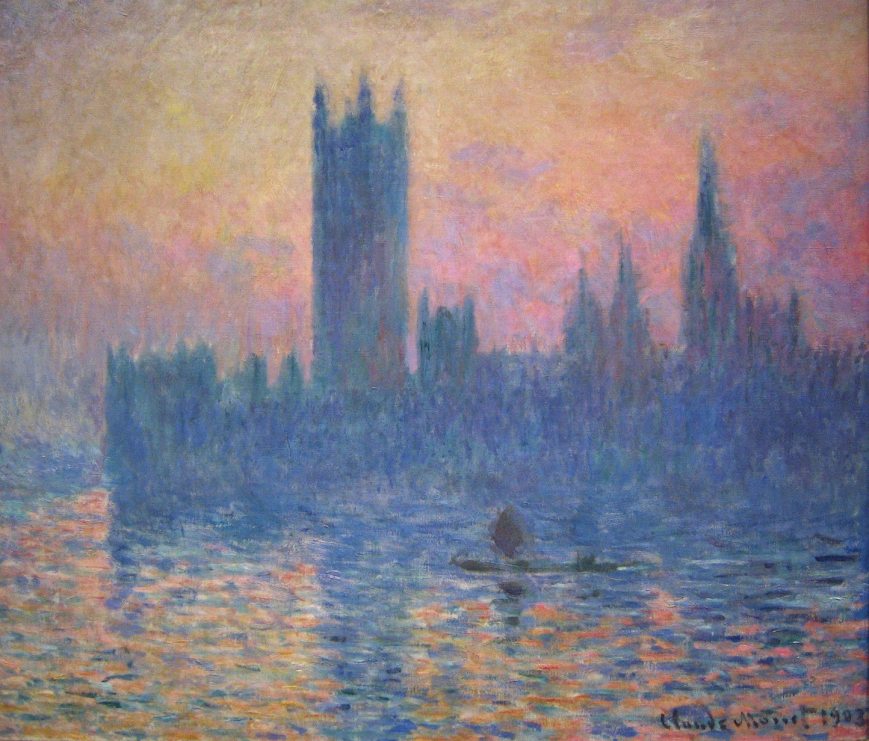
Today, with help from a Tweet by @MarylandMunros, I associated a graph made by the J. Craig Venter Institute (JCVI) with a painting by Claude Monet.

Top: a visualization of ocean microbial data collected on JCVI’s Global Ocean Sampling Expedition (GOS). See the original post here.

Bottom: “Houses of Parliament, Sunset, 1903” painting by Claude Monet (image taken from Wikipedia).

Screen Shot 2016-06-01 at 7.25.14 AM.png

Screen Shot 2016-06-01 at 7.29.14 AM.png


Lab Stock Photos: The Inside Job

A biosafety cabinet is essentially a big box with a window and opening on the front, and an airflow from above that creates a “curtain” of air, to protect both the worker from the materials they are handling, as well as the materials from the worker. It is used for tissue culture, handling biohazardous materials, and sterile work.

It is usually not recommended that photographers crawl into biosafety cabinet to make that perfect shot. But that does not prevent the stock photo industry from doing just that!

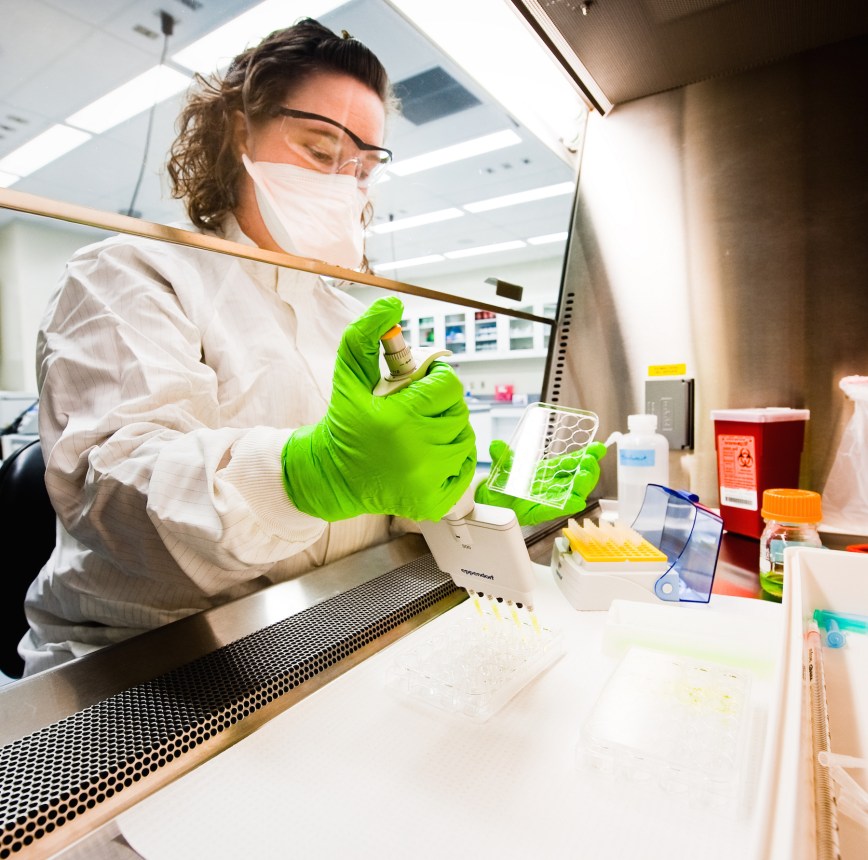
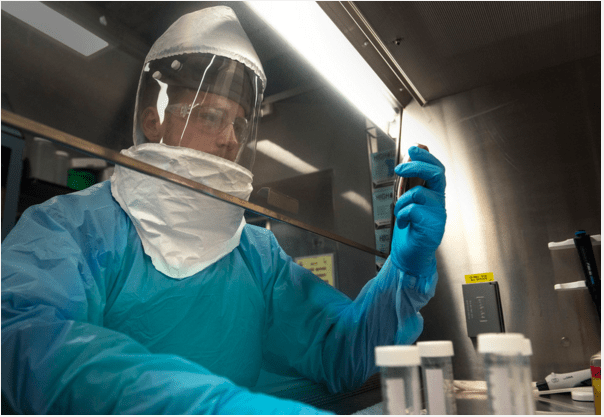
So here we go: photos from inside biosafety cabinets. Note that some cabinets have windows on the side, which could explain some of these images. Other pictures might be perfectly explained by a little tripod or a selfie stick. But in most of these pictures, just pretend that the photographer is crawled up in a corner, for a good laugh.

The first photo is from the SafetyAtWorkBlog, where the caption reads: “A researcher works with materials in a biosafety cabinet in the Biosecurity Research Institute at Kansas State University. A biosafety cabinet is a safety enclosure that uses HEPA filters and directional airflow to contain pathogens.”

brisafety.jpg

Shutterstock: “Young asian scientist pipetting samples in lab”, Copyright: KYTan:stock-photo-young-asian-scientist-pipetting-samples-in-lab-391395604.jpg

A photo from the same lab worker shows up in Dreamstime, entitled “Young asian scientist performing microbial tests in lab” – credit: Tan Kian Yong:young-asian-scientist-performing-microbial-tests-lab-series-biosafety-cabinet-68361375.jpg

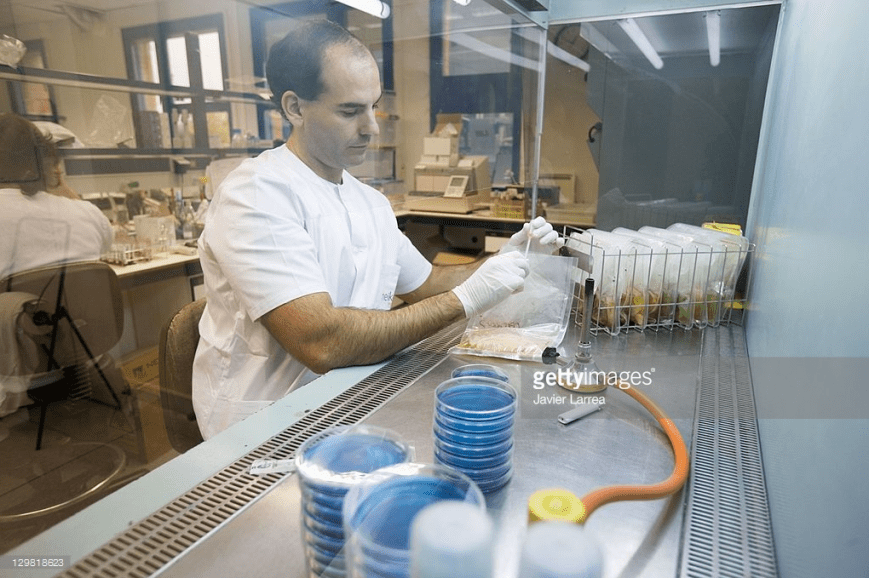
Getty Images, credit: Javier Larrea. The caption reads: “Salmonella cultures in biosafety cabinet, Laboratory of Diagnosis, Departamento de Produccion y Sanidad Animal, Neiker Tecnalia, Instituto de Investigacion y Desarrollo Agrario, Ganadero, Forestal y del Medio Natural, Derio, Bizkaia, Euskadi, Spain”:Screen Shot 2016-05-08 at 9.42.19 PM.png

Penn State News:  “Tyler Goralski, a graduate student studying biochemistry and molecular biology at Penn State, streaks out a bacteria sample at the Pell Laboratory for Advanced Biological Research.” – Image: Patrick Mansell:Screen Shot 2016-05-08 at 9.47.53 PM.png

AFP Getty Images, found on Daily Mail, in an article about Indonesia and HIV. The caption reads: “Awareness about HIV in Indonesia remains poor despite the fact that more than 660,000 people are estimated to be living with the virus. Pictured is a medical laboratory technician at an HIV care hospital in Indonesia”:Screen Shot 2016-05-08 at 10.05.00 PM.png

From 123RF: “Female scientist researching in laboratory, pipetting cell culture medium samples in laminar flow. Life science professional grafting bacteria in the pettri dishes. Photo taken from laminar interior.”. Copyright : kasto:Screen Shot 2016-05-08 at 10.13.48 PM.png

Also from 123RF possibly the same model: “Female scientist researching in laboratory, pipetting cell culture samples on LB agar medium in laminar flow. Life science professional grafting bacteria in the petri dishes.” Copyright : kasto:Screen Shot 2016-05-08 at 10.17.49 PM.png

From Alamy, “Plate culture in laminar flow cabinet. Biological test laboratory. Fundacion Inasmet-Tecnalia. Donostia, San Sebastian”:Screen Shot 2016-05-08 at 10.20.51 PM.png