
Electricity-Free Lamp Is Powered by Octopus Bacteria – Dutch designer Teresa Van Dongen has merged design and biology in her new project – Kiran Umapathy – PSFK
“Electricity? So passé. Dutch designer Teresa van Dongen dared to combine biology with the technology by creating an electricity-free lamp—the Ambio—that runs on octopus bacteria. “
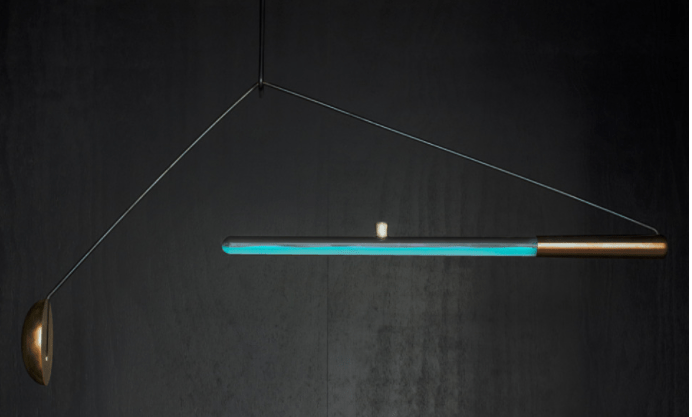
The Ambio lamp is filled with living bioluminescent bacteria. Source: PSFK.com
An artwork controlled by a colony of bacteria – Aaron Souppouris – Engadget
“Anywhen is an immersive artwork by French avant-garde artist Philippe Parreno. (…) It features an ever-changing mix of sound, light and shadow, augmented by fish-shaped balloons, a transforming array of suspended speakers and a cinema that seemingly appears at random. Except, it’s not random. The individual elements of Anywhen are at the whim of bacteria.”
An art of loopholes. How the French artist Philippe Parreno studiously avoids having ideas – Emily Nathan – The New Yorker
“I want to turn the museum into a similar kind of instrument, a weird hybrid made out of light and recorded sound and bacteria and acoustic panels, with sequences and motifs that recur and retreat,” he said. “Unless you want to spend eight hours there, you will definitely miss something. But that’s part of it, no? You always miss something in life.”
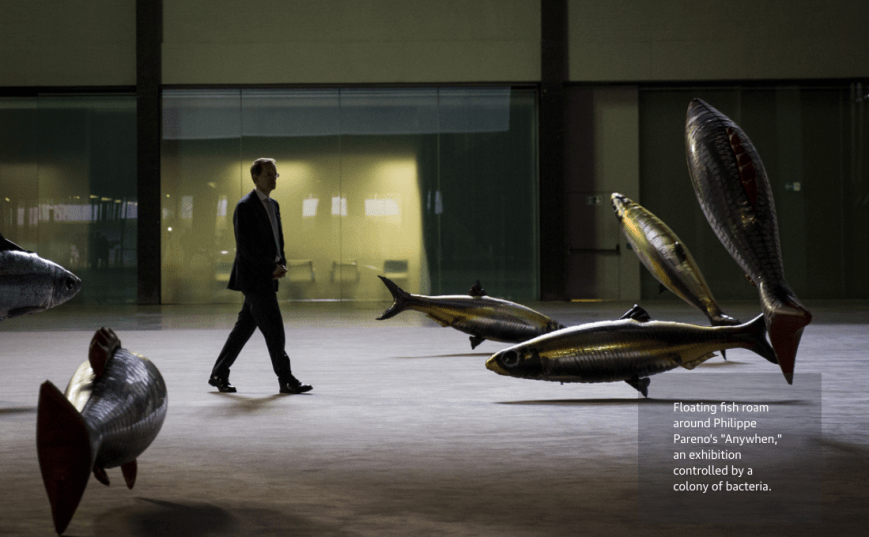
Philippe Pareno’s “Anywhen”, an exhibition controlled by bacteria. Source: Engadget.com.
This Scientist crystallises Bacteria for Stained Glass and Lace! – Evelyn Warner – Labiotech
“Simon Park is a scientist who wants to teach us about the microbiome through his art. Among his works are a self-portrait, lace and stained glass, all of which have been produced from bacteria! (…) Through his art, he aims to draw our attention to them and make them more familiar. (The apotheosis of the latter is his self-portrait from his own microbial flora!) “
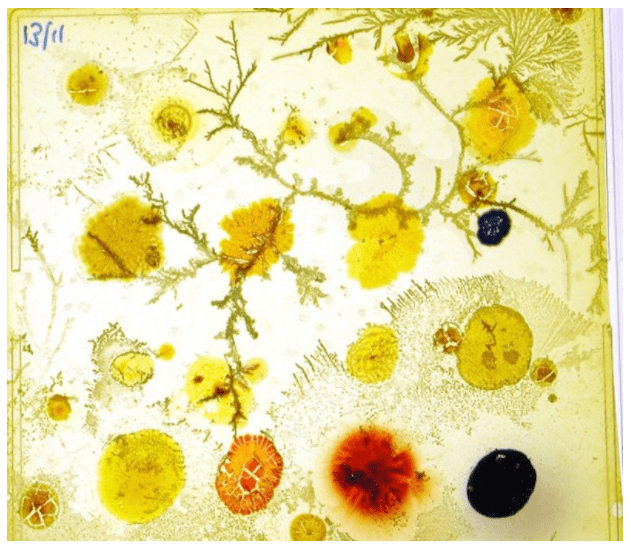
Bacterial Stained Glass by Simon Park. Source: Labiotech.eu.
Belowground visions of life: Soil makes Art – Global Soil Biodiversity
“How can soil biodiversity scientists share their knowledge with the public? Art is the answer given by “Belowground visions of life: Soil makes Art”, a project funded by the Leverhulme Trust in the UK. This project supports an artist in residence, Ed Reynolds, working with Dr Tancredi Caruso, soil ecologist at the School of Biological Sciences, Queen’s University Belfast.”
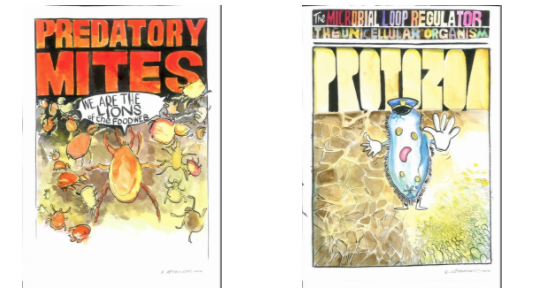
Original artwork by Ed Reynolds. Source: Global Soil Biodiversity.com
Microbial Awards Season in Biology 350! – Mark O. Martin – Microbes Rule
“Who knows if I can change lives? I do know that I can change the way my students view the world, using “microbial-colored glasses.” I also believe that art can intersect with science, often in ways that enhance learning. This semester, I had my Biology 350 micronauts try it two different ways, with (hopefully) some success. First, the Vexed Muddler and I cooked up a #MicrobialArt competition.”
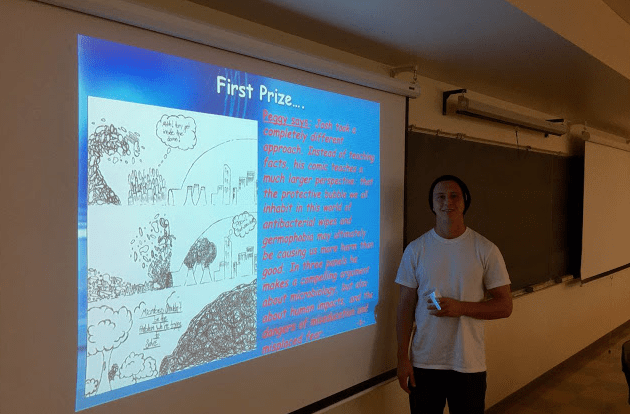
Josh’s art won First Prize: unfair and inaccurate assumptions about the microbial world.
“That was a heck of a #MicrobialMorning, but there was more to come. That’s right: it was then time for the #LuxAcademyAwards! Earlier this semester, I had students create “microbial art” by “painting” with luminous bacteria (Photobacterium leignothi) on Petri dishes. I then wanted folks across the Internet to vote on their favorites, and distribute yet more #MicrobialSwag to lucky #MicrobialArtists!”
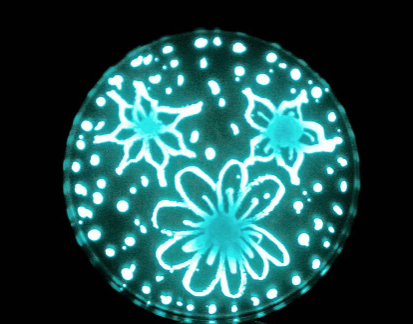
Molly created #LuxArt2016 4th place winner.
Bacteria-Inspired Art Infects a Chelsea Gallery – Andrew Nunes — The Creators Project
“Bacteria are more than just the building blocks of microorganisms in art collective Slavs and Tatars’ latest exhibition at Tanya Bonakdar Gallery. Titled Afteur Pasteur, an homage to the microbiologist who discovered microbial fermentation and pasteurization, the exhibition uses references to bacteria and microbes as unlikely lenses to examine larger cultural and historical ideas. (…) A fully functional ‘bacteria bar’ serves the yogurt drink ayran (sorry, there’s no kombucha here) allowing visitors to ingest a constituent life form while perusing the remaining works.”
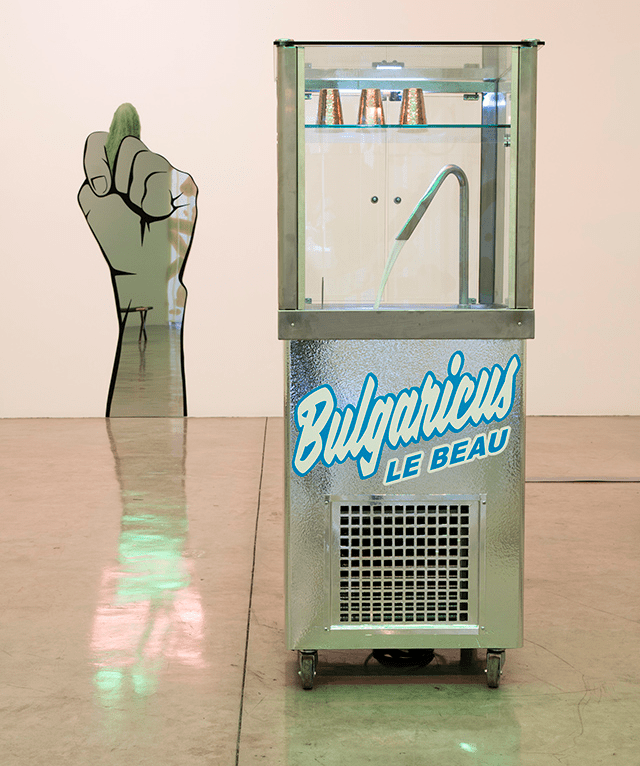
Ayran bar, Slavs and Tatars, 2016. Source: The Creators Project.
 Microbiome Digest - Bik's Picks